

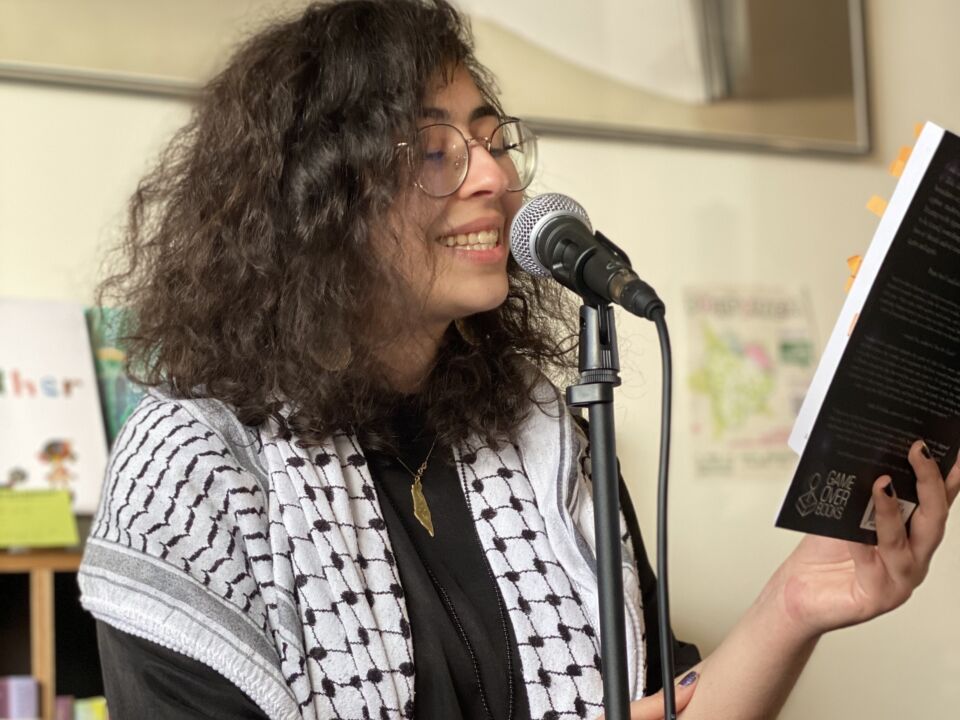
When Mystery Becomes Process: A Conversation with Summer Farah
I meet Farah on Zoom on a frigid January afternoon. We haven’t seen each other on a video call in two years since our time in a workshop offered by Kundiman, a non-profit organization that offers workshops and programming for readers and writers of Asian-American literature.
She looks the same: bright in her enthusiasm and generous in the space she offers in conversation. Her poems reflect her disposition: they are open, musical, unpretentious, and deeply imbued with care and serious questioning. Whether she is reflecting on The Met’s stolen array of objects or asking Etel Adnan about grief and art, she uses these points of inquiry to unravel explorations of herself and culture at large. There are few finalities in her debut collection, The Hungering Years, out now with Host Publications. As the title suggests, there is deep yearning in this collection that only morphs with each page.
In the words below, we hear from a poet not at the beginning of a journey, but immersed in the forks of its path.
Rebecca Mangra: I know that this is such a strange question to ask right now, but how has the new year started off for you?
Summer Farah: Man. I mean … things are really bad with ICE in LA. And they always are, but there are a lot of people kidnapped in my neighbourhood. Places that I go to, you know. So, the energy is very frightening, and I'm like, man, why am I doing anything? Everything is so fucking stupid. But otherwise, you know, I'm grateful for the things that I have.
What about you? How's the new year treating you?
Rebecca Mangra: My brain feels kind of soupy. The weather in Toronto has been consistently grey to the point where I've forgotten what the sun feels like. It adds to the horrors that are persisting. I’ve been doing a lot of Zoom calls like this to figure out how we move forward.
But there are things to celebrate—you have a collection coming out in February! How has that buildup been like? I mean, you write so much: you make zines and you edit. You're also a critic. You wear many hats. Does this feel different at all, or does it feel like a new engine has started?
Summer Farah: It feels more tangible in a lot of ways. Sometimes I think about projects where maybe I gave myself that grace of effort. Where something existed for me to just throw out thoughts and feelings into: a little object to put into the world for fun. I didn’t have to think about it on a critical, analytic, future-impacting scale, like my Mitski zine. That's how I felt about it, but it actually ended up on syllabi. Multiple instructors have contacted me about teaching it, or I've heard from students who were taught it, and it's beautiful. It's so wonderful. But I didn't really mean for that to happen, to have an object that you're studying that wasn't made in mind with a kind of readership outside of the circle, right? I made that for my birthday, thinking that the people who are going to buy and read this are people who want to celebrate my birthday. But it didn't end up that way.
I visited a class to talk about this Mitski zine, and one of the students politely asked me if I wrote those poems today, would they be different? And I was like, “Yeah, man, yeah, I would have edited them.” [laughs] I don't know—they would have been different in many ways, right? Because I was just a different writer then. It was just a few years ago. I would have spent more or different time on them.
It's been interesting to put out a full-length collection where it is an object that has a considerable weight behind it, distinct from a chapbook, distinct from publishing reviews or poems in various magazines. Those are the kinds of things where there's not necessarily an ephemeral nature to them, but it is a little bit like, “Well, this is kind of just going to live in this space, maybe, who knows.”
But with a full-length collection, it has been different, not necessarily in terms of my attachment to the work, or the level of work that I put behind it. But now it feels like a sort of culmination of all of those things funnelled into that object. And I don't want it to have that much pressure, but I don't know. You can't logic yourself out of an emotional response.
RM: Yeah, that's a great way to put it. I’m also wondering, what was your experience like with Host Publications? This is a woman-owned, small press. You've worked in publishing as well, so I'm wondering what was it like to be on the other side and working with a very new, very cool press?
SF: It was the best experience I could have possibly imagined. When I was looking for a press for my full-length, I had this Venn diagram of things that I wanted: a press that had marketing and publicity support, a press that had rigorous editorial, and a press who had politics that aligned with mine. I was pretty certain that I wouldn't get all three of those things. I was like, “Well, if I get two out of three, that would be okay.” But I got three out of three, which is just amazing! Every step of the way with Host has been what I think everyone deserves, despite what is often thought of as unattainable through poetry, especially small press publishing. Everything that I was worried about, they have been able to figure out. I feel like I'm not coming out of the process with regrets, which is shocking.
I do enjoy difficult work because I like the effort, but I also know that I'm drawn to works that maybe wouldn't fall under the “difficult” umbrella, and what links those kinds of affinities is the mystery of the work.
RM: That's good to hear! I feel like with the full-length collection, as you mentioned before, there's a lot of emotion there. There's a lot of buildup, and you're kind of putting this baby into someone else's hands.
I do want to talk about the book itself. I have a lot of questions. I don't know if I'll get to all of them, but I will try. I love the fact that this book is about your obsessions because I'm also very obsessive. When I see novelists that can have each book be so vastly different from the others in their oeuvre, I'm always in awe. As a writer, I also love going back to these things that make me scared, or make me go on a merry-go-round in my mind. I love going back to those familiar devils.
You have so many thematic structures in the book. Of course, I want to talk about Etel [Adnan] because, as Lena Khalaf Tuffaha talks about in her introduction, she is a matriarch of Arab poetry. I'm actually reading the book you reference in one of your poems, The Beauty of Light, featuring her interviews with Laure Adler. I found myself underlining just so many things. She's so wise, but also very particular and honest.
Etel is someone that you write about and to a lot. It’s not necessarily confined to this collection. I'm wondering, throughout your artistic encounters with Etel, what is the most important thing you've learned?
SF: Wow. [pause]
I think she encourages me to lean into mystery and the indecipherable and the intangible. And through that engagement, there will be something, and whether it's a discovery or just more mystery and path to follow, it is fruitful. I see that in Journey to Mount Tamalpais, which is about a return. I see that in Arab Apocalypse, which is a work of agony. What is a pain that is indecipherable? And in that language too, it’s something that breaks apart, you know? And so I've been really drawn to her ability to do that. I find her work … I was going to say difficult, but I was reading lectures by Brenda Hillman recently, and she had a section called “Meaning and Mystery,” and she reconfigured the conception of a difficult work into a mysterious work, or thinking about a poem as having a mystery, whether or not the poem feels like it is full of clarity or it is an easy read. I appreciate that a lot more because I do think that “difficult” is a word that I use lovingly often. I do enjoy difficult work because I like the effort, but I also know that I'm drawn to works that maybe wouldn't fall under the “difficult” umbrella, and what links those kinds of affinities is the mystery of the work.
I think that there is a lot of mystery in Etel's work, and a lot of mystery that she herself is engaging with and then, in turn, encouraging us back to do the same. It’s something that I don't think I've necessarily found in my own work yet, but it's something that I've learned that I'm drawn to, learned to work through, and maybe one day will learn to implement more.
RM: The poems are also in these block formats, which reminded me of her paintings as well. She uses these really bright, solid colours and geometric shapes. Was that visual aspect important?
SF: I really love prose poems, and that comes from other poets that I've learned from, like Hanif Abdurraqib. I really, really loved Sennah Yee's How Do I Look? and how efficiently she uses prose poems. It's a form that feels really naturalistic to me. In this book, there's a lot of discomfort in the poems themselves, and so the shape of the work being something that's both comfortable in my sort of poetic reign, but also a confined, constricted kind of thing, felt apt.
RM: Yeah, I think we're always in the kind of prose versus free verse poem fight. I also really enjoy prose poems—there's a lot of space for subversion. I’ve also heard the worst takes on prose poems: that they should be banished and discarded completely.
SF: It's so silly. Prose poems still have a rhythm that is distinct from, I would say, a well-written block of prose fiction.
I'm interested in the intimacy between a reader and a poet in a collection, and part of cultivating that intimacy is not necessarily through an inappropriate over-sharing, but a communication with the reader as if they are someone who I am giving that to.
RM: Speaking of Hanif Abdurraqib, at the end of your book, in your acknowledgements, you talk about the fact that this book wouldn't be possible without him and his work. Hanif, in one of his interviews for There’s Always This Year, said, “I'm not afraid to be cringe.” And I'm not going to use that word with your work, but in your poems, you’re very vulnerable and open. A lot of your speakers are dealing with loneliness, but also IBS. You reference memes and vaginas. The poems are very unvarnished. There's kind of an invisible, austere layer that I think a lot of poets, including myself, hide behind. But I feel like you're totally happy with chucking that curtain and being like, “Well, no, this is who I am. This is what I'm dealing with. This is the world we live in.” The actual world, right? Not this kind of separate, “beautiful” world that I think we all want to live in, and maybe through art we're all trying to get to. There's something present about your poems. I think that comes from a place of wanting to connect to the reader. Can you speak to that?
SF: I think part of this collection is leaning into and writing through embarrassment. I like to think of the genre of the confessional poem—maybe I take it a little bit literally in that there are things that I'm confessing that are maybe not something that you always want to talk about, like having a yeast infection, or, yeah, my stomach hurts. I don't know.
I think shame around the body, sexuality, or just wanting things in general is something that is very big for me, whether it is that I feel ashamed because of a cultural conditioning, or out of guilt from a place of privilege. I'm a very guilty person. I feel bad all the time. I think that those dominating emotions in my life make me want to write them because they are on my mind. I'm really interested in guilt as a theme.
It’s something that I'm interested in playing with and attempting to write through, and finding something interesting on the other side of it. When I'm in pain, I tell everyone around me about it—those who I'm close to, they're updated deeply on my medical journeys. I'm interested in the intimacy between a reader and a poet in a collection, and part of cultivating that intimacy is not necessarily through an inappropriate over-sharing, but a communication with the reader as if they are someone who I am giving that to.
RM: That’s really beautiful. One of the lines that I really love in the collection is from your poem, “Listening to Olivia Rodrigo On A Plane to San Diego, October 2021.” You write, “I've written my only happy moments to death / to legend to myth / they live in my poems / & not in my body they live in my poems.”
I want to ask you, what is the relationship between bodies and poems? The poem as a body, or even poems as containers, when it feels like we have these things that are spilling out of us and nowhere to put it all.
It also sucks to view joy or warmth or people you love as objects to be placed into a piece of art, like a poem, where they aren’t themselves because you can’t really represent reality in a poem. It’s a condensing of their personhood and their vibrancy.
SF: For me, the act of writing a poem is a very intuitive thing. It's normally a sensation that comes to me, and then I go for it. Poems come to me often when I'm in motion, especially walkin’, when I'm in pain. In the poem about pelvic floor physical therapy, I quite literally interrupted my physical therapy stretches to write the first version of that poem. The poem comes from moments in which I am very situated in my body, where I have this kind of bodily awareness. But I worry sometimes that I don't want to replace the desire to do things with the desire to write a poem.
Sometimes, I will listen or read other people's work, or I will read something, and I'll sit there and think, “God, I gotta have some experiences.” And that's the Olivia Rodrigo poem—I was listening to “drivers license” on the plane, and I can't drive, and I'm listening to this heart-wrenching, gorgeous song about something that I won't experience because I'm no longer a teenager who just got their driver's license to drive into my crush’s house or whatever. I can live it through Olivia Rodrigo. When I do, it's kind of like this interesting realization where I'm engaging with art and having such an emotive sensation.
But I scold myself when I think I want to have experiences after engaging with a good piece of art. It also sucks to view joy or warmth or people you love as objects to be placed into a piece of art, like a poem, where they aren’t themselves because you can’t really represent reality in a poem. It’s a condensing of their personhood and their vibrancy. The act of experiencing things in order to turn it to something else can be self-serving. A poem—who’s it for? It's kind of for me. I think that leans into the obsessions you fall into with art and escapism and a replacement for reality.
RM: For so many of your poems, it’s not just about the content, it’s about the form. There are so many refrains, such as “Again and again and again … ” Many poems end in a comma, in medias res. A lot of these poems felt to me almost religious—there’s a sense of devotion. There’s a lot of music. It complements so much of the longing in the collection.
SF: I am listening to music a lot. I was in choir for a lot of my life. I have a minor understanding of music theory, and I do think my instinct for composition is musical: borrowing its rhythms, the sounds of it, as well as the things that I really like—I love repetition. That comes from loving artists who end on a repeated phrase over and over again. I really love abrupt stops. I love things that fade into the distance.
I tried to construct that in the form of prose poems. I was a little surprised with myself in the revisions and proofing of the book. To step away from it and realize how spiritual it is, how religious it is, how much the devotion feels like religion. I have a relationship to faith in that I was raised Palestinian-Christian, and the connection to cultural-ethnic identity was very tied to the religious identity. Specifically, Christians in Nazareth—a holy place. Having knowledge of the history, and of family in that space, is intertwined with that kind of relationship to the land. It’s impossible to sever the religious relationship to that kind of Indigenous stewardship.
A lot of my interaction with religion was through music. There’s an album of Eastern Orthodox Easter songs by Fairuz, and that was something I listened to a lot growing up for Easter. Now, even when I’m not with my family on Easter, I still listen to it. Sometimes, I just listen to it for fun because it’s beautiful. A lot of people have a relationship with religion and music, so that was a specific kind of linkage that I had.
RM: On the topic of Palestine, you write about Nazareth a lot—as you should! The poems are both close and reaching. What was it like writing this place that at once, belongs to you, but one where you feel incredibly distanced from?
SF: Of all the places I write about in the collection, I’ve been to all of them quite recently, except for Palestine. I haven’t been since I was a really little kid. I write about being in Minneapolis, and I was in Minneapolis. I write about being in Seattle, and I was in Seattle. There was a specific groundedness where the poems came from being there in that moment—versus writing about Nazareth and Palestine broadly feels like a sort of memory, and writing a lot from photographs of myself and my family from that time. I’m writing after stories my parents tell, or will tell to people like my sister-in-law, and other people we encounter. It becomes sort of mythical.
It makes me feel like the self that I was when I was there isn’t really real. It's strange and feels disorienting. I worry about it sometimes. I always try to make sure it comes from an honest place. I have to look up pictures to get things right. And that’s strange and sad. I wish I didn’t have to do that. I wish I could close my eyes and visualize it the same way that I can for a street in Berkeley.
And it would be so different now if I did get to go back. I also want to be sensitive. I always worry about cousins and my extended family in Palestine seeing poems and being like, “What are you talking about?” But they’ve never done that. They've always been like, “That’s great, send us your book!” [laughs]
It’s difficult because the distance is multifaceted. There’s a literal distance, that I am here and Palestine is there. There’s also a metaphysical distance where I’m holding onto all these details of the experience of being there and at this point, it’s like, is it really that? Or have I written about it so many times that that is now the memory?
RM: Writing toward memory, I think, is always a valuable exercise.
Note from the interviewer: If you're located in the United States, you can buy Summer Farah’s book through the Workshops 4 Gaza bookstore, which allows you to also donate to the Sameer Project. You can also donate to the Sameer Project on your own—they are doing incredible work on the ground in Palestine. I am currently working on getting copies of The Hungering Years shipped to Canada. Stay tuned!
While the world seems like it’s falling apart (it is), I urge you not to see this as an omen, but rather an opening. You have the ability to step through to a different world (I know others have told you this, and yes, I’m telling you again, reminding myself again). For example, send a letter to your MP about Bill C-233. Start or contribute to a community fridge. Offer to help your neighbours or classmates. Check in on people you haven’t heard from in a long time. Summer recommends donating to Mutual Aid for Lebanon and Amal for Palestine.
Do a little bit more than yesterday and tell someone you love them.
