

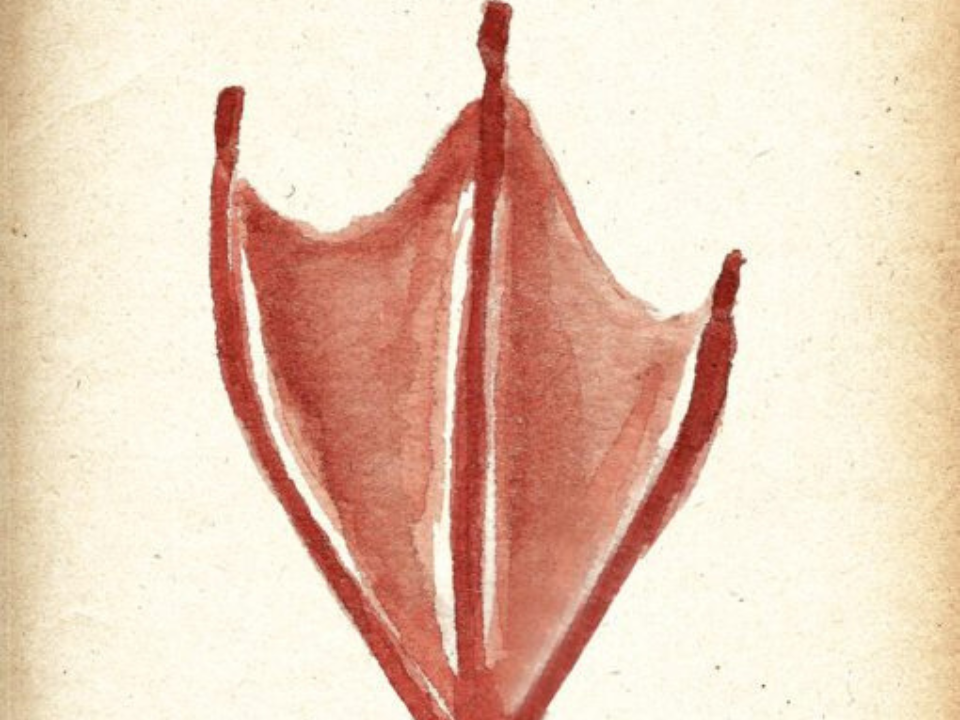
Unmaking the Archive: Goose and the Legacy of Petropoetics
Canada’s oil and gas industry plays a pivotal role in both Melanie Dennis Unrau’s academic work and her poetry. In The Rough Poets, her exploration of oil-worker poetry as literary phenomenon, Unrau suggests that “petropoetics” gives insight into "a way of living and understanding the world that is centred on the extraction and combustion of fossil fuels." Goose, Unrau’s second book of poetry, unmakes these ways of understanding. Goose is made up of three visual poems, each spanning multiple spreads, composed of hand-traced words and illustrations lifted, redacted, and recomposed from Canadian surveyor S. C. Ells' poetry. Ells surveyed the Athabasca oil sands for the Federal Government between 1913 and 1945 and styled himself as “the father of the tar sands." He also wrote strident poetry and short fiction, publishing the collection Northland Trails in 1938. Though Ells's role in the oil industry’s development was largely forgotten when the Alberta government gained control of the oil sands, his poetry appeared to be well-received; Unrau’s library copy had once belonged to Margaret Laurence.
Goose opens with a foreword from the McMurray Métis offering context on European exploration and its accompanying rhetoric of terra nullius that negates the histories and presence of Indigenous communities to justify land-appropriation. These histories include famed Métis shipbuilding and navigation on the rapids of the Athabasca River, as well as the invaluable work of Indigenous trackers who transported goods for the fur trade, lumber to construct the town of Fort McMurray, and, in Ells’ employ, bitumen samples. The foreword grounds the book's intentions: as a white settler woman, Unrau scrutinizes the colonial archive, and participates in reestablishing Fort McMurray as Indigenous land.
In the afterword, Unrau describes her process:
I made the poems by … marking instances of the words and images I wanted to work with, then tracing them onto thin sheets of paper with very fine pens. With some exceptions I worked with the constraint of tracing these elements exactly where they appear on Ells' page, moving my poems from page to page and letting the markings overlap.
Unrau adds that this was an unforgiving process, that to revise a poem she had to start over. I met Unrau online in 2022, at a virtual writers' residency hosted by the Banff Centre for the Arts. We co-wrote together for several hours with our cameras intermittently on. She was working on the manuscript that would become Goose, and I recall, too, that she was making a braided rug out of recycled clothing. The two practices seemed compatible: both the painstaking craft of working with discarded fabric to make a rug, and the craft of pulling out subsumed words from a colonial text, are processes that unravel and reverse the logics of capitalist production.
The first poem, "The Goose," is composed of borrowed text from Ells’ “My Symphony.” Unrau noticed that Ells tended to tell his readers about Canadian “nature” rather than show it, never physically describing Canada geese beyond the adjective "grey" while personifying them with epithets like “clear cut,” “stark,” “unerring,” and “stout-hearted.” She writes: "the words of the poem reveal an inattention to the geese that suggest that 'My Symphony' is more about Ells than the waterfowl." Ells’s original poem is ostensibly about migrating geese, and yet in the absence of language that shows the geese, the focal point lies elsewhere. In a ballad with a regular, alternating rhyming pattern, Ells's geese take on a martial quality that alludes to a familiar narrative of conquest over a terra nullius. Unrau suggests that the ballad is not about nature. Rather, in his dramatization of wildlife and seasonal change, Ells sought to portray himself as a natural resident of this landscape by giving the geese qualities he valued in himself.
Unrau's tracings make visible the actual geese that Ells showed little attention to. Erasing Ells' figurative language from various poems in Northland Trails to reveal only the word "geese," or occasionally other plaintive descriptors like “grey geese” or “stark” “grey wedges,” Unrau overlaps her tracings to arrive at shape poems that mimic the formations of flying geese. These geese formations occupy eight spreads in the collection, leaving little doubt for what to focus on. And yet, the title of the poem is called "The Goose." Who is the goose? There is only one answer, like in the children's game "duck, duck, goose" where children are tapped on the head one by one, hoping not to be singled out. The goose is a trick, whoever is tapped “goose” must go on a wild goose chase to recapture his spot. The goose is "Father Goose," S. C. Ells, who had hoped to be known in Canadian history as the "father of the tar sands."
The breath of the line needed no direction, its scattered formation across the page lent itself readily to a vision of dispersed geese that was at once familiar and natural to render out loud.
"The Goose" is surprisingly fun to read aloud. I showed it to a nine-year-old child, thinking she might like the pictures or that it would pique her interest to see shape poems published as serious literature. She turned the page and immediately began reading: "geese, geese, geese ... goose, geese, geese, geese and ducks. geese, geese, geese ... " The breath of the line needed no direction, its scattered formation across the page lent itself readily to a vision of dispersed geese that was at once familiar and natural to render out loud. When we got to the words "grey wedges," this too made a sonic picture, and the absurdity of this descriptor for living geese sent us into giggles. I like to think that this critical irreverence is exactly what Unrau was aiming for.
The second poem, "the tracking line(s)," refers to the work of Indigenous guides whom Ells hired to transport bitumen. In Ells' poem "The Athabaska Trail," the line “Gone are the trackers, coiled are the track-lines,” emphatically relegates the trackers to the past. It is the only line in the redolent, scenic opening stanzas of Ells's ballad that begins with a stressed syllable, "gone," its irregularity jarring Ells' depiction of a romantic, “wild” northern landscape. Both verbs of displacement are stressed—“gone,” “coiled”—as well as the syllable “track,” mentioned twice, drawing attention to the trackers but refusing to give them presence in the poem. Later, the stressed syllable returns in the refrain “Drip, drip and patter, patter,” which describes the workers’ struggling labour, and yet they disappear into scenery as the meter regularizes with “The yellow leaves fall clumsily down.” The poem conjures nostalgia, but the speaker admits neither his own responsibility for the difficult labour of the Indigenous trackers nor his role in their disappearance.
Attention to the poem’s shifts in meter—these seemingly unintentional or inarticulate moments where the rhythm stumbles—hints at how Ells sought to obfuscate the presence and work of the Indigenous guides. These are the moments that Unrau re-articulates. “the tracking lines(s)” is composed of archival photographs of tracking, presumably taken by Ells, as well as words and passages collaged from related texts. One such text is Indigenous elder Alice Boucher’s account of Métis life on the Athabasca River, from the book mihkwâkamiwi sîpîsis (University of Alberta Press, 2005), which also featured Ells’ photograph of the trackers. Another is from Alvena Strasbourg’s self-published memoir, Memories of a Métis Woman: Fort McMurray Yesterday & Today, which includes descriptions of Métis shipbuilding superimposed on a 1955 navigation map. Unrau juxtaposes these accounts, which describe the tracker’s labour in vivid detail, with Ells’ personal and government correspondence, creating a jarring contrast. Unrau notes in the afterword that she had hoped to find the names of the trackers in the archival photographs in provincial documents, in a sense pursuing her own tracking line into the archives, but her search turned up empty. Reading between Ells’ poem “The Athabaska Trail” and his correspondence with the Royal Northwest Mounted Police, Unrau erases Ells' poetry and letters so that all that is left amid the white space of the page is the phrase "they be provided with moccasins and tobacco.” Unrau’s haunting erasure poem makes legible the material evidence of Indigenous peoples who were erased, bodily and historically, like the near-empty page, into an imaginary empty wilderness.
The genre of oil-worker poetry has hitherto witnessed working-class life and power dynamics, including articulations of care and harm between people, machinery, and the land.
The final poem, “Contents,” reveals the banality of an extractive view of Canadian nature. Erasing Ells’ poems “The North,” “My Lullaby,” “The Challenge,” and “Farewell,” Unrau draws attention to their one-dimensional construction of the land. Unrau’s retracing of “The North,” for example, consists of a series of hostile and exoticized adjectives, among them: “far,” “untamed,” “primitive,” “naked,” “choking,” “windswept,” “nameless.” In “My Lullaby,” Unrau traces formations of “lu,” “la,” and “oo” across the page. Her reprisal of “The Challenge” shows that it is as single-minded in its descriptions of greatness and daring as “The North.” “Farewell” is whited out to emphasize the lyric I, who, liberated from rhetorical flourish, is made to confess what he has done to the land:
I have followed
lands forlorn
…
I have ravished
the glittering skies
…
I have followed and trampled in welling
Blood winter’s swirling calls!
In The Rough Poets, Unrau argues that a focus on petropoetics can "sharpen our analysis of how we got into our present predicaments [of climate change] and how we might get out." The genre of oil-worker poetry has hitherto witnessed working-class life and power dynamics, including articulations of care and harm between people, machinery, and the land. Just as language can concretize these relationships, it can also be used to interrogate and reckon with their power dynamics. In Goose, Unrau uses Ells’ own language to reveal the erasure inherent to his poetics. Working with what the archive conceals, Unrau offers a different call for us to heed: to recognize the essential harm of a way of life dependent on fossil fuels and extraction, or else become geese, diving into the oil fields, trapped in its tailings.
