

Pyrogy, pierogi, perogy: A Review of Ukrainian Ritual on the Prairies
When I moved to Québec from Saskatchewan, I became convinced that no one knew how to spell the word “perogy.” After seeing both “pirogi” and “pyrogy” on the lunch menu at a Ukrainian deli in Montréal, I called my 97-year-old grandmother one night, hoping that she would have the answers: “Baba, I need your expertise. Is it pierogi? Varenyky? Perohy? Why does everyone say it differently?” I could hear her scratching down a note-to-self for later investigation, and was befuddled that she didn’t know. After reading Ukrainian Ritual on the Prairies by Natalie Kononenko, I learned that my spelling of perogies is a distinctly Western-Canadian phenomenon, one that is entrenched in a complex history of immigration and the settler-colonial project. In the preface, Kononenko divulges that the word was her “biggest problem” while writing the book: though “the Ukrainian word for this food is pirih, singular, and pirohy, plural,” Prairie Ukrainians “use the terms perogy, singular, and perogies, plural.” The exact reason for this transformation is unknown, though it effectively demonstrates the etymological journey a word experiences in its displacement between continents. While I am part of a proudly Ukrainian family, I had never recognized Prairie Ukrainian cultural identity as one with its own distinctive history, lexicon, and rituals. As a child, being Ukrainian was not always cause for celebration. I grew up in the shadow of stories about my family’s escape from the 1920s Holodomor famine. I was mocked for celebrating Christmas in January—a by-product of the Julian calendar—and called “garlic breath” by taunting schoolmates after my kovbasa and cheese lunches. Reading Kononenko’s book was an act of reclamation for me, just as she intends it to be: “Ukrainian nationhood was and remains precarious indeed,” she argues. In the wake of Russia’s 2022 invasion, work to document Ukrainian culture is more important than ever.
[T]he magic of Ukrainian Ritual on the Prairies is that it harbours this sense of community, something that is gradually being lost with both the dwindling population of rural Prairie towns and the isolating disconnect of a technology-driven world.
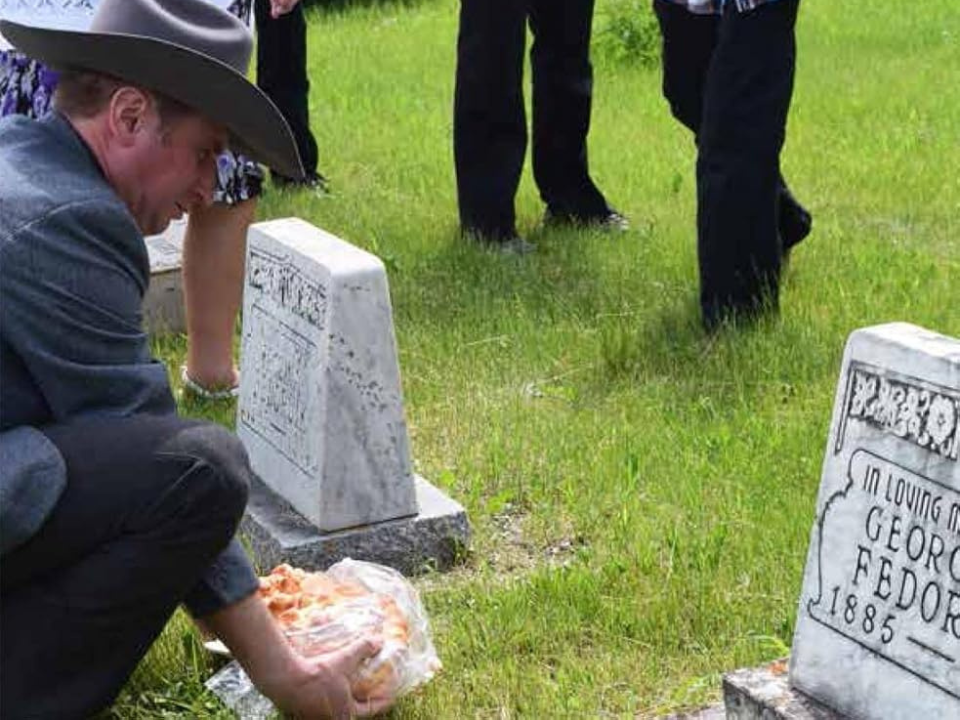
In 2008, Kononenko, a Professor of Folklore and the Kule Chair in Ukrainian Ethnography at the University of Alberta, founded the Sanctuary Spiritual Heritage Documentation Project as an effort to record the distinctive culture of Canadian Ukrainians. Her fieldwork unfolded through 250 interviews, 180 hours of recorded media, and 300,000 photographs. Over the course of ten years, she visited hundreds of small communities throughout Alberta and Saskatchewan. Ukrainian Ritual on the Prairies documents what Kononenko terms “vernacular nationalism” in the Ukrainian Canadian diaspora, a hybrid cultural identity that has “adapted to life in Canada and created new and meaningful ways of being Ukrainian” through “innovations in ritual and other aspects of sacral and community life.” The book is organized into nine chapters centred around the church, wedding ceremonies, birth customs, funerals, cemeteries, the calendar year, and Ukrainian festivals, with numerous photographs of interviewees and Ukrainian artifacts distributed throughout each section. At some moments, it reads as an academically-focused reference guide to Prairie Ukrainian culture; at others, it is a joyous, semi-biographical celebration of Ukrainian people, delivered with accessible and lucid writing. The end of the book contains an appendix of every correspondent interviewed, and the accompanying website includes a searchable database of recordings from these exchanges. On more than one occasion, I called various relatives to ask if they had heard of so-and-so, listed in the index as an interviewee; the magic of Ukrainian Ritual on the Prairies is that it harbours this sense of community, something that is gradually being lost with both the dwindling population of rural Prairie towns and the isolating disconnect of a technology-driven world. Kononenko and the Sanctuary Project team have created an invaluable resource, not just for other cultural ethnographers and folklorists, but for all Canadians curious about Ukrainian identity and history.
Kononenko’s interest in Ukrainian culture originates in her own heritage as the granddaughter of a well-known Ukrainian nationalist, Konstantyn Kononenko. At first, her experiences with Ukrainian cultural preservation were tinged with criticism from family, friends, and peers: “My emphasis on folklore, they said, made Ukraine seem like a backward, unsophisticated country,” she explains. And further: “There was an asceticism to it all. One had to suffer for Ukraine.” This question, of how to be Ukrainian in Canada, originates from the idea of an “imagined homeland,” Kononenko writes, an idyllic image of Ukraine where villagers wear vyshyvanky every day—intricately embroidered blouses reserved for special occasions—and execute the “complicated steps of a stage performance, with or without music, when doing farm chores.” She references stage backdrops in church halls that depict this “bucolic Ukraine,” a “beautifully verdant land that would blossom even more once it was freed from the Soviet yoke.” Early Ukrainian settlers in Canada often relied upon literature, memory, and nostalgia to reconstruct a picture of the homeland they yearned for, as correspondence to and from the country was difficult. But assimilation, not cultural preservation, was the Canadian government’s goal in encouraging Ukrainian immigration. “The early settlers were not grouped together in order to allow them to maintain their culture and language,” Kononenko confirms, and “painful discrimination came during the First World War,” when Ukrainians “were interned as enemy aliens and subjected to forced labour.” An imagined homeland, then, was a source of comfort for many, a safe space in a cold and sometimes hostile new environment.
Kononenko uses original Ukrainian words as much as possible, even if their Russian counterparts have become a more ubiquitous part of Ukrainian vocabulary. This choice is an act of linguistic recovery:
Had Putin and the architects of the Russian invasion read the book that follows, they might have realized that Ukrainian culture is not simply distinct; it is powerful. It is a culture so vital that, when it encounters new surroundings, even dramatically new life circumstances such as transplantation to Canada, it does not die.
Spotting deconsecrated churches became an integral part of my family’s drives through rural Saskatchewan, and the numbers merely increased with each passing year.
But, as Kononenko points out, small Ukrainian communities are not as prevalent as they used to be. “The onion domes of Ukrainian churches are an iconic feature of the Prairie landscape,” she notes, “yet those churches are disappearing at an alarming rate. Some have simply been left to decay, while others have been burned and buried.” Spotting deconsecrated churches became an integral part of my family’s drives through rural Saskatchewan, and the numbers merely increased with each passing year. Kononenko elaborates: “many rural congregations have fewer than ten people, and the parishioners find insurance, heating, and maintenance costs, not to mention eparchy fees, to be more than they can manage.” The fear of these buildings disappearing altogether was a large part of what motivated Kononenko to write Ukrainian Ritual on the Prairies. “This work may well document a situation that will soon cease to exist,” she laments.
In her chapter on “The Calendar Year,” Kononenko demonstrates the remarkable adaptability of Ukrainian rituals. Ukrainian Christmas and Easter celebrations on the Prairies blend the old world with the new: they “are an interesting combination of expressions of religious faith mixed with actions that were meant to ensure future harvests.” In Insinger, Saskatchewan, for example, Kononenko explains that a sheaf of wheat was often used by early settlers in place of a Christmas tree as a traditional Christmas decoration. Another tradition involved throwing kutia—a honey, poppy seed, and wheat berry dish eaten at the start of the Christmas Eve meal—on the ceiling. If a significant amount stuck, the year’s harvest would be abundant. As some of Kononenko’s respondents noted, “the introduction of hard-to-clean stippled ceilings” curtailed this practice in many families. My own mother grew tired of scraping the sticky wheat substance off the ceiling each year, though I begged for the tradition to return. These interviews make Kononenko’s book pleasurable, and often humorous, to read: as one interviewee detailed, “Baba would have killed them (the men in my family) if they threw kutia. She was tiny, but she was fierce.”
Ukrainian Ritual on the Prairies is about balancing legacy with reinvention, about looking forward while also looking back
Not only do Prairie Ukrainians shape the landscape of western Canadian life through food, dance, and ritual, their mark is also sometimes, quite literally, monumental. In Mundare, Alberta, there is a giant kovbasa (or sausage) statue; in Canora, a massive figure of a woman in Ukrainian dress; and most famously, a towering pysanka, or decorated Easter egg, in Vegreville, an attraction that my family regularly detoured to see on road-trips. The giant egg was commissioned to celebrate the 100th anniversary of the Royal Canadian Mounted Police. As Kononenko points out, “the fact that a pysanka is used to celebrate the Mounties, a consummate Canadian institution, shows that Ukrainians are now an integral part of Canadian life.” In comparison to Kononenko’s book, which provides an accurate portrait of Ukrainian Canadian culture in vivid, living colour, the Vegreville egg monument now feels like a caricature or a misunderstanding, an unsatisfactory simulacrum. Ukrainian Ritual on the Prairies is about balancing legacy with reinvention, about looking forward while also looking back. “This book is not about preserving the past. It is about creating something new,” Kononenko writes. She accomplishes both: an appreciation of rural Ukrainian rituals that are rapidly disappearing, and a vital reminder of how important the sharing of Ukrainian knowledge and customs are in the 21st century.
