

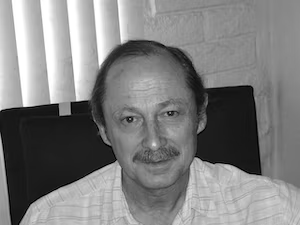
The Man Who Cared
Paul Sturbridge took care of people. As an insurance agent for twenty-seven years, he figured his policies had interposed themselves between a quarter of Billings’ population—taking into account the public buildings and services under his company’s umbrella—and the vicissitudes of nature, accident, illness, crime, and death. If he could not outright protect, he could at least mitigate, compensate, and console. Though short in stature, he was broad at the shoulder and seat, and whether behind the office desk or in the still-smoldering ruins of a family home, he felt almost physically capable of absorbing his clients’ anxieties and grief. In case of emergency he demanded to be contacted personally no matter what the hour. He had housed flood victims under his own roof —for those who had lost all, a motel was no proper comfort.Naturally Paul was his company’s face to the world, speaking forthrightly into the TV camera with wavy black hair and a sober furrow in his brow so pronounced it could have been a fold. A brief clip in the commercial showed him accepting a national award for customer service. “Just a fussy mother hen, that’s all,” he said.
But then death interfered. In June the Sturbridges’ last child graduated college. Paul looked at his wife JoAnne, a former part-time receptionist at the Nissan dealership, now assistant personnel manager, and saw that she was financially independent. She busied herself hosting a literary group and directing the church’s youth choir. She knitted yarn dolls for friends and relatives, floppy-cuddly with exaggerated features, like folk art. If he were to be taken suddenly, Paul thought, Joanne would mourn, the children, too, but it wouldn’t be the blow that struck them down. In that moment he understood he would die. Across the desk from him, a client argued for the most generous life insurance benefit to leave his widow and heirs. The man’s features misted and contracted with the pain of departing, but softened with the promise of their home paid, basic needs guaranteed, their path widening into pure prospect. “Once you’re dead,” Paul said, “it won’t matter to you what happens to them, any more than it will to them. They’ll die, too, along with their children, and the children of those, and so on. Ad infinitum. Ad nauseum. Before even being born they’re all dead. “You might say, then, ‘I’ll blow off the policy and save the money for my own pleasure.’” But why bother? Soon enough you’ll die, and whatever you thought of as pleasure will go with you. Eh?” He paused politely for agreement. The company put Paul on a leave of absence. The job had earned him a six-figure house on the Billings Rim—back when the average home cost fifty-five—as well as a hunting cabin. JoAnne kept herself pretty at least in part for him. She jogged when weather permitted, and her backside in the satiny shorts still kept its foolish, profound womanly sway, her tinted black hair alive in a ponytail. They talked of their outings as “dates.” Their children liked their company, phoned to chat. For their silver anniversary the kids had taken them whitewater rafting on the mis-named Stillwater, conspiring with the other paddlers —strangers from Arizona, California, Germany—to sing stupid love songs all the way as the coxswain barked interruptions of “all forward … left back.” Sugar, Sugar. Wild Thing. Stand By Your Man. “Wild thing, I think you move me,” their son had bellowed as a suckhole flipped him half out of the rubber craft. He and JoAnne must have done something right. And yet when the couple seated themselves in the darkening movie theater for a Midnight Classic, The Wonder Boys, and from the surrounding speakers Bob Dylan’s cinders of voice rasped, “I used to care, but things have changed,” a cavern opened in Paul that instantly engulfed him. What consequence whether one’s span was telegraphed by one long dash, a short dash with a couple of dots, a mere dot alone, since once sounded the clicks were swallowed alike into the same silence. And to listen into that microcosm of a dash, break its minute entity into more infinitesimal components, what matter the specific arrangement of sound waves, if they occupied time as selling insurance or ice skating. Or killing children, who would only die a dot sooner. Paul took to scrutinizing his surroundings, to determine if anything was different from anything else. Not really, they were all things, the veined leaf on the tree, the car tire, the sun pouring its cool light on late summer, the blonde at the bar with her hastily puffed cig, brass buttons stamped with anchors, clean line of nose, dewdrop earrings, smudge where collar met neck, nick of cleavage. He took her to a motel, but as their mouths joined he inexplicably said, “No.” Confessing to JoAnne, he said, “I nearly went with a harlot. Not a harlot,” he corrected, “but a sinner like me. Only there is no sin. You’re the best, most steadfast woman. That’s what you’ve hoodwinked yourself into being. It seems better than what others have hoodwinked themselves into being, though it isn’t. But I’m glad I think this about you, even though I’m wrong.” Paul stopped attending church as it became clear there must be no God. If he was so vulnerable to the fear of death, he must have invented belief as a convenience. And so then did everyone else delude themselves into belief through unacknowledged terror. The terror was immediate and real, which made belief by contrast pitiful and transparent. Driving home with a pound of coffee for JoAnne, he believed there was nothing to prevent him from diverting the car into a tree. It wouldn’t be an act of anger, despair, or self-pity, but merely an acknowledgment. Going with the flow. Disgracefully, he found himself provoking JoAnne further, hoping that risking her loss would goad him into an effort to regain her. Labour Day, after JoAnne had driven him home drunk from her family’s barbecue, he brushed his teeth before the mirror, lightly stroking the gums before falling in a heap at the foot of their bed. Drinking sometimes still afforded a thoughtless bliss in ritual. When his old friend David called to remind him of their annual hunting trip, which in his cogitations he had forgotten, he welcomed the distraction, wondering anxiously how far it might carry him. JoAnne’s response had been calm, controlled hysteria. “I know you’re not coming back,” she said. Now she’d risen in the middle of the night to see him off. Her black eyes receded above the high cheekbones—she was proud of her trace Mandan-Hidatsa blood—and the flannel nightgown hung straight like a ceremonial garment. Paul clasped her, the moment dark and still as if the two of them were suspended in a pool, while his feet shifted as if treading a StepMaster.His friend’s shack was scarcely larger than the Dodge Dakota that Paul parked in the dirt. Paul crossed the bare plot of yard. David stood in the door frame like a side of meat hung from a hook. Even his cigarette looked lopsided. Above the stubble the skin at his left cheekbone was abraded, a pink shine. But at the sight of Paul, David’s blue eyes snapped sharp, and his Cupid’s-bow lips smiled. He had been a handsome man. At forty-eight he maintained the erect carriage to match his stiff crew cut, now grey. His weight was unchanged since high school, and his state championship in tennis. When he hadn’t had dealings with David for a few months or so, Paul could be moved, seeing him. In this shanty the kitchen lay just inside the doorway, and David had poured him a cup of coffee before Paul even removed his coat. Four a.m. in early November, it was unseasonably warm. By evening, though, an arctic air mass was expected to loop down, dropping the temperature by fifty degrees or more, and Paul would have canceled the hunting trip had David’s invitation not been so transparently a plea. “Shot of Jack?” “What the hell,” Paul said, holding out his cup. “Wild men on the loose.” Seizing the quart of sour mash by the neck, David wristed a dollop into the coffee with practiced flair. He had been most recently a bartender. “Hey, almost bought a Kawasaki,” he said. “Yeah? What kept you?” “Forgot I was broke.” “That’s too bad. I can see us bouncing along the stream bed, guns on the handlebars, shooting the shit out of the woods, deer falling out of trees.” Paul gulped his coffee, which tasted like warm metal. He had forgotten; David was the only person with whom he talked this way, thought this way. Loose lip. Spit out your brain without thinking. “Yeah. It was going to be yellow.” David had tidied for him, Paul noted, following the broom’s fresh tracks on the dusty linoleum. A plate and bowl glistened in the dish rack, still damp. But the living room looked as if a plane had crashed through the roof, tarpaper curling from the wall, wooden ribbing exposed, a broken chair listing. As if the air were colder, he stood with his back to the electric wall heater. “Want to get our day in, beat the storm, better shove off,” David said. They loaded his gear in the bed of Paul’s Dakota. “Whip that one in the face,” David muttered, as Paul slammed the tailgate shut. “What?” David stared through him.
After gassing up at a truck stop, they left the freeway. Black, silent towns humped along the road, then blended back into the dark. “If we hadn’t been neighbours, we never would have been friends, would we?” David said. “It doesn’t matter how things happen,” Paul said, but David was right. Through junior high David had built model cars, then in high school customized the real thing, and always played tennis, while Paul concentrated on school and reading. The preferred subject was heroes, from Audie Murphy and Scooter Burke all the way back to the Iliad, the Odyssey, and the Aeneid. He memorized “Horatius at the Bridge”—took a year. In college he sampled lit courses and considered he might become a poet. Driving a carload along the Clark’s Fork of the Yellowstone, reciting, “Winter is icummen in…SING GODDAMN!” he’d banged and yanked the steering wheel so hard, in rhythm, that it pulled off in his hands. But David had built him a treehouse in sixth grade, which was their fort during the neighbourhood slingshot wars. They aimed pebbles through the corner of the window while gravel smacked and pitted the pine boards. It was the era before lawsuits. Summer, Paul and David slept above the ground with maple leaves brushing the roof. During the spring of seventh grade, when his parents’ divorce led to insomnia, Paul broke the sleeplessness with a night in the sweet-smelling pine, waking to stinging morning cold and his down bag crusted with frost. The Dakota’s brights searched alongside the blacktop for the turnoff to Paul’s cabin in the mountains, and he slowed. Beside him David’s fingers methodically rubbed his left cheekbone; whether cause or effect of the rawness, Paul couldn’t say. Already the livid skin and a stale odor David had brought to the cab had chased Paul’s earlier gaiety. In his thirty adult years David had fixed cars and mixed drinks. He’d gone to war, divorced twice, done time, de-toxed, dried out. He’d served as wilderness guide and game warden, and driven repos. He’d been shot at, home and abroad. In truth, David had become, long had been, an obligation owed to Paul’s own past. Paul’s main feelings toward him were worry and pity. And weariness. He’d done one of those ‘interventions’ before there was a term for it, and David kicked out his headlights in thanks. Lending him money provoked fights with JoAnne, who loathed him. He’d picked up David stranded in two states, testified as a character witness in both his trials. “I can’t find the donkey,” David said. “Kick your fucking ASS,” he shouted and sprang in the seat. In the middle of the dirt road Paul jounced the Dakota to a halt. “What are you talking about?” The clean line of David’s jaw was set. “Are you doing drugs?” David laughed softly through his nose. Paul drove on, unease hobbling his foot on the gas. The truck crept, speedometer hovering between 5 and 10. However derelict his state, David had always gathered himself for a hunt, shrewd and resourceful. Afterwards they drank and swapped stories like any two friends. Grey lodgepole trunks flitted past the highbeams. Ensconced in a stand of spruce, the cabin was tightly knit of peeled logs chinked with mortar. The moon had finally broken through cloud cover, and Paul easily found the deadbolt, jiggling the key until the door swung open. Moonlight raced across the plank floor. Paul lit a kerosene lantern. The sparse, crude furniture was scattered like old conversations. Unloading the truck, the men propped their overnight gear inside a wall. Paul stuffed a day pack with ammunition, thermos, jerky, and his Thinsulate parka. They wolfed sweet rolls and smoked sausage. “Something’s wrong with my head. It’s like I turn around and something’s missing.” David whirled to illustrate, elegant, six-foot, greying man hamming like ... The 3 Stooges, Paul thought. “Have you seen a doctor?” “I’m in a bad way,” David said brokenly, and he had Paul’s attention. What most unsettled and infuriated others about David’s behaviour, Paul included, was the mask of stoicism. Handcuffed, retching drunk—or pointing his boot toe through the headlight globes—his face was blank beyond nonchalance. “Hey, maybe this isn’t the best thing. I should take you somewhere,” Paul said. “Naw, don’t do that.” David wrung his hands. “I need food. I need deer meat. I been starving.” “That’s what we’re getting,” Paul decided, lightly flicking David’s arm. Slinging their venerable rifles over their shoulders, the men clumped over dry needles, no attempt at stealth as yet. The first reliable deer trail was a mile away. As the terrain opened into boulder-strewn sage, morning backlight blued the distant evergreens. David’s carriage improved, his military deliberateness restored, yet fluid. A half mile from the creek, without altering his gait, he subtracted sound from his footsteps. This was the time of day the whitetail would return from browsing along the water’s edge, to bed down in the deeper woods higher up, against the gently sloping, crumbling canyon walls. Fresh droppings clustered on the path. Young cottonwoods by the creek gleamed white where bucks’ antlers had rubbed them clean, the bark hanging in tatters. The men’s practice was to still-hunt from cover while the deer were mobile, then, failing a kill, stalk them to their hidden sleeping places. Paul settled into his stand, a trio of granite oblongs fronted with juneberry bush. The peculiar warmth coated his skin like oil, and then gusts kicked up, tousling the foliage. Turbulent, with no consistent direction, the eddies were charged with confused smells, water, the dankness of fallen leaves, sage. Paul’s stand lay between the stream and a belt of lodgepole at the foot of the lichen-splotched ridge. Beyond, anvil-shaped mountains rose to the sky. David had concealed himself nearer the stream. His boots protruded like chunks of log from a dense thicket of bare willow saplings. Perhaps agitated by the indecipherable wind-borne scents, the deer didn’t come. An hour passed. Paul glassed the canyon slope with his Zeiss 7x35s, detecting an antler among the branches the instant before the eight-pointer broke cover, dashing uphill, then folding back into the trees. He was at least three hundred yards away, too long for Paul’s Winchester. David hadn’t risked the wild shot, either. Paul figured out what puzzled him. Rather than bounding with tail raised, the buck had run flat-out, tail and neck stretched straight, head down and mouth open. He’d been pursuing, not fleeing, probably an unseen doe, in full rut. If they were patient, the doe might double back, the buck following. Twenty minutes later, they did. The doe minced into the opening, ear twitching, peering behind. Muzzle lowered, the buck stumbled from the woods’ edge but head-on, a poor shot. And then they spooked, the goddamned neurotic whitetail, for no apparent reason, bolting up and over the ridge. David ran after in his knee-pumping upright stance, the rifle absolutely still in his hands, Paul jogging alongside until they reached the ridge top, panting. Clouds careened overhead, darkening from white to grey to black, and a narrow squall twisted through the mountains like a grimace. The chill was precipitous. Below, the valley was bisected neatly into sun and shadow, and as the buck plunged across that line the upraised taper of his tail abruptly dimmed. The first snowflakes shook down. They bushwhacked through scrub oak and scree down to the valley floor, picking up the deer trail in a dry draw. The buck had slowed to a trot, hoofprints a yard apart, which still would leave him well ahead. The doe must have taken her own way. The personality of the man beside him was an absence, and the past rushed all the more into the void. Paul felt stalked by ghosts of themselves, footfalls in his ear, the bare cottonwood spires closing in overhead. The snow hit hard, filling the buck’s tracks so that they lost the trail. They walked shrouded in falling snow. David grabbed his shuddering arms and hunched forward. He’d brought no coat. “Here.” Paul produced the parka from his backpack and traded for his friend’s cracked leather jacket. Though he could feel the cold, his fleece pullover and the heat of their laboured walking kept it out of his joints. “Track should show up easy in the snow now,” David said. “Snow will fill them up fast as they’re made,” Paul said. Snowflakes gummed his eyelashes. Wind skirled in the treetops. “We need to go back.” David switched on his taut, deaf face. Paul seized his arm. “We’ve got to go.” It was a blizzard. They’d lost even the banks of the narrow gully. If the snow didn’t let up he’d need his compass just to find their way back. “I saw JoAnne’s beaver once,” David said. His cheek wound was blood red. “Bullshit you did.” “I crawled under the dining table when we were eating breakfast, coffee cake, and her knees were apart in her robe. Her blue terry-cloth robe.” The confession, or boast, was ludicrous. In twenty-five years David had not eaten breakfast at their home, and JoAnne didn’t own a blue terry-cloth robe. David leaned into his stride. The snow was ankle-deep. The cold doled out responses slowly, and only after another hundred yards of blind driving off his calf muscles did the apprehension follow that David meant him harm. His features stoical, all the expression pulsed in the scarlet badge, where Paul read spite, cunning, and even love. David had decided to walk off the edge, and he wanted Paul with him there. “You want to freeze your ass, fine. You’re not taking me with you,” Paul said. “I’m not doing this. Are you coming with me?” David’s cherry lips smiled, and he angled forward. Paul zipped the borrowed jacket over his fleece, layering last the orange vest. Then he turned back, the motion of his legs away from David filling him with disbelief. He squinted at the fogged compass, cleared the lens with a gloved thumb. Snow blew sideways. It had removed definition from the landscape. Peculiar, as he had an inner sense and a logic saying the ridge lay to his left, but that was all. Ice was crusting Paul’s eyes. A smothered log chopped his feet from under him, and he sprawled. Swiping snow from his face, he resumed his pace. Jammed in the pocket of David’s jacket, his hand encountered the Marlboro pack. Though Paul didn’t smoke, David would light him one the night of a hunt, after they turned the Jack bottle upside down, the last ritual before dropping onto their cots. Frowning with concentration, he would take a draw, exhale, hold out the cig. Paul would reach with thumb and index finger. Their footsteps were making a line in the snow, his and David’s, that was growing at both ends, that was extending itself in opposite directions. Otherwise, nothing distinguished the snowscape. How quickly the rough brush and jagged rock outcrops were erased in the bland blanket of white with its trivial gradations, a pabulum to the eye. Paul felt a sinking drop within him. It was the richness of consciousness leaving him over the past few hours, so familiar that he had accepted it thoughtlessly. In its place was music, or what he used to think of as music. It was the songs of the rafting trip, but instead of progressing toward melody and resolution, the notes were just sounds. He was left with sounds that bore no relation to each other, in a field of snow. He thought of his children, mistaking limitlessness for meaning. This could happen, which led to that, which led to the other. They were just at the root of the tree, not imagining that past the trunk, limbs, branches, twigs, were sticks outlined against a pale sky. Though all sense told him to keep moving, Paul stood stock-still. Without thinking, he reversed himself again. David could not be left behind: the message leaped from his heart to his brain, an involuntary surge, the rush of good, red blood. Now the snow flew directly into his eyes, as it would into David’s. Already it was erasing his prints with its soft packing. Of course there was no trace of the other man, who had no compass, who could be veering anywhere. Paul quickened the crunch of his feet, the only sound. Any faster, and he would panic. Panicked, he ran into the wall of white. The thickening blanket dragged at his boots, freezing his feet. And then the dim column materialized, first a slight density in the snow, then solid form, the drab brown parka. David’s face seemed set in ice. This time he allowed himself to be steered without a word, Paul’s arm around his back. Paul buzzed the stubbly grey crew cut with his hand. They moved through a whirl of atoms. Cold penetrated to his bones as if it originated there and moved outward. As their legs plodded without feeling through the blankness, shifting casts of white suggested shapes that might emerge but did not, as if nothing was casting shadows on nothing. Maybe there was a heaven, Paul thought dreamily, and it was no more than this white dissolve, the eternal awareness of being one with God. Maybe the nothing he had been experiencing actually was everything. He began praying, but it was only “Oh Lord Jesus Oh Lord Jesus” repeated over and over. His body was freeing itself, he was losing it. Then he saw the cabin. Inside felt positively tropical, though the wall thermometer read 28° F. “We’ve never not got a deer,” David said. He looked terrible, weary beyond mournful, eyes red-rimmed like a hound’s. Heat still radiated from the cast iron stove, and the men stripped before it to don their second set of thermal underwear and heavy clothing. David’s teeth chattered. Paul threw on more logs, and David poured a few inches of Jack into plastic cups, hands shaking. He’d stashed a 1.75 litre in his bedroll. Outside the window the snow couldn’t fall fast enough, it couldn’t wait to dump from the sky like sand from a bucket. Laden spruce limbs drooped past the roof overhang, their looming black undersides the only holes in the white. Paul lit the kerosene lamp, and the men sat in rough pine-slat chairs with their whiskey. Famished, they each consumed a can of beef stew heated on the wood stove. “In sixth grade we sold the most Boy Scout Jamboree tickets,” David said. “We rode from one end of Billings to the other. I had a chopped custom Schwinn and you had a Jap bike. We’d memorized the pitch: ‘Good morning, ma’am, we’re from the Boy Scouts of America. We hope you can help us out by buying tickets to the annual Boy Scout Jamboree in beautiful Denver, Colorado. Even if you can’t attend, your contribution will help the Boy Scouts.’ Only you kept making it up. ‘The Jamboree is on Mars but buy the tickets anyway because we need the money … Hi, we’re Heckel and Jeckel from Heckyjeckyland.’” David laughed. “I’d forgotten that.” “At the end of the day we coasted down from the Rim without touching the brakes once. It was like a roller coaster when it feels like no gravity. You were scared.” Paul started a story about the treehouse, trying to shoot baskets into the neighbour’s yard, and the mother kept retrieving the ball for them, and she was wearing a red bandanna for a top, and the dog was running around, chasing the ball … and it was pointless, he’d lost the thread, brain dim with fatigue. David had fallen asleep, cup still slung loosely in his hand. He started slightly when Paul removed it. Paul cleaned up and spread out his sleeping bag on one cot, unrolling David’s bag, as well. Paul put another log in the stove. Staring out the window, he could sense the snow more than see it, as if the night were alive and moving. Before lying down he jostled David’s shoulder. When he didn’t stir, Paul shook him, then pressed beneath his ear, a trick he’d read in an adventure story. David’s body did not move, and there was no pulse at his wrist. There was no breath from his nose. Paul stood in bafflement. David’s stillness seemed a product of his own mind, being so drunk and exhausted. If he washed his face in cold water this might go away. Instead he poured himself a drink, and another. He couldn’t leave: night, blizzard, snowdrifts up to the wheel wells. He drank another three fingers from the bottle and laid David on the second cot, covering him with a sleeping bag as if—what? He might be troubled by the cold? Still he performed the task with drunken doggedness. He lay down and slept fitfully, pitching about semi-conscious, unable to grasp where he was. He dreamed of swimming up from great depth, straining for the greenish-pale wash of the surface far above. His last breath was imploding, and airlessness tore at his chest. The green was collapsing into black, silent white dots spraying across his eyes as the silence became more profound, clinging to the slow-motion striving of his arms and legs. After an hour or two he woke half off the cot, head nearly touching the floor. He got up to stoke the stove, and with a gladdening rush he saw, in its glow, David sitting in the slat chair. On its arm rested a full plastic whiskey tumbler, the amber liquid glinting warmly as if the fire were within. “David, Jesus, I dreamed—” Paul began, lurching toward him. He didn’t like his friend’s posture. Legs didn’t bend that way naturally, and he reached out rudely to confirm that the spectator was a corpse. The touch of the dead hand raised the hair at the back of Paul’s neck. He maneuvered the balky, slumped body onto its cot, then pitched into bed, falling asleep despite the sound of his own groaning. He dreamed that people had long tails useful as ropes or knouts, but in frustration he was slamming his against the refrigerator. Waking bolt upright, he knew exactly where to look. Again David sat in the chair, feet propped on his rifle case, unlit cigarette dangling from his hand. Paul ignited the lantern mantle and turned the flame up high. David’s lids were closed, long lashes exceptionally delicate above the freckled cheeks and the scabbed sore. His lips were pale and seemed to have shrunk. Paul opened the cabin door wide and snow trickled onto his feet. Sliding his hands under David’s legs and back, bracing his knees, he lifted the weight into his arms, carried it out the doorway and threw it into a drift. Through the clearing sky, the moon deepened the hollows of his bootprints as he followed the same brief path to the indoors. He didn’t look back. Sleeping, he received bright, eager dreams bathed in unnatural light. The snow was cold sand, he on hands and knees. When he woke he sensed the dawn even before seeing the greying at the window. Beside him David was stretched out on the cot, covered with the down bag. Left elbow crooked, the hand was tucked under his head in an attitude of ease. Melted snow pooled under the cot. Paul threw all their belongings in the pickup bed. Reverently he laid David’s body, stiffened, as if stuffed with batting, on top. Despite the cracking of branches, the storm had passed. Paul stayed rooted, staring unbelievingly at his hands. A rushing through the trees stirred the ice crystals in the air, adding to the impression he was being watched. By David, perhaps, or by Jesus. He was a very small patch in this field of white. In the rearview mirror, the long form, dusted white with new snow, was turning to ice in the subzero morning. Sunlight slanting between lodgepole trunks outlined it in a rim of fire. Banging into a buried rut, the truck’s wheels left the road and the body went airborne, allowing Paul a fractional second to believe it would not return but levitate directly into heaven. Was David Jesus Himself, disguised, testing?
After David’s funeral Paul returned to work, and with JoAnne it was like first courtship all over again. In church he lifted his voice in praise. David was the Resurrection and the Life to come, and Paul saw him everywhere, peeking from the cornices in church, outlined in the green buds of a false spring. JoAnne sat him down, his hands in hers. “You know, I don’t think God wants us to come to Him through folly,” she said. “I don’t think he would raise the dead just to open the heart of one soul.” “You mean, why am I so special?” Paul said. “Why doesn’t He field an entire major league baseball team of the dead and thereby bring His light to millions? That doesn’t trouble me, JoAnne.” He laid his hand on her arm, joy of his flesh. “God knows us, each one. He chose what would work for me.” But a little doubt did gnaw at his horizon. When a few days later JoAnne asked, “Think. Is there anything you might have forgotten from that night?” Paul sat with his fingertips to his temples and closed his eyes. “You were drunk,” JoAnne suggested gently, “and you just thought David moved. Maybe you wanted him to move. After all, he ended up where you put him in the first place, really.” Paul thought he was seeing something. Along with David’s fresh impress in the snow, outside the cabin. Footsteps, two sets, leading to the body’s imprint and then back, with the distinctive pattern of Paul’s boot tread, inverted pyramids. If he had moved David himself, then probably there was no God. Paul felt as if there was another person inside himself, and it was he whose eyes had watched him in the frozen clearing, laying his friend’s corpse in the pickup. Three times, while he slept, that person had brought David to life, unable to accept his death or to stop tending to it. That person had deluded himself into believing existence mattered, a core of delusion built up over the course of a lifetime, layer upon layer like sedimentary rock. That core was obdurate to reason, too strong, resisting knowledge and truth. That person unbalanced Paul, made him walk lopsided, lift JoAnne’s arm to his lips. The doubt meekly introduced by JoAnne fatally undermined Paul’s religious faith, yet left him suspended above his previous disbelief, perversely incapable of despair. He must accept either of two delusions: the mystery of God and the life to come, or that self who mattered, a social construct or a personal one. In fairness to God or “God,” just in case, he remained a regular churchgoer. Paul was powerless. Enslaved by himself or by “God,” he persisted with resignation in the cynical task of assuaging his clients’ imagined “concerns.” He made “love” to his wife with “passion.” He humored his children’s “affection” for him with desperate “fondness,” and his family grew in “happiness” throughout his old age.
