

On Swimming and the Puzzle of Constraint: A Conversation with Anna Swanson
Anna Swanson’s poetry has appeared in a range of journals and anthologies, and her first poetry collection, The Nights Also (Tightrope Books, 2010), won the Gerald Lampert Award and a Lambda Literary Award. With the publication of her second collection, The Garbage Poems, newly out from Brick Books, she explores themes of chronic illness, embodiment, and queerness, alongside the climate crisis—exposing how corporations have shifted responsibility for the single-use manufacturing model onto individual consumers. Swanson has described the project as “a series of found(ish) poems built out of text from garbage collected at some of [her] favourite swimming holes over the course of eight years.”
The autobiographical work is a deeply immersive experience—a celebration of the lyric potential of water and an act of care extended to the reader. Swanson’s political and luminous language, which invites discussion, has me convinced swimming is an artistic inquiry, with rhythm emerging from the collision of restraint and joy. Our exchange was deliberately unhurried in acknowledgement of the meticulous work of repurposing years’ worth of found fragments.
Veronique Synnott: Your collection is divided into six sections, one for each body of water you visited over the years of working on this project. Each section of poems is separated by “Some Definitions,” where you turn to definition as a form to interrogate the single-use manufacturing model—and the power structures that blame individual consumers for littering, thus preserving corporate stability—while also thinking deeply about chronic illness and embodiment, as a creative act, as well as relationship to land and water.
I understand a great deal of research and reflection went into crafting these definitions. Were you surprised by what you uncovered, particularly around the lobbying that shaped legislation? Likewise, our healthcare system often shifts responsibility for chronic illness onto individuals (“Am I not sick anymore but only lazy?” p. 30). Could you speak to the poetic implications of writing about these two structures concurrently?
Anna Swanson: Despite using garbage as part of my creative process, I didn’t set out to write about single-use plastics, corporate profit, ecological destruction, climate crisis, capitalism, or colonial power structures in the original project. But every time I read the poems in public, people would ask me if this was an anti-littering project, and I would have to figure out how to answer reasonably while my body flooded with rage. My resistance to the work being understood through that lens helped me clarify the values and political views that were being missed in this interpretation, and it motivated me to write them more explicitly into the project.
A first round of rejections for the manuscript, including from the publisher who eventually did publish it, also showed me that in titling the project The Garbage Poems, I was setting up expectations for the reader that the existing manuscript didn’t satisfy. While those early rejections were difficult, I’m grateful that the world gave me the push to integrate these concepts into the body of the work itself.
Part of what I was trying to do in this book was to retrain my own brain to stop falling for corporate PR campaigns that would have me blame ecological harm on whoever had left beer cans and chip bags at my favourite swimming hole. Instead, I wanted to direct that fear, grief, and rage at oil subsidies, policies that protect corporate profit, and the systems of colonial extraction that drive this destruction.
In both cases, I’m writing about a realm where neoliberal politics insists on individual responsibility in the face of structural harm. This insistence isn’t accidental or neutral, but a strategic effort to direct collective outrage into the realm of individual action. Whether it’s recycling, clean eating, or zero carbon footprints, this individual focus intentionally obscures root causes and power structures and protects the beneficiaries of those systems from the kinds of collective action and structural changes that might threaten the status quo.
Except for a few poems or passages, these ideas aren’t explicitly compared or directly connected in the text, but I hope that the structure that allows these ideas resonate within the larger structure of the book. Part of what I was trying to do in this book was to retrain my own brain to stop falling for corporate PR campaigns that would have me blame ecological harm on whoever had left beer cans and chip bags at my favourite swimming hole. Instead, I wanted to direct that fear, grief, and rage at oil subsidies, policies that protect corporate profit, and the systems of colonial extraction that drive this destruction. Likewise, I wanted to stop falling for the ableist logic that had taught me to equate my worth with my productivity.
Veronique Synnott: Under the definition of “not knowing,” you write, “I stop knowing what is strategic. I stop knowing what is a waste of time." In your collection, you illuminate the vastness of what we don’t know for sure—or cannot prove—when navigating, for instance, a healthcare system designed to send us in circles, to confuse or dismiss us. Does shaping singular moments from an experience that continues in real time make this “reality” more bearable? And conversely, is the collection a way to honour what you do know?
I know how my body feels in the water in a way that is not about information, where the goal of knowing isn’t to contain or control but to have the experience of being in touch with sensation, with being, with aliveness.
Anna Swanson: What a great question: Is the collection a way to honour what I do know? I’ve never thought of it that way. But I like it. I think that what I do know can sometimes be obscured by the insidious bombardment of questions about what I am told I should know, and have had to make peace with not knowing: Why is this happening? What is the exact cause and mechanism of my illness? Which treatments or courses of action that will make me feel better?
I think that you’re right that a lot of the knowing of the book happens in singular moments, rather than in the larger timeline of life experience. I know how my body feels in the water in a way that is not about information, where the goal of knowing isn’t to contain or control but to have the experience of being in touch with sensation, with being, with aliveness.
I think one of the kinds of knowing in this book is related to a different kind of narrative knowing. I know what it is like to feel stuck in my own suffering, and then to find a way into an experience of physical joy and ecstatic aliveness, but without having changed the material everyday realities of living with chronic illness in an ableist world. Many of the poems in the book are about finding a different pathway than the one I’m told will fix all my problems, more of a sideways portal than an escape into the sunset. I write about rejecting the “cure narrative” in this book, but the reality is that I didn’t start there.
I am building a life where I have access to joy without the prerequisite of a cure, where I am reorganizing my mental map of what it means to live in a chronically ill body.
If I were to dig up my original grant proposal, written during a time when I seemed to be recovering from 15 years of chronic illness, and right after the head injury that I thought had temporarily set me back, I might find some unexamined echoes of the traditional cure narrative I end up writing against in this book. I think I was invested in a traditional narrative structure with a beginning, middle and end. I realized in writing this book, and especially in writing about my creative process in Impact: Women Writing After Concussion, that I may not get to have a beginning, middle, and end in relation to illness in the way I’d once naively hoped. But for every moment when I’m able to find joy or connect with the physicality of my body and the world around me, I have a chance to experience a microcosm of that journey. I step into the moment, show up, and allow myself—my day, my state, my mood, my brain—to be changed by it, to arrive somewhere.
And in order to experience that, I have to let go of the desire for the destination to be permanent, to be an altering of the material reality of my everyday life, to be a cure. Instead, I am building a life where I have access to joy without the prerequisite of a cure, where I am reorganizing my mental map of what it means to live in a chronically ill body.
Though it isn’t referenced in the book, I also can’t help thinking about the biblical “to know.” It’s generally understood to mean a sexual act, but I like to think it also sounds like a larger, looser, more visceral, more embodied kind of knowing. Swimming feels like knowing the water in that way, touching the skin of my body to the surface of the water, and feeling the water fit itself against every part of me no matter what shape I take, changing as quickly and as fluently as a reflection, while not becoming more like me in any way. What would it mean to know my own body, my own experience, my own desires, in this way? Or to know the people around me, the ecological changes, the harm created by the power structures that shape my life?
I also think about how received or imposed cultural knowledge, which is perhaps a milder way of saying indoctrination into existing power structures, can block other means of knowing. The two instances that you highlight here—knowing “what is strategic” and “what is a waste of time”—are both productivity-based assessments. And my un-asked-for “knowledge” of productivity and ableism has often prevented me from knowing what I want, what I connect with, what makes me feel alive, what it would feel like to simply be in a world where my worth wasn’t tied to my productivity.
I will probably never say that I’m grateful for chronic illness. But I am grateful for what I’ve learned in relation to that illness, and through the work of disabled thinkers and writers, especially those in the disability justice movement.
VS: In the first poem’s final line, you write “you begin again.” The definitions section that follows opens with “beginning,” and the last line of your book ends on “return to the beginning.” This repetition echoes a long recovery process, but it also suggests an approach that is open, non-judgmental, and free of the pressure of “proficiency.” Perhaps transformation is a sufficient form of a recovery—or an alternative to it?
AS: Recovery is a complicated word for me. There were periods of my life where it was the central interest, activity, and labour of my daily life. I didn’t have hobbies or interests, I had recovery.
I focused on the idea of recovery for years, decades even. It was part of the language I used in earlier writing grants. But it wasn’t until I gave up on recovery as a way of framing about my relationship with chronic illness that this project started to come into focus.
I think part of my attachment to the word and concept of recovery, initially, was rooted in a reluctance to see my experience of chronic illness through the lens of disability. Recovery suggested a baseline reality of being well and able-bodied, with an injury or illness that was temporary and would pass, which didn’t put me into the category of disabled. I worried that if I used the word disability, and then did get better, I would have been lying and deceiving people. But I know it was also fuelled by internalized ableism.
At some point, I realized that I had spent years focusing all available time, money, and energy on healing so that I might become well, at which point I could start my life. And I started to understand the ableism inherent in that logic—I didn’t actually think that only non-disabled lives were worth living, could be meaningful, could include profound joy, and yet I realized I was acting on that logic. I think that my obsessive focus on recovery got in the way of understanding the material reality of my actual life, as I was living it, year after year, decade after decade. It kept me focused on escaping the category of chronically ill, rather than trying to insist on better and more equitable access to whatever would make the lives of sick and disabled people meaningful and joyful right now.
It’s been 30 years since I first got sick, and 17 years since my first concussion. I have been living with chronic illness for most of my adult life. At some point, the idea of recovery, of returning to my life as it was "before" I got sick, is little more than a thought experiment. I have grieved aspects of my earlier cognitive and physical capacity—I loved having a quick and powerful brain that could make many simultaneous connections and then hold onto them and integrate them, that could hold a poem in my head for a week, editing and moving lines around without ever writing it down. I loved having a body that could go over waterfalls in a whitewater kayak and then roll myself back up at the bottom if I needed to. But no amount of healing will bring back my brain and body as they were at 22, which is the last time I remember what it was like to exist without chronic illness.
I am not saying that healing isn’t valuable, but it is fetishized in ableist ways. It’s a tricky balance, sometimes, wanting to feel less tired, wanting to be in less pain, but not wanting to buy into the ableism that ties anyone’s worth to those outcomes. It’s hard to figure out how to engage with the agency I do have in relation to my health, while not falling for the logic of wellness culture that blames people who remain sick for not working hard enough to be well.
I like the idea of transformation as an alternative framing, and I think you’re right that transformation is more relevant to the narrative arc (or arcs) of this book. The moment of transforming despair into joy, the moment of returning to myself. These transformations aren’t permanent, and there is not a single overarching transformation that is the plot of the book. Instead, the focus is on learning to notice and turn toward these moments, over and over again.
I hope the poems look at how transformation or healing can be repetitive, iterative, can be about showing up in the moment again, despite already having done this same work before.
There is a lot of "beginning again" in the book and to me that is both more vulnerable and more powerful than a narrative structure that hangs on a single act of ‘recovery.’ I wanted to avoid replicating the ‘cure narrative’ trope where illness and recovery are the linear building blocks of a traditional beginning-middle-and-end narrative structure. Instead, I hope the poems look at how transformation or healing can be repetitive, iterative, can be about showing up in the moment again, despite already having done this same work before. That said, I hope that this book doesn’t frame joy as a reward for the hard work of healing, as something earned. Even on a micro scale, I don’t want to be replicating a cure narrative.
VS: While The Garbage Poems remains decidedly a poetry collection, it borrows from creative non-fiction and memoir in compelling ways. What was the process of embracing hybridity like for you, and how did the book arrive at its current form?
AS: The manuscript that Brick accepted was basically just a poetry collection, framed by two essays that I added to address the issues mentioned earlier. The introduction described my creative process, my personal history of chronic illness and concussion, my experience of trying to get a diagnosis and to access health, and the ableist culture that informed all of this. The afterword was an obsessively-researched and slightly academic diatribe against the framework of “littering” to talk about the ecological destruction caused by single-use packaging and the larger system of colonial extraction. Luckily for me, and for the book, that structure didn’t stick.
Two people had a big influence on the structure and form of this book, Alayna Munce and Kyo Maclear. In addition to being the publisher at Brick Books, Alayna Munce also worked with me as the editor for this book. Working with Alayna was the most joyful and generative editing process I’ve ever experienced, including early morning swims and editing outdoors at picnic tables. In our first meeting, when we got to the essays, Alayna gently said something along the lines of: But what if you didn’t? She somehow managed to make this sound like an adventure rather than a devastating editorial critique. What if you came at these topics as a series of questions? As a glossary? As variations on a theme? What if you explored fragmentation, repetition, borrowed forms?
I think Alayna was hoping I could transmute my personal essay into a page or two of dense, formally creative, poetry-adjacent writing. Instead, I came back with 20 new pages of writing, expanding in scope to explore several new topics. I had enough material to divide it into sections and intersperse it between each section of poetry.
Over the course of the editing process, I also took a hybrid forms class with Kyo Maclear as part of my MFA program at the University of Guelph. Kyo introduced us to many different formal strategies for personal narrative and creative non-fiction. The class offered a wide range of examples and strategies and gave me permission to get weird. It also helped answer some of my more craft-oriented questions like how to create a sense of propulsion and forward movement through the text without depending on plot or traditional narrative. I was so excited by the possibilities I was discovering in that class that I didn’t realize I was turning my poetry manuscript into a hybrid text until after it had already happened.
I like that the structure we arrived at allows the poems to exist in their discrete moments, in their small windows of embodied joy or knowing, without having to carry the freight of biography and timeline. I like that the reader still gets the context that helps them understand why I was searching for joy, and what it meant when I was able to find it, but that it arrives incrementally, in fragments, and builds toward a fuller understanding in conversation with the poetry, rather than laying everything out in advance.
VS: In your book, swimming and the habits you formed around picking up packaging, cans, and other garbage read as a kind of ritual; your practice feels structured and repetitive, performed within a specific context and carrying meaning. It brings to mind other works that centre swimming as a way to reclaim the body (including The Chronology of Water by Lidia Yuknavitch and Swimming Studies by Leanne Shapton). Could you tell us about artists who influenced your re-envisioning of this “ritual”?
AS: I’ve read both of these books, or parts of them, and there definitely were resonances with this project, but both come from more of a background of swimming as competitive sport. I do sometimes swim, albeit very slowly, for longer stretches, but mostly when I say “swimming” what I mean is floating, frolicking, or simply being in the water somewhere outside. I do have a history of competitive canoeing and kayaking, so I can also relate to their origin stories, but swimming has mostly not been about sport or effort or exertion for me.
In terms of ritual, I was particularly interested in the practice of mikveh, a Jewish ritual immersion practice often used to mark moments of big transition, which I first encountered as part of BC Witchcamp at Loon Lake in the 1990s. I love seeing how art and community work, especially by queer and trans anti-Zionist Jewish artists, have been reimagining mikveh as a liberatory ritual to recognize transitions of all kinds. In particular, the Queer Mikveh Project, and the Gay Bathhouse Mikvah project by Cat Cunningham and Shelby Handler.
Mikveh is only mentioned explicitly a few times in the book, but it has been part of my own private swimming practice since long before I began this book. If we’re swimming and you see me swim away to a quiet corner of the pond and then submerge myself three times, that’s what I’m doing. It’s probably the closest I come to any form of prayer.
VS: You possess the rare ability to end poems on a strong note. To give only a few examples:
“…Now I surface wet / with crossings,”
“… please, we are facts / with faces & cameras as proof.”
“slower, slower—are you / getting this?—like a change // coming due.”
Could you speak to your writing and editing process—specifically how you recognize or arrive at an ending?
AS: Thank you. I find endings difficult, so it’s a joy to hear that they land this way. For me, endings are mostly about recognizing when they’ve already happened. My friend Lisa Baird and I edit together often, and we talk about this in terms of feeling the little ping and fizz of dopamine that comes from adding, removing, or re-arranging language until suddenly the line or the whole poem lands differently. Sometimes writing the last line is simply the act of removing the lines that previously came after it. Something settles into place. Or, conversely, a new edit unsettles everything around it and provides the missing tension. If I’m paying attention, my body will tell me.
I started writing this book five years after a serious concussion that had affected my ability to read and to write, especially poetry. I had written only a few scattered poems in the five years following the injury, so this project was my first real return to poetry after a long absence. But I could no longer write poetry the way I had before. Before the injury, I used to build a poem in my head, edit it, turn it around for days, move lines around, and then write down a fairly solid first draft once I knew the shape of the whole poem.
After the head injury, my short-term memory no longer worked like that. Everything had to happen on the page. Using constraint was actually a huge relief for me during that time. Rather than looking at the blank page and trying to summon up something from nothing, I could treat writing as a puzzle to be solved. I’d hold an image or an idea in my head and then start looking for words from my transcribed set that made something ping in my body.
This reminds me, somewhat obliquely, of what Natalie Diaz said in an interview when asked about images that appear in the opening poem of Postcolonial Love Poem and repeat throughout: “They all were built from my image system, my way of constellating languages and images. For the last few years, I have been intentional and practiced about leaning fully into my own lexicon—into words and images and bodies and physicalities that are emotional to me, that have a risk to me.”
I say obliquely because I wasn’t purposefully building my own lexicon, but constructing one through chance, and I wasn’t intentionally focusing on a sense of risk. But I did build poems by paying attention to whether and how the words activated something in my body. And I think what makes things activate in my body is often a sense of risk or vulnerability or emotion.
I didn’t have the words jump or swim or river or cliff or sneakers, but I wanted to describe the terror and exhilaration I felt watching these boys jump. I remember finding the phrase “adidas-punch” and feeling the physical thrill of finding words to match the image in my head.
I remember the very first poem I wrote using this process, about a group of teens cliff-jumping in sneakers at the nearby river. I spent hours searching through the available words I’d transcribed from the garbage hauled home that morning. I didn’t have the words jump or swim or river or cliff or sneakers, but I wanted to describe the terror and exhilaration I felt watching these boys jump. I remember finding the phrase “adidas-punch” and feeling the physical thrill of finding words to match the image in my head. Two words in, I knew I had a poem. Because I also didn’t have they in my early word set, the line became: “we adidas-punch our way into the water.” When I read that poem out loud now, I still feel the exhilaration of the original scene, and also the physical thrill of finally finding the words.
I talk about this book as a process of learning to write poetry again, but I think I was teaching my brain to write poetry in an entirely new way because my brain simply couldn’t do what it had in the past. The constraint forced me to describe familiar things in new or unfamiliar ways, which I think is one of the essential qualities of poetry. I couldn’t sit down and do this from scratch, but I could do it when faced with the challenge, the frustration, the puzzle of constraint. And the poems that emerged were, somehow, in my own voice. I couldn’t always find it at the outset, but I could recognize my voice when it appeared. I found it in that process of wrestling.
Looking back, I think the constraint recreated that sense of fraught effortful expression that had been part of my everyday experience since the concussion but made it into a game where what I was struggling against wasn’t my own injured brain, where I didn’t have to experience the traumatic feeling of hitting my own cognitive limits again and again.
VS: Joy is a fundamental element of your collection. The expression “survival joy,” enacts an imperative and places the work in conversation with a community of voices, including Billy-Ray Belcourt, who understands joy as a radical form of queer and Indigenous resistance. Did writing this collection help you envision how language makes queer imaginings possible, and how did the project shape your activism?
AS: That’s so many questions! But, joy, yes, let’s start there. I could talk about joy for weeks! Though this book sends its tendrils out in many different directions, I think joy as a deeply political act is the central interest.
I’d be thrilled to think this book was in conversation with Billy-Ray Belcourt, though obviously we’re writing from very different places. But the idea of joy as a liberatory force resonates strongly for me, and I love what he has to say about it.
Ross Gay’s Catalog of Unabashed Gratitude was a touchstone for me while I was working on this book. Part of what I appreciate about the joy in his poetry is that it doesn’t wait for the world to stop being cruel or violent, but exists not just despite, but as an adaptive, intentional, cultivated practice in response to the many griefs and structural injustices of the world as it exists today. I also like the way Ross Gay explores joy not only by turning his careful and generous attention to the small instances of aliveness around him—his feral garden, the community orchard, strangers feeding each other ripe figs on a street corner—but through the pleasure of the language itself, its excesses and excitements and exuberant tumbling syntax.
While I’m not writing from the same experience, I wanted to look for a kind of physical joy that I didn’t need to wait for, that wasn’t something I was remembering from before I got sick or imagining in a time after a potential future recovery. I wanted to imagine something that could exist in my sick and injured body exactly as it was, as it is. Even if I was on medical leave, even if I was depressed, even if I hadn’t ‘earned it’ by being productive. Even if that joy might lead some people to assume that I didn’t need or deserve the accommodations or medical leave that allowed me to have it. The kind of joy that, simply by existing, exposed the cracks in the ableist system that equates productivity with worth. The kind of joy that challenged the power structures that told me I could have accommodations for my sick body and injured brain, or I could have joy, but not both at once. That’s the kind of joy that I’m interested in, the kind that we’re taught isn’t supposed to exist, the kind that, in its existence, challenges structures of power in some way.
But joy is not always resistance, just as embodiment is not always liberatory. I have watched videos of Jewish Israelis dancing and singing joyfully through the streets waving Israeli flags on what they call “Israeli Independence Day” and Palestinians call “Nakba Day.” While some Israelis in these videos might genuinely be feeling joy in their bodies, this act of public celebration, especially as it weaves through Palestinian neighbourhoods, weaponizes joy and embodiment as acts of colonial violence, erasure, and domination, with the aim of furthering the colonial project of occupation, land theft, and ethnic cleansing.
That said, I don’t think a disabled person feeling joy is categorically liberatory or that a white Jewish person feeling joy is necessarily colonial. But if we’re going to talk about joy as resistance, context does matter, and it’s worth talking about what structural power the joy is resisting, what system it threatens.
VS: And context can of course help clarify the meaning of found words. In The Garbage Poems, the constraint of found words is evocative of cold water; both the constraint and the cold water create a sense of wonder. On page 33, you write:
The cold water is a portal
that can transport you
only to wherever you
already are.
It works or it doesn’t,
like all magic.
Did your sense of wonder deepen as the project evolved or did it shift in another way? And did giving yourself permission to use words beyond those collected for the titles help frame the constraint as a form of play?
Like the hybrid portions of the book—those recurring series of definitions which allowed me to smuggle in biographical, technical, scientific, political and historical details—giving myself free reign with the titles was one way to release the actual poetry from carrying the freight of background, context, explanation, or ‘aboutness.’
AS: Play was definitely a central part of the writing practice for me. Part of the project of this book was to notice wonder and joy, to stay with them, to pay attention, to record them, to practice those pathways in my brain so that I might experience more wonder and more joy. I’ve always been told that the more you write down your dreams in the morning, the more you’ll remember them. I have found this to be true for wonder and joy as well.
As for the titles, not applying the constraint to the titles did allow for more possibility and flexibility in the body of the poem. Like the hybrid portions of the book—those recurring series of definitions which allowed me to smuggle in biographical, technical, scientific, political and historical details—giving myself free reign with the titles was one way to release the actual poetry from carrying the freight of background, context, explanation, or "aboutness." If a reader already knows, loosely, what a poem is about, then I’m free to get weird and play with language for the sake of pleasure, surprise, and experiment, without worrying that it will be misunderstood. I can lean into the contrast between a clearly stated theme in the title, and the chaotic, effortful, joyfully failing language in the body of the poem.
Sometimes I approached the writing as a kind of monolingual translation. For example, in “Mikveh: Blessing for Immersion in Living Waters,” I looked at the English translation of the Hebrew blessing for the mikveh ritual and tried to “translate” it (in the loosest sense possible) into garbage words. The title is the original name of the blessing, and the body of the text is my constraint-driven reconstruction of the blessing text. The title allows me to direct a reader to the specific text that I started with, and it allows me to invoke a specific cultural practice that would be hard to reference without that specific word. Many of the poems started as translation challenges I set myself, even if I wasn’t working with a specific text. “I take my concussion for a swim” began as an experiment to see if I could translate the experience of concussion into garbage words, just as “For the Boys Cliff-Jumping by the Memorial Stone” was essentially a challenge to translate the concept of cliff-jumping. But because I have often already given away the answer in the title, the translation doesn’t need to be tethered to function or faithful replication, and can instead focus on play and the joy of the language itself.
VS: What are some of your favourite titles?
AS: My favourite title might be one that didn’t make it into the book. “Dear Potato Chip Lover” was a direct quote from the back of a Miss Vickie’s chip bag, and I thought it made a perfect title, but I couldn’t ever quite get the poem to work.
“Pond as Venn Diagram” was satisfying because I’d found someone’s grade school math notebook and really wanted to introduce some of the math terminology into the poems. “In Which We Replace Garbage with Love” is fun in that, on the surface, it provides a very simple instruction for reading the poem (replace each instance of love with garbage). It also lets me explore my efforts to retrain my brain’s reaction to garbage, to resist the idea that this ecological damage is the fault of people who didn’t love or care about the ecosystem, as the PR-campaign origin story of the word “litter” has trained my brain to do.
I wanted to reprogram my brain to interpret garbage at the swimming hole as physical evidence that other people have been here and love this place as much as I do. I also still secretly enjoy that it allowed me to invoke bell hooks’ definition of love as a verb instead of a noun, as an action instead of a feeling. And I think that’s as relevant for loving a place as it is for loving a human. Written much later in the project, “Your Discarded Grocery Receipt as an Archeology of Joy” returns to this same theme and manages to sum up my approach right in the title.
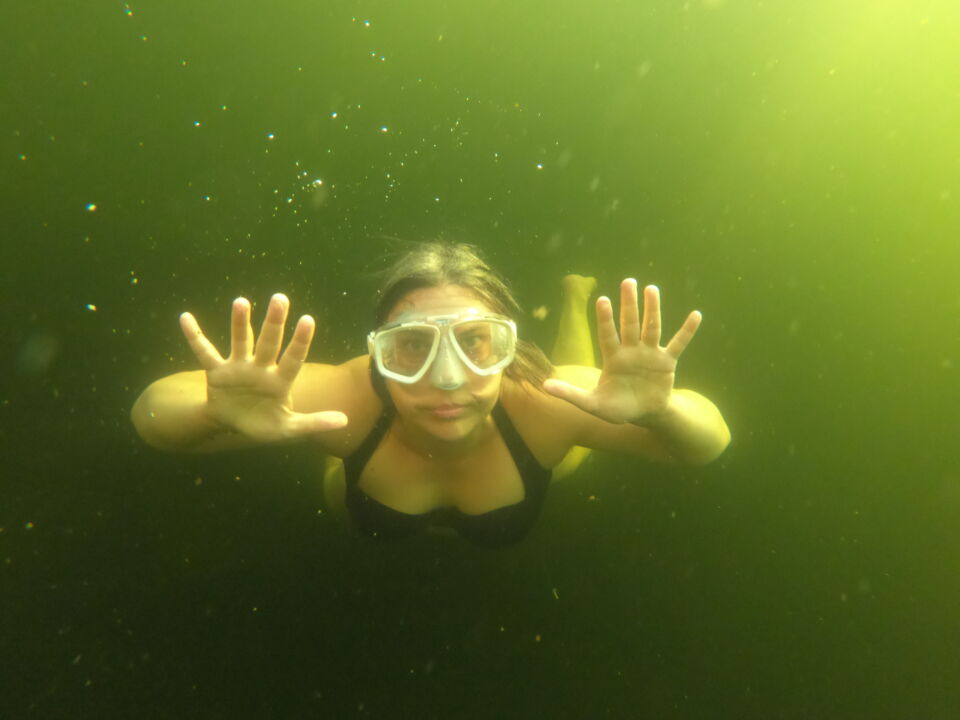
I also like the title “April and I Take the Underwater Camera Swimming On the Last Weekend of Summer” as it brings April, the illustrator, into the action of the poem. April was so much more than an illustrator for this book. They are a creative collaborator and a friend, and they were present in many of the swimming scenes I’m writing about. It felt fitting to invoke our swimming adventures in that last poem of the book, especially given that this was how we took the author/illustrator photos of each other at the end of the book.
VS: Could you tell us more about your collaboration with visual artist April White—how did partnering on this project, and the friendship that developed, change the contours of your collection? Relatedly, how do you enact kinship in the realm of poetry and poetics?
Many of the ideas in the book began as conversations in local rivers and ponds, and we spent countless hours using go-pros to shoot underwater footage of each other swimming, diving, and floating.
AS: Collaborating with April has been one of the great joys of this project. I met April at the opening of their show at The Rooms (our provincial art gallery) and fell in love with their work. I took home the flyer from their show—it was a watercolour painting of their breakfast table with a carton of milk and what looked like a package of Peak Freen cookies—and put it on my fridge. I kept thinking that it would be amazing to ask someone to paint watercolour portraits of the garbage I’d collected to share alongside the poems.
It took me six months or so to realize that I already knew the perfect artist, and to work up the courage to ask them if they’d be interested. I wrote up a grant to commission six illustrations for a Garbage Poems website where people could hover over any word in a poem and see which piece of garbage it came from, and even try making their own garbage poems. One grant led to another, and several years later we had funding for April to illustrate what had become a book-length project.
What started as an art crush became commission, became collaboration, became friendship. We’re both big fans of swimming, and at some point we started to refer to swimming as "doing research." It began as a joke, but there was more truth to it than we realized at first. Many of the ideas in the book began as conversations in local rivers and ponds, and we spent countless hours using go-pros to shoot underwater footage of each other swimming, diving, and floating. We did a two-week residency together on a small off-grid island where we had to canoe to town to get our groceries, and otherwise spent our time swimming, talking about swimming, and making art about swimming.
I realize this is not the way authors and illustrators usually work together. It took a long time to find a publisher who was willing to invest in printing this book in colour, and for a while we didn’t know if it would happen at all (given the absurd financial logic of the endeavour). I’m so grateful to Brick Books for agreeing that the illustrations and colour printing were a core part of the project, and for making it happen. These images reflect so much of the joy and creative connection that went into this project, and it’s so gratifying to see a visual record of that in the pages of the book.
It’s also been such a delight to get to launch the book into the world with April! Our first launch was here in St. John’s at the Leyton Gallery, who represents April’s work locally, and we were able to do a reading combined with mounting a show of the original artwork for the book. The gallery even pulled out some of their earlier paintings from storage, including the breakfast table scene from the Room’s show that had lived on my fridge for so many years.
VS: The alignment between your practices permeates the collection. I am also struck by the syntax in your collection. For instance, the sentence structure in this excerpt is remarkable.
“voice, n. How, even after, or in the face of? While witnessing? When each year worse, more frequent, increasingly unpredictable? When, with impunity? In an ongoing? During an escalation of? How, when every day?”
How does omitting words drive the pacing, and is it meant to evoke the way chronic illness alters our relationship to time?
AS: Each of these fragments brings something very specific to my mind (I can’t hear “escalation of” without thinking genocide). I’m assuming my readers can get from “worse, more frequent, increasingly unpredictable” to climate crisis without me having to spell it out, though this isn’t a strategy I’d tolerate in a government press release. But here, leaving out the central topic of each clause opened up different possible layers of meaning. I wanted the language to convey a visceral sense of the urgency, the escalation, the sense of panic, rage, and powerlessness. But I also wanted the lines to gesture at the recurring structures of violence and injustice that have existed for much longer than I’ve been alive (as has the art made in the face of those injustices).
Sometimes words like genocide and climate crisis and colonial violence feel inadequate to talk about the things they name. Sometimes naming atrocities gets sidelined by turning it into a debate about terminology instead of a conversation about actual atrocities and how to stop them. I believe in being precise, especially in government statements and other official communications—it’s not conflict, it’s illegal occupation and ethnic cleansing and genocide. But when I focus on that precision in poetry, it can sometimes have the unintended effect of creating an affect that is dissociated from the content. The fragmented syntax somehow helped bring the writing back to the body, to the act of speaking, of trying to speak, of attempting and falling short.
I think you’re right that there is a lot of unusual syntax throughout the book, especially in the poetry sections. When I started this project, I was just returning to poetry five years after a head injury. I had a lot of trouble with short-term memory and word recall. Basic parts of speech would suddenly go missing in the middle of a sentence. I couldn’t always access my voice fluently, and sometimes I couldn’t access it at all. Working with an external constraint allowed me to explore a parallel version of this experience without going through it every time I sat down to write. I got to play with the experience of not having access to the right words, based on an arbitrary external limitation, instead of feeling anxious about the state of my brain.
I love when meanings sneak into a text uninvited, unconsciously, or in collaboration with readers. Writing may often be a solitary act, but meaning making is not.
Part of what I love about constraint-based poetry is that it injects a certain measure of strangeness into the diction and syntax. Working with constraints helped me understand that fluency and meaning are not always correlated, that a focus on fluency at all costs can become a kind of masking, a replication of the familiar for the purpose of hiding how much effort the task requires, and that hiding that effort and ever-possible failure of language can end up working against the aims of poetry.
One of the few things I regret about this book is that I think I inadvertently smoothed over much of the strangeness and linguistic struggle in these poems in my efforts to “succeed” at the challenge I’d set for myself. If I had it to over again, I’d try to use larger intact chunks of the original text and leave more rough edges visible in the poems.
I didn’t intentionally set out to write about how chronic illness can alter relationships with time, but I’m delighted that you’ve found that in the text. It’s certainly been my experience. I love when meanings sneak into a text uninvited, unconsciously, or in collaboration with readers. Writing may often be a solitary act, but meaning making is not.
VS: Before I ask a final question, I want to congratulate you on being a finalist for a 2026 Lambda Literary Award, and for making the longlist for both the Pat Lowther Memorial Award and the Raymond Souster Award!
AS: Thank you! Like many writers, I find prize culture complicated, but I’m not immune to the thrill of being recognized by these awards, especially when I think about how many stunning books of poetry were published last year.
VS: On the subject of openings, can you tell us what you are working on and what you want to immerse yourself in these days?
AS: Right now, I’ve been diving back into revisions on my MFA thesis project, a poetry manuscript that explores Jewish inheritance through an anti-Zionist lens. The project looks at how Jewish intergenerational trauma and Jewish safety have been weaponized to justify the ongoing genocide of the Palestinian people. But the poems are also interested in the embodied rituals that have been passed down through the same lineages as that trauma and ask how these practices can be resources for healing, solidarity, resistance, and the work of collective liberation.
I’m excited to learn more about Jewish anti-Zionist history, not just the Jewish Labour Bund but also radical traditions from other Jewish lineages (like Ladino and Arab/Mizrahi Jews) since Jewish history is so much more than Ashkenazi history. I’m spending time with my collection of tarot decks because there’s a series of poems in the new manuscript that take symbolic objects from various sources, including family stories, and describes them as tarot cards.
Beyond writing, I want to immerse myself in water—in oceans, ponds, rivers, and hot tubs. I want to make things with my hands and spend time being creative in ways that don’t revolve around language. I want to spend time in places where I feel wonder. I want to build community with people who believe no one is free unless everyone is free, and to keep working toward a more just and liberated world.
