

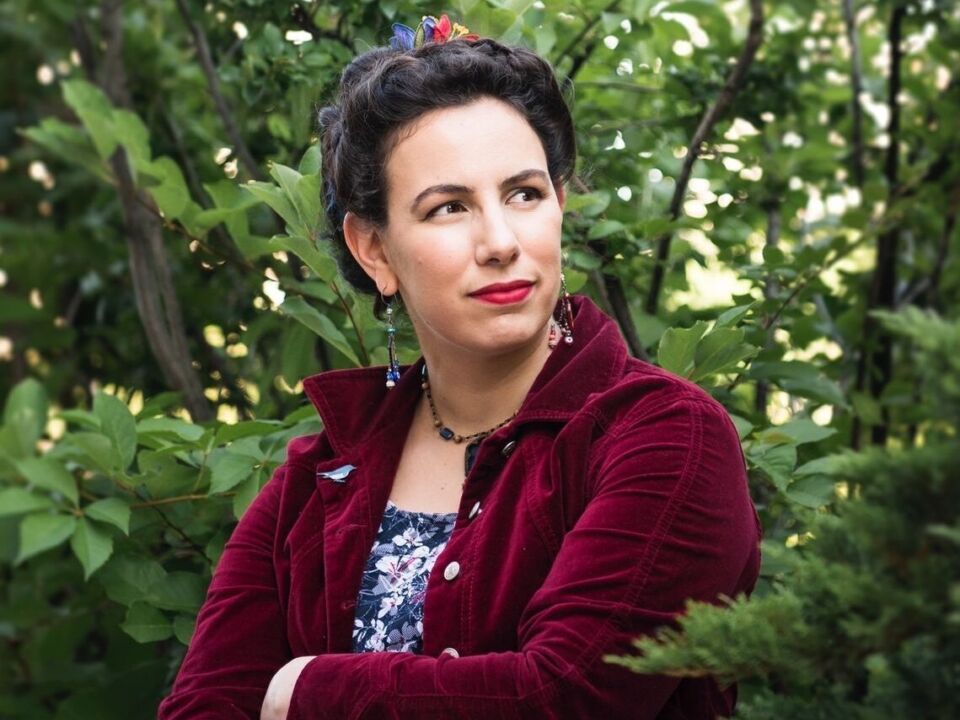
On Fantasy and Fascination: A Conversation with Amal El-Mohtar
When Amal agrees to an interview with me about Seasons of Glass and Iron, it is September 2025, and we are sitting outside at the Banff Centre for the Arts, in the shade of a trembling aspen tree, which is full of little birds of grey and yellow colouring that chirp up as we speak, offering their own insightful contributions. The air is cool and the sun is bright, and in all the buildings around us people are writing, and making art. This seems to me, the most natural setting in the world for Amal’s newest collection, Seasons of Glass and Iron, which collects over a decade of the author's short fiction, showcasing stories full of lush worlds populated by interesting women finding one another, and magic seeping into everything.
When we sit down to do the interview, it is February 2026, and we are meeting over Zoom. The air is blisteringly cold, and the sky (over me, at least) is overcast. There are no trees in the little den of my apartment, no happy little yellow birds, no bright clear sun. Yet, when we speak, Amal is just as vibrant, just as excited, just as open and engaged and welcoming in the dark of February as she is in the light of September. This warmth and vibrance has shone through all of her fiction, as I believe it shines through in what follows—as our conversation winds through elements of genre, family history, language, and the book itself.
Ben Berman Ghan: One of the first questions that I had about Seasons of Glass and Iron is right from your introduction—which I enjoyed for its footnotes—where you took a little space to say, this is a collection of stories across 15 years, and 15 years is a very long time to be generous toward, in thinking deeply and critically about writing one has done across such a big period of time. But it’s so interesting seeing this body of your work this way. A lot of these stories were written before This is How You Lose the Time War, which you co-wrote with Max Gladstone, which I think a lot of readers understood as science fiction, while the bulk of your work reads as fantasy, and the in-between places of speculative fiction. I was wondering about your approach to genre, and how you first entered these spaces of reading and thinking about genre fiction as a reader.
Amal El-Mohtar: There's always a moment while talking about genre where I decide how much of a jerk I wanna sound like, you know? Because the issue is I have a very earnest and sincere answer, but I always worry it comes across as obnoxious.
Ben Berman Ghan: I would like you to really go for it!
Our broad definition of magic is the exertion of your will on the material reality of the world, right? That is identical to telling a story.
Amal El-Mohtar: The thing about genre is that I maintain—and I'm on record saying this in multiple places—that all fiction is fantasy first, and everything else, including domestic realism, is a subgenre of fantasy. I mean multiple things by this: one is lineage, one is just looking at the breadth and depth of literature. Realist literature is a very recent invention, and the vast majority of our committing imagination to text, of our writing, is fantastical. It is of the “more than lived, the more than perceived.” Surreal is insufficient, like, I wanna say, sur-empirical, you know, it is, it is more than.
The boundaries of what was considered real used to be very different, right? I mean, cosmology and what you could know to be true were for a very long period of time the same: there are monsters on the edges of maps, there are spirits in the air.
That was the case up until very recently. Think of your bog-standard Victorian experiencing radio for the first time, there was a very natural overlap with, well perhaps we are hearing the spirits of the dead, and there was a lot of interest in such technologies from a spiritual perspective. There's just so much in our world and in our inheritance that is fantastical, that the overwhelming enormity of literature has been more what we broadly consider to be fantasy today.
In addition to that, when you tell a story, whether that story is about the mundane experience of your day or about a dragon, you are engaged in an act that is structurally identical to our definition of magic. When I am choosing to create a narrative out of something I observed, that is an imposition of my will and my perception on reality. I’ve taken that reality, and broken it into something that I can give to you, that you haven't experienced. Our broad definition of magic is the exertion of your will on the material reality of the world, right? That is identical to telling a story.
So when you know this—about what telling a story is, what building a narrative is, what curating order out of chaos in the world is—and you reduce all of that incredible potential and power to only be in service of reproducing the world as it is, instead of conveying a greater truth that you can derive or build from it, I think it’s just a missed opportunity. When you have all of this power at your disposal, why not have the crow talk? Why not have a dragon? Why not do all of those other things?
I often come back to this T.S. Eliot quote that I always deliberately break—you've heard me say before, Ben! If poetry breaks or dislocates language into meaning, then I think that fantasy breaks or dislocates reality into truth. I say this not to denigrate realist literature in any way, it is more to give fantasy literature its laurels. I want people to see fantasy literature as something capacious and enormous and generative and powerful, and not like a weird choice that I'm making to indulge in something niche.
All things are fantasy. And if we could just start from there, I think a lot of questions about genre could just become a lot more interesting and fruitful. I had huge anxieties that I had to overcome about writing science fiction. The language of myth and folklore and fairytale and fantasy is something I feel very fluent in, like a native language. But the languages of math and science are very much not. I had a chip on my shoulder about my STEM literacy essentially—this idea that you can’t write science fiction unless you’ve read it all, or you have an engineering degree, or understand orbital mechanics in a way that won’t make Neil DeGrasse Tyson yell at you on the Internet or something. The first science fiction story that I wrote was “The Lonely Sea in the Sky,” which is in the collection!
Really, I still think of myself as a fantasy writer. I feel like science fiction as a term is useful in different contexts. And to me, taxonomy is one of the least interesting ways of deploying it.
BBG: I think of that line in “The Lonely Sky in the Sea,” where the protagonist declares fairytales have become their scripture, as something that runs all throughout the collection. But I actually wanted to move from genre for a moment to form.
All of the poems in this collection are presented to us twice, once in English and once in Arabic, which are translations by your father. Could you talk a little about that process of translation, and what it was like writing—in a sense—with your dad across languages, and how that flourished in the book?
AEM: The first poem of mine that my dad translated to Arabic was “Song for an Ancient City,” and he did it as a complete surprise. We were sitting at the dining room table and he said, “I’d like to read you something in Arabic and I want to know how much of it you understand.” This is something he does frequently, because he will often find a verse or a song that he wants to share with me.
He started reading out this poem, and I was like, wait a second! I was really dazzled and moved and weepy. It was this beautiful act of building a bridge between my diasporic condition and everything that he had to give. There's always so much pain to navigate with what you inherit from your parents across the rupture of war and displacement. Because from my parents' side, they are struggling with what to give us that isn't their trauma. They want us to have a connection to our culture and language and lineage while the sources of those things are under attack and bombardment and conditions that forced them to leave. There is a very narrow and difficult path to walk between receiving that, and also being given the tools to thrive in the new environment.
I was born in Ottawa and grew up in Aylmer, but the only language I spoke until I was maybe two years old was Arabic. But I don't remember thinking in Arabic. English just seeps in through everything like water through cracks, and French was a language that I was going to school in. Arabic got outstripped by those. My dad translating the poem was both a gift to me to show me what was possible, but it was also a gift to see my words about this place that had moved me and connected me, absorbed into Arabic. So there was just this blending that I loved and appreciated.
There wasn't a great deal of collaboration initially, because both of these poems were translated in 2023. But for the collection he called me and wanted to revise his translations. He had surprised me with the initial ones, and now, he wanted to go over it with me and make sure it was matching my intention in some ways. So we had this deeply beautiful conversation—I was wandering around in my garden while we were on this call, while he was reading to me from his computer. He’d be choosing between one word or another, and he'd say, “This word has more of this resonance, and this one has more of this.” And I could say, well, what I mean with this is more this other thing. So we were collaborative for this collection in a way that we hadn't initially been.
What was especially beautiful to me about it was that as we were having this experience, he paused at some point and said, “You know, this is reminding me of when my father was alive that we would sometimes be in the same space, both of us writing, and then peer over at each other's stuff and read it and offer commentary.”
My grandfather was a poet. This experience just felt like a degree of being in my family lineage, that I felt like I hadn't previously really made contact with. That my dad specifically could have the experience with me, that he'd had with his own father, was very moving.
BBG: That's beautiful. I do think there is also a connection there, as you talk about connecting memories and continuity in life. Memories, or misremembering, is one of the things I found was threaded so beautifully throughout the collection, something connecting many of the stories throughout. I can’t imagine what that would be like, to revisit one’s work across such a vast span of time, which can give a pretty interesting perspective on preoccupations on your work you didn’t know were there. I was wondering what revelations that gave you—what the Amal on the page gave to you, as Amal the reader?
I was in a thoroughly different time of life when I was writing many of these stories, and in many ways I was jaded and frustrated and heartbroken. I’ve had 20 more years of living, and it’s good to feel there has been some deep and abiding truth that hasn’t changed in me.
AEM: Something that I expected going into it, but was nevertheless startled by in collecting the stories was how many of them are about pairs of women talking to each other. There is an affect to the way that women are with each other in the stories that I was startled and moved to find. So vivid and continuous, just a really unbroken line of remembering, loving not only the friends who occasioned a lot of the stories or who are in them in various ways, or for whom they are written—but an orientation almost toward the possibilities of women loving each other, or women being dazzled by each other.
It was good to see for a lot of reasons. Partly as the world continues to darken. I was in a thoroughly different time of life when I was writing many of these stories, and in many ways I was jaded and frustrated and heartbroken. I’ve had 20 more years of living, and it’s good to feel there has been some deep and abiding truth that hasn’t changed in me.
With compulsory heterosexuality there’s this pressure to think about your future husband or whatever, and I spent much more intense, imaginative time longing for two very different roles: a female best friend and a mentor. A woman who was my ride or die, and a woman who would teach me how to be in the world of art and beauty and creation. These were fears that needed to be filled for me to be the person who I was, and in a windy way, the person I longed to be was going to be shaped by those things.
BBG: Like, I don't really think there's any semblance of writers talking about writers writing in this book, but writers talking about reading, which is something that enthralls me throughout the collection. So, I thought I would ask just a little bit like, how did you come to being like a reader through, you know, family and childhood? Where did that love take root for you? Where did the love of these sort of fantasies and scriptures start?
AEM: I learned to read quite young. My parents have told me that before I could read, I would memorize the bedtime stories that they read to me. If my dad was tired or something and just wanted to skip ahead or paraphrase the story, I wouldn't let him.
The love of reading is so foundational to me. It was absolutely my favourite thing to do. Rivalled only by swimming. I think that when I'm writing fantasy, a lot of the time what I'm trying to do is bring up or speak to what it feels like to read and how beautiful and sacred a thing that is. And as I've grown older, I've only felt more deeply and with more wonder and awe. How extraordinary a thing it is that we can read, and that we can write things that will be read. And in my lifetime, we are seeing the most disgusting desecration of that with LLMs and generative AI, it makes me feel like I am being called to battle essentially, against something that is genuinely evil, and that I am going to have to write about in a very fulsome and cathartic way I think.
BBG: There’s a line from China Miéville’s The Last Days of New Paris that describes us against the machines: “The poets and artists and philosophers, resistance activists, secret scouts and troublemakers, had become, as they must, soldiers.”
And what is it about reading and swimming, as fascinations? Is it that we can’t take books into the pool? Underwater is the place we cannot read?
AEM: I truly think that is part of it. I could probably listen to an audiobook while swimming, but I wouldn't want to, even though listening to a podcast or an audiobook while I'm walking happens all the time. I actually think possibly the existence of those technologies has taken something from me. I used to be very aware that when I went on a walk, my mind became kaleidoscopic.
When I go birding, it’s a very different somatic orientation. It’s very outward as opposed to inward—I’m not walking quickly, I’m just standing in places, waiting for birds, and being enchanted by them.
BBG: When I think of you, I always think of you birding. I remember back in September, we were sitting outside and you were in the middle of a sentence and then you said, what kind of bird is that? And we had to get up and look.
AEM: It was a yellow-rumped warbler.
BBG: I'm glad we got to this note because I would've been crazy to talk about this book for an hour and not get the trifecta: Amal loves women, Amal loves reading, Amal loves birds.
