

MicroLit Review: Distributaries by Laura K. McRae
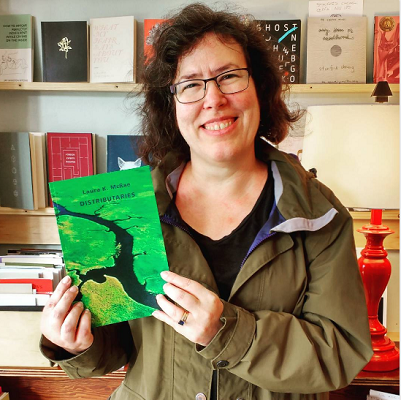 Laura K. McRae and her debut chapbook, Distributaries“Distributary: A branch of river that breaks off and flows away from the main stream.” So reads the epigraph to Laura K. McRae’s debut chapbook, Distributaries. The cover bears a photo showing a section of the Liao River in North East China, while the end matter presents a sketch of the Po River Delta in Italy. Both images illustrate the geological phenomenon that lends its name to the collection. The idea of a “distributary” also informs the chapbook’s structure: a long poem in 31 connected parts, numbered ii-xxxii (the first part is left out, without explanation), Distributaries follows a fractured stream of consciousness in the voice of one unnamed speaker.If there is a “main stream” to be spoken of in the poem, it is the memory of a car accident that took place in the speaker’s childhood. The poem commences with a snapshot of this event, related not only in medias res, but also in mediam sententiam:
and the headlampsgleam,touch the streaked windshield,soothe that crack--from my four-year-oldhead--an incisionpoorly stitched and improperlyhealed.The “distributaries” that move away from this memory are images and reflections that relate to it in both literal and abstract ways: literal because the poem follows a coherent, if circuitous, line of thought, and abstract because of the emerging motifs that harken back to this moment of bodily and psychological trauma, namely movement, fracture, speed, and water. In this way, for example, the reader remembers the accident that occurred in the speaker’s childhood upon encountering the description of another evening car ride:
In our white Toyota,no air, no radiowheels a furred disc,we crossed the desert at twilightstarscracked ice in the breathlessair […]The adjective “cracked” in particular echoes the original crack in the speaker’s head. Similarly, in another piece the sight of a skull recalls the same image:
A skull lies beside the roada Georgia O’Keefethe colour of the concrete slabwhere the laughhouse once stood,round, littered with desiccated fruit,the colour of the calla liliesin that Diego Rivera nude.These additional anecdotes can read almost like false starts, sharing one aspect of the initial “stream” but immediately departing in their own directions, mirroring the ephemeral nature of memories.McRae’s attention to the formal aspects of poetry is evident. Distributaries can be read as a study in hypotyposis, vivid description, and McRae has an ear for rhythm and a predilection for rich language. Elsewhere an accumulation of subtle rhymes and half-rhymes punctuates a family anecdote:
They lost track of his parents, moweddown those wood crosses. My father sayshe remembers themthough he could notread the names. There’s a spacebeside my mother, spaceon her stone for Father’s name.And the raw lines of textwill round will softenwith the years in the green-mottledOregon rain. In the far northof Scotland, rain does not glow that strangeperidot-veined jade.This careful exploration of sound—“name,” “name,” “rain,” “strange,” “jade”—delights the ear, and contributes to the haunting effect of the speaker’s meditation on her family’s tombstones.Though Distributaries starts with a defined moment in the speaker’s life, it resists a straightforward narrative. Instead it represents an almost dreamlike state, where the speaker passes from one reflection to another, connecting memories to images to literary and artistic references—from The Italian Job to Georgia O’Keeffe to Van Gogh to John Travolta. Similarly, the speaker alludes to travels in locations as varied as China, Oregon, Scotland, and the Mediterranean, each place evoked only briefly, fleetingly, in a process that resembles free association.
If there is a 'main stream' to be spoken of in the poem, it is the memory of a car accident that took place in the speaker’s childhood.The poem’s syntax and punctuation also suggest this approach to poetic composition: enjambment takes place not only over lines but over the poem’s parts, and McRae’s frequent use of dashes further emphasizes the sense of fragmented urgency.At one point in the chapbook, around part xxii, the speaker abandons the use of first-person pronouns, adopting more systematically the second-person “you.” The change is subtle, but serves to deepen the reader’s immersive experience navigating the meandering streams of the speaker’s recollections. Distributaries can be seen as imitating memory itself in the way it highlights at once the immediacy and the transience of lived experience, and in the way that it suggests the parts of our memories that remain obscured, just slightly out of reach.Annick MacAskill lives and writes in Kitchener. Her poems have appeared in journals including Room Magazine, The Puritan, The Fiddlehead, Arc Poetry Magazine, and Lemon Hound. Her work has also been nominated for a Pushcart Prize and longlisted for the CBC's Canada Writes Poetry Prize. She is the author of Brotherly Love: Poems of Sappho and Charaxos (Frog Hollow Press, 2016). MicroLit Reviews is an ongoing series on The Town Crier. We’re looking for 400-600 word reviews of micro press books, chapbooks, broadsides, zines, visual poetry, digital literature projects, and everything else weird and wonderful being made in literary communities across North America. Please send all submissions or pitches to [email protected] with the subject heading: MicroLit Reviews Submission.
