

Pillow: An Interview with Andrew Battershill
 Andrew Battershill writes and teaches in Columbus, OhioAndrew Battershill’s first book, Pillow, was released by Coach House Books in October 2015. Puritan publicity agent Dana Ewachow interviewed him about the book, working with Coach House, and his writing process.Dana Ewachow: First things first: why the name Pillow?Andrew Battershill: I submitted my manuscript to Coach House under the title You Feel Me? and changing that title was the only non-negotiable edit Alana gave me. One of the first things said in our initial discussion was, “That title is not the title.”Do you ever have that thing where you first meet someone and you feel this weird, deep pull toward them, and then you get involved with them and realize that what drew you in instinctively wasn’t so much attraction as it was the deep, primordial desire we all have for death and pain and nothingness? Well, I think that’s how it is with me and titles. In the end, Alana and I went back and forth about the title for a while, and I think Pillow was actually her suggestion. Basically, we settled on that one in the spirit of asking what the book was actually about, and I think, ultimately, this is book is about Pillow. I think titling it as we did put the focus on him as a character in a way that I like. Also, there’s no question mark at the end, and there’s no conditional phrases in it.As for the name of the character, that’s a much shorter answer, it was his boxing nickname: “Pillow Fist Pete.” He goes by Pillow because it’s cooler.Dana Ewachow: Pillow’s thought process is very unique. He lends importance to things that appear random or unimportant to the average person, while dismissing/ignoring events going on around him. Is this because he’s taken too many blows to the head, or is there more to his perspective?Andrew Battershill: With Pillow I wanted to walk a line between him being definitely a little brain damaged, but also just maybe a weird guy who has led a very unique life. People, and by extension characters, are, at least in part, sums of their experiences. In Pillow’s case some of that is literal, and some of it is more indeterminate. As a former boxing star, Pillow is a uniquely experienced person, which is to say that he’s very experienced in some extremely sketchy aspects of life that a lot of people never even have to deal with, and he has almost no experience with a lot of everyday ideas and situations. Basically, Pillow is someone who put all of his emotional, physical, and intellectual energy into one pursuit, and then that pursuit damaged him so badly that he had to stop doing it quite early in life. So, what I wanted to get at with his thought process is the idea that he started thinking about a lot of things later in life, after he’d already had and lost everything he wanted.Dana Ewachow: Pillow is obsessed with animals. He abstains from eating animal products. He shoehorns animal facts into conversations. He clearly believes animals deserve respect and admiration. Seeing as he has violent and complicated relationships with the people around him, are animals his exception? Does it show that even as a criminal he has a kind of moral compass?Andrew Battershill: I think everyone has a moral compass, and Pillow especially has a strong one, but he's (partly out of necessity and partly by choice) been surrounded by a lot of magnets. In terms of Pillow’s relationship with animals, I wanted it to highlight, in a stylized way, a thing that is inherent to everybody as they act and empathize their way through the world. Assuming one has the ability to empathize with other people, we tend to do that in an uneven way, sometimes empathizing very deeply (especially with people or animals we like or think are fun or cute) and other times maybe accidentally forgetting to empathize at all. Obviously the perspective we’re most understanding of is our own. I wanted to use Pillow’s thinking as a kind of example of that process.Dana Ewachow: The violence in the novel is usually brutal and sudden. Is this to keep the reader on their toes, or was this a presentation of Pillow's view of the world?Andrew Battershill: I consume a lot of crime fiction and boxing and as a result, I take in a lot of violent media. So, the stylization of violence for entertainment is something I’ve thought a lot about and something I try to do in an ethical way (assuming that there are any actual ethical stakes to writing a small-press novel in Canada, but let’s bracket that).Basically, the thing I wanted to avoid was sanitized PG-13 violence; the kind of stuff where “bad guys” get punched once and fall down unconscious for several hours but somehow aren’t dead. That’s a really lame and aesthetically weak way to treat what is a constant pernicious force in the world, and something that affects people a great deal and usually incredibly negatively.What actually happens when you punch someone in the head is way, way more complicated, sad, and interesting than falling down and getting up, unhurt, a convenient amount of time later. First off, they will rarely fall down, and you’ll have to deal with what they want to do now that you’ve punched them and they haven’t fallen down. Also, you might break your hand, because punching someone with a bare hand is a very stupid and dangerous thing to do for all parties involved. People have so little control of their environment that if you punch someone you’re only slightly more likely to hurt your hand and not damage the person you hit in the slightest as you are to accidentally kill them. And, even after whatever immediate effects there are, you have the fact that if someone gets punched in the head too many times, or just hits their head or bounces too many soccer balls off of it too often over the course of their life, they’ll seem fine for a long time and actually end up having a trauma-induced degenerative brain disorder. If you’ve ever punched them, you’ll have a small slice of ethical responsibility in that. So, what I’m saying is that if you’re going to write about someone getting punched in the head you should treat it as the complicated thing it is, and that’ll be both more aesthetically compelling and more ethically defensible than indulging in sanitized fantasy violence. Ultimately, I figured that if I was going to write a novel that in some way traded in violence, that it should do so in a way that presented violence as, y’know, a bad and complicated and scary thing.
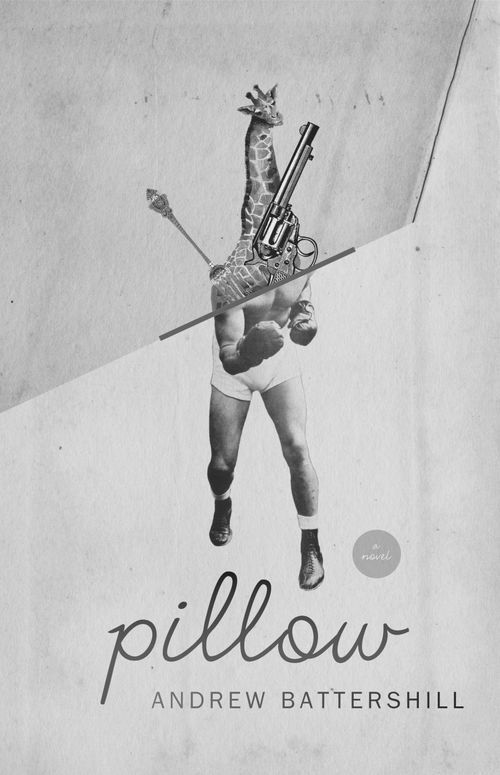 Andrew Battershill released his first book, Pillow, with Coach House this yearDana Ewachow: The characters Pillow and Emily are in a relationship, though not a traditional one. Emily tends to ruin moments of intimacy or romance between them on purpose. Was this just in her nature, or was this a way of avoiding a conventional romantic subplot?Andrew Battershill: I think that’s a combination of things. On the one hand, that’s just a part of the character I had in mind. On the other hand, I think it’s also a product of the structure of the book. The romantic moments are, until quite late in the book, separated from the rest of the plot and events, and therefore episodic, and a lot of those ruining moments are spots that I thought were good to end chapters on. But, yeah, a lot of it is just Emily being kind of into anti-climax as a mode of humour.
Andrew Battershill Writes and Reads “Fun”
Dana Ewachow: As a writer, did you find yourself working against certain habits? Clichés? Andrew Battershill: I think that when I was younger I’d have had a lot more to say about this. When you’re first starting out I think it’s important to take in all kinds of stuff, and decide what you do and don’t want to write about, and that’s not a process that can be totally positive. It takes a lot of deciding what you don’t want to do (or, in my case, can’t do well, like writing short stories) to find what you do want to do and have talent for. I guess the one big thing that process did for me was to privilege the idea of fun. At a certain point after reading and being bummed out by a lot of self-serious literary novels, I realized that I read for entertainment, and I didn’t want to produce anything that wasn’t, in some way (and my definition for this is pretty wide), at some point, actively fun for a reader to consume.That being said, at this point I’m trying to focus mostly on what I think is good, and what I want to do in a positive way, rather than negatively defining against clichés, if that makes sense. I try to keep an eye on my own habits to make sure I’m not getting too boring and lazy, but if I run into clichés or bad habits in a book I’m reading, I’ll either be invested enough in the book overall to ignore them, or if I’m too annoyed, I’ll just stop reading. While it’s necessary to think about what you don’t like and why you don’t like it, I think it’s also intoxicatingly easy to get caught up in critical thinking, and the process of easily and smoothly articulating how something is failing. Pretty quickly it becomes counter-productive to creative work. Especially now that I’m working full-time and having to carve out time to write, I’m trying to just have fun and do my own thing when I write.Dana Ewachow: What are you reading at the moment? What is grabbing your interest currently?Andrew Battershill: I’m currently reading Natsuo Kirino’s Real World, which is a creepy, atmospheric thriller about four teenage Japanese girls who get embroiled in some murder intrigue.I’ve got two Canadian poetry books that I’m picking off poems from and they’re both great and funny and interesting: Laura Clarke’s Decline of the Animal Kingdom and James Lindsay’s Our Inland Sea. Canadian poetry is really, really good right now, and young, interesting writers are doing unique and wonderful things. Also, there’s this collection by some dude named Suzannah Showler called Failure to Thrive that everybody (including people who aren’t married to her) should read because it contains beautiful, thoughtful, sensitive poems.The last novel I was really all-in on was Miranda July’s The First Bad Man, which is just the strangest, most compelling, and best book I’ve read this year. That’s the one I’d recommend to people, mostly because I think Miranda July is the real, real, real, real deal, and I’m having a blast following along with her artistic career and reading and watching everything she does as it comes out. Watch all her movies, read all her books, and listen to a bunch of Rihanna—you won’t regret any of it.Andrew Battershill is a writer and teacher currently living in Columbus, Ohio. A graduate of the University of Toronto’s MA in creative writing program, he was the fiction editor and co-founder of Dragnet Magazine.