

Mary Costello on Alice Munro
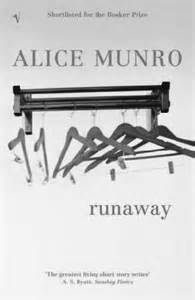 Runaway by Alice Munro
Introduced by Aoife Walsh.There’s not a single person working in literature or letters in Ireland today who will not answer “Alice Munro” if you ask them, “Who do you think is the greatest living Canadian writer, my dear?” Our small country welcomed the master storyteller into its bosom a long time ago. This series on Irish literature is no different; over the coming weeks, you’ll hear her name lovingly crooned by many of our contributors.
Of all the aspects of Munro’s work, it was the interior lives of young, middle-aged, and old women that have affected me the greatest as a reader. Maybe because I was an adolescent when I first encountered her old women—falling in and out of love again, choosing a sweater to wear, cleaning a mark off a kitchen floor, letting their children go—I was forced to finally grant my own mother and my own grandmothers similarly laden moments. Alice Munro showed me the private lives of women of all ages, lives I have imagined for myself ever since. My readings were done with an eye on my own future (I was a teenager; everything was about me) so that deep down I believed, “When I grow up, life will be like Alice Munro stories; all of them, all of the time.”
Alice Munro’s stories are perfectly paced. With their heightened sense of foreboding, their devastating secrets, and sheer ordinariness, they are as childhood tales to me; they are places I go in my mind to find comfort. But they make no mark on this life as I know it, just now. Perhaps that is a good thing; I must still be a way off any kind of narrative.
So when Mary Costello published her debut collection of short stories, The China Factory, in 2012, there were several reasons why it was a publishing event for me personally and for Irish literature generally. Ms. Costello had worked on this collection for nigh on ten years and now she was publishing it with The Stinging Fly Press, a latter-day imprimatur of the contemporary Irish short story. (The Press’s lean, keen backlist of books also includes debuts by Kevin Barry, Colin Barrett, and Claire-Louise Bennett, a mid-career collection by Michael J. Farrell, the Davy Byrnes Short Story Award anthologies for 2009 and 2014, as well as several other anthologies edited by Philip O’Ceallaigh, Declan Meade, and Fighting Words.) Along with her own story of a long road to publication, which itself implied patience, care, a searing intellect, and a devotion to the short form, came whisperings of her writing’s kinship to that of Alice Munro. In her review for The Guardian, Anne Enright said:
This is a writer unafraid of the graveside, or the bedside, of filling the space of the story to the brim. Large events happen in small lives—people die, for a start, they fall in and out of love, they have children and affairs. The slow leaking of love out of a relationship is described in particular and terrible banality, as Costello's characters move about their ordinary rooms. There is a kind of immaculate suburban sadness in many of these tales ... It is the accumulation of tiny pleasures ... that makes The China Factory such a satisfying and accomplished debut.Ms. Enright’s mention of Munro later in this review marked similar tools for plot momentum: “Like Alice Munro, Costello is not afraid of a good car accident, a cancer diagnosis, the arrival on the scene of a roaring madman.” But it doesn’t matter; the Booker prize-winner and Fiction Laureate had uttered Munro’s name and the effect was to be lasting. Later, Mary Costello’s writing was compared to John McGahern’s, William Trevor’s and James Joyce’s in Dubliners. I’d add to that list another excellent, slow, and exacting Irish writer who is a master in restraint: Claire Keegan.
Now then, in Mary Costello, there was an Irish Alice Munro, someone I can read and understand as an adult but cradle and cherish in the same, adolescent way. Because of the west “country cadence” of her sentences and the washed out greyness of her sets, Mary Costello’s stories can never be mistaken for anything other than great Irish stories. It is for all of this that The China Factory is an important addition to any list of 21st century story collections and why it made sense to invite Mary Costello to speak about one of Alice Munro characters at the outset of this series on Irish literature. Juliet, one of Mary’s favourite literary heroines, is from the stories “Chance,” “Soon,” and “Silence.”
Mary Costello on Alice Munro
 Mary Costello, author of The China Factory
Photograph © Martina KenjiMy favourite literary heroines reside in the 20th century and don’t look much like heroines at all. There’s Ruthie and Sylvie in Marilynne Robinson’s Housekeeping, and Lila and Doll in her latest novel, Lila. These girls and women are transients, migrant workers, in whose wandering souls Robinson reveals the intrinsic value of human beings. At the other end of the heroine spectrum is JM Coetzee’s Elizabeth Costello, a tired old novelist in possession of an extreme sensitivity to the suffering of all beings, which causes her to speak her mind and say the unsayable. With this character, there’s no escape from the self, no shirking of awkward truths.
And then there’s Juliet. It is 1965 and Juliet is 21 when we encounter her in “Chance”, the first of Alice’s Munro’s three linked stories from her collection Runaway. A Classics student, Juliet is tall, socially awkward, with little experience of men. In the town where she grew up, “her sort of intelligence was often put in the same category as a limp or an extra thumb.” Her professors are delighted with her giftedness and her love of the Greeks, but there is the question of what will become of her. The problem was she was a girl, and if she did not marry she would become “bleak and isolated.”
Juliet meets a man on a train and six months later she travels out of Vancouver and arrives, uninvited, at his home near Whale Bay. Eric is not at home but she waits in his house overnight, full of dread and shame. “You’re here,” he says when he arrives the next morning. She is aware of the complications of a relationship with Eric, but she stays, because, “there will never be another chance so momentous in her life.”
In her life Juliet protests almost nothing. Outwardly she is calm, measured, rational, but inwardly she is full of trepidation, acutely aware of the precarious nature of existence. In her pursuit of love and in her yearning to belong she suffers heart-stopping moments of utter devastation.
In the second story, “Soon,” Juliet has abandoned her studies, set up home with Eric, and borne a daughter named Penelope. When she travels back to her hometown with her daughter, we witness her guilt in failing to fulfill her daughterly duties and the growing estrangement between Juliet and her parents.
In the final story, “Silence,” Juliet finds herself alone in middle age. Her beloved daughter has gone from her life without a word, first to a spiritual centre (“She came to us in great hunger”) and then vanished entirely, leaving Juliet lost, shocked, baffled. It is not her only grief. Eric is dead, drowned at sea when Penelope was 13, his body then burnt on the beach by his fellow fishermen and friends. As she waits for word from Penelope, Juliet’s state of mind is portrayed with a quiet devastating power. Years pass, and then one day she discovers that Penelope is living in a town way up north, living the ordinary life of a wife and mother. If Juliet ever had to explain all of this to a lover, what would she say?
My daughter went away without telling me goodbye and in fact she probably did not know that she was going. She did not know it was for good. Then gradually, I believe, it dawned on her how much she wanted to stay away ... You know we always have the idea that there is this reason or that reason and we keep trying to find out reasons. And I could tell you plenty about what I’ve done wrong. But I think the main reason may be something not so easily dug out. Something like purity in her nature. Yes. Some fineness and strictness and purity, some hard-rock honesty in her. My father used to say of someone he disliked, that he had no use for that person ... Penelope does not have a use for me.On the surface, there’s little that appears heroic about Juliet’s life. A typical introvert, she constantly struggles to navigate the outer world. Munro is a writer who has always given the inner life its due and here she gives immense weight, depth, and value to Juliet’s interior world. Early on, Juliet makes a brave decision to pursue love. However, her most courageous decision—her great act of love—is in not seeking out her daughter, but leaving her to live her own life. As she heads into old age Juliet takes a small garden flat, lives a quiet life among her books, where, I imagine, she will interrogate her own life—and conscience—against the backdrop of her beloved Greeks.
Juliet’s life is, truly, suffused with the Greeks. In the everyday she accommodates the mythic. Homeric words and stories stream through her and she feels, in her own life, something of the impact and force the gods gave to the lives of the ancient Greeks. Her interior life is one of fervour and quivering intensity, where everything is observed and everything counts, and nothing is wasted. She engages in rigorous self-examination, and bravely accepts tragedy and loss without bitterness or blame, but as part of the human condition, part of a passionate and intensely lived life. For surely it is not only those who protest and fight against life’s hardships who can be called brave and heroic, but also those who can accommodate such hardships and transcend them, and in the process withstand immense psychic suffering.
Threaded throughout Juliet’s story is the question of fate, chance. There is a moment towards the end of the first story when Juliet decides to wait for Eric and not catch her bus back to Vancouver. This decision determines the arc of her life. The arc that includes 13 years of joy and then the rest—the lost lover, the lost daughter, the silence, the eternal waiting. Would Juliet have fared better if she had stuck with her studies and risked growing bleak and isolated in the male world of academia? Would her loss and suffering have been any greater? In Darwin’s Worms, Adam Philip argues that, in Freudian terms, nature sees that there is just the right amount of suffering in the world—both our own nature and Nature in general. In a world without God, we have no one else to blame.
Note: a version of this essay first appeared on the Waterstones UK blog in April 2015. It is republished here by kind permission of the author.Mary Costello is the author of The China Factory (The Stinging Fly Press, 2012; Canongate Books, 2015), which was nominated for the Guardian First Book Award, and Academy Street (Canongate Books, 2014). She lives in Dublin, Ireland.
