

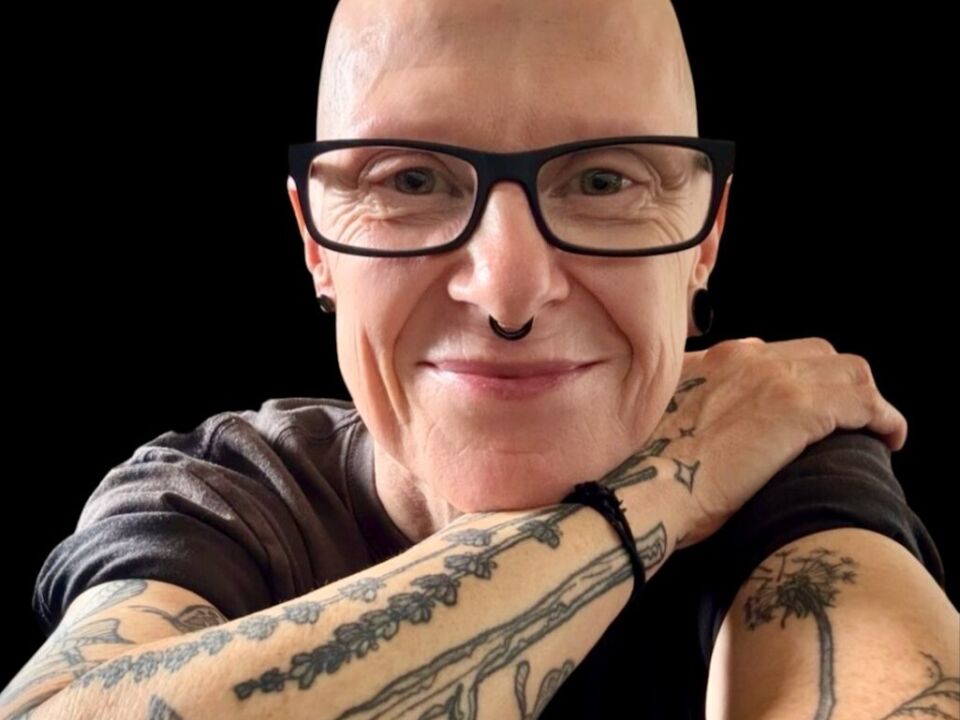
The Body Has Been Consulted
T
he pharmacist said I could wait for the special authority to come through, or I could pay for the testosterone myself.
I'd told my doctor I could wait a few more weeks. There was no urgency. We'd done the paperwork, discussed the dosage, arranged a follow-up. Once the special authority came through, the testosterone would be free, like almost everything else I'm prescribed, and the pharmacy, my doctor said, would provide the supplies and show me how to inject. I had been patient about this for fifty-four years and patient about it in my doctor's office, and the election was coming up. I didn't know what it might change about what people like me could get, or from whom. And there was a vial of testosterone on the other side of the counter.
I paid. I'm a single parent on disability. I know exactly how much money I have, and I know how to wait for things, sometimes for months, sometimes until the wanting goes away.
The supplies, it turned out, weren't provided. They were extra. I asked whether someone could show me how to inject, and the pharmacist offered to do it for me, there, every week.
I have dissociative identity disorder.
Somewhere between every and week I started to go—not anywhere you could see, I was still at the counter, still nodding—while the ones who had never been sure about any of this said see, and we shouldn't be spending this, and we shouldn't be doing this, and someone was adding up the supplies, and someone wanted the door, and someone was still, absurdly, delighted, and whoever was left holding the conversation agreed to have the first injection right there.
My kid had already offered to teach me. He had supplies at home. He knew how. This information was available to me, but apparently not to whoever was dealing with the pharmacy.
The injection went into my arm. I hadn't wanted it in my arm. It hurt, and the person who gave it didn't explain what they were doing, so there was nothing I could take home and repeat. When my eighteen-year-old had his first injection at the youth clinic, there was a nurse, an explanation, supplies, a follow-up appointment. He wanted a photograph for social media. His care team celebrated with us. It was an occasion.
I came out with a sore arm.
What the fuck just happened?
I still needed needles. A few days later, the day after the election, on my way to a queer reading where I was performing, I went to a harm-reduction site to get them free. Some of us didn't want to go in. These places have a reputation, and the voice that keeps track of reputations sounds a lot like my mother's. I'm not doing anything wrong, I told it. I've had my own struggles with addiction.
My best friend, Damian, had already shown me how to piss standing up behind the garages; it took several attempts before I stopped getting my socks wet.
The people at the door let me in. I said I had no idea what I was doing. No problem, they said. You've never been in here before? They didn't have everything I needed, but they gave me what they had, and when I told them what it was for, one of the workers said, Oh, you've just started taking it? Oh my gosh, that's fantastic. My partner takes it. Good for you. It's never too late. They said it was a much-needed service. They were worried about what would happen to it now.
I'd arrived needing needles. I left almost in tears and went on to the reading.
Later, I read the handout that came with the testosterone. This medication is used in men who do not make enough of a natural substance called testosterone. It is given by injection into the buttock muscle. Further down, it sorts its readers. If you are male … If you are female … serious side effects, including: deepening of the voice, hoarseness, unusual facial/body hair growth.
There was no third if. When I was little, my family used to ask whether I was a boy or a girl today. They thought this was funny. It wasn't. My grandfather asked it at Sunday dinner with his fork up, waiting for the table to be ready. My mother asked it on the step, for the neighbours. My best friend, Damian, had already shown me how to piss standing up behind the garages; it took several attempts before I stopped getting my socks wet. There was one acceptable answer. At eight, or younger, I said neither, and my mother explained that I was a girl, as though I'd been confused about the available evidence.
I wasn't confused about the evidence. I was confused about why it settled the matter.
Decades later I started using they/them, before I understood myself as nonbinary, out of respect for everyone in here. For a while I went by Kath and Crew. It didn't require me to choose who was speaking. There are boys in here, and girls, and a lot of me that feels like no gender at all. I don't know which came first, the neither or the several. I've spent a lot of time trying to answer that, and much less time asking whether the answer would change what I wanted to do.
The next injection wasn't due for a week. In between, there was hockey.
At school we weren't allowed to play rugby in case we damaged our breasts. I can still appreciate the foresight. I'd sat several entrance exams as a child and passed the one for the school with cadets, because I wanted to go into the army. My mother sent me to an all-girls school instead. There was sewing. There was no rugby. I don't know whether I'd have liked cadets. I had the ordinary child's conviction that the things I wanted would be wonderful, and no opportunity to test it.
More than forty years later I joined a women's masters hockey team. By then I'd collected an impressive set of reasons I couldn't: my mother disapproved, my former partner said I couldn't, I couldn't skate well, I didn't know the rules, I'd never played. The last three were accurate. I joined anyway. The other women had been playing for years, some of them older than me, and they knew where to stand, how to receive a pass, how to stop without using another player. In my first game I collided with my mentor and we both went down and I landed on my tailbone, and the hockey pants, which had seemed substantial when I put them on, proved inadequate for the particular relationship I'd established with the ice. I could barely walk for two weeks.
The body has been informed that hockey is dangerous.
The body has already fallen over.
The body would like to know when we're playing again.
I'm fifty-four. Or the body is. Some of us have been fifty-four for approximately the correct amount of time; others haven't got anywhere near it. I'm late to hockey the way I'm late to most things I was told weren't for me. Lately some of the telling is mine.
At any given moment I'm also taking in what everyone in here is saying, feeling, worrying about, yelling, and the game doesn't wait for any of us to finish a thought.
The physical part I can mostly manage. It's the deciding that's hard—where to be, who to pass to, now, not after I've thought about it, because I'm a slow processor. At any given moment I'm also taking in what everyone in here is saying, feeling, worrying about, yelling, and the game doesn't wait for any of us to finish a thought. I still end up offside. I still miss the puck. I have scored a goal. It was in our own net.
And there was boxing. My father liked to watch it. I think he tried it a little as a boy. My mother told him it was a terrible sport, a sport for dumb men, and he kept watching. I'm very like my father. He never saw that.
I go to queer boxing now, and trans boxing, and kickboxing, and I had no idea how much thinking was involved: combinations, sequences you hold in your head while someone is coming at you, which you're meant to remember and then do, at a speed that has nothing to do with the speed at which I think. I raced Ironman for years, all over the world, in the female category. Ironman was one straight line. All I had to do was keep going and going. It never put me in my body the way this does. Now I'm tracking someone else's body as well as mine, and the voices on top of the voices, and I can't throw a jab without noticing how many of us have an opinion about it.
They come in between the numbers. Ladies don't do this. It's such an aggressive sport. You're too old for this. Brain damage.
The last one isn't an unreasonable thing to say about boxing.
Once, holding pads for my partner, I was listening to one of them—I shouldn't be doing this—and I let the pads go loose. On the two, their glove came in, and my own pad hit me in the face. They were very apologetic. It was my fault. I hadn't given them anything to hit against. Then I had to find the combination again, on the fly, from wherever I'd got to.
Getting changed for boxing, or in the hockey change room, the voices sometimes start on the body itself—look at it—the body I kept covered for years, with a bald head I won't put a wig on. And someone will say, I like your tattoos. It puts me straight back in my body.
Afterwards, walking home, the street is different. I know I can box. I hadn't expected how much that would change a walk down the street, or how much of the body I'd be standing in while I did it.
Not everything that's been done to this body was put to a vote.
For years I was trying to grow a mullet. I'd get it nearly long enough and wake up with a buzz cut and start again. Someone else in here had an opinion about the mullet. Then I lost my hair—alopecia universalis: scalp, eyebrows, eyelashes, nearly everything—and that argument was over. Nobody won. I won't wear a wig.
At some point I started getting tattoos. One of us wanted them, a tougher one with ideas about what a body ought to look like and a good deal more enthusiasm for needles than the rest. Another part of me found it difficult to look at the body at all. Not the ordinary dislike of a photograph. Difficult to look. The tattoos are worms and birds, trees, butterflies, snails, ladybugs, deer antlers, and I want more. An arm that had been hard to inhabit became an arm with snails on it. The one who wanted the tattoos wasn't trying to make anyone else feel better about the body. That happened anyway, to someone who hadn't asked.
The worms were first. When I was small my mother cut one in two with her shovel, and I was beside myself. I don't believe it didn't hurt. I was also fascinated. I thought she'd made two worms. That isn't how it works. Sometimes the front half grows a new tail and carries on. The back half can't.
I grew more of us and carried on. Nobody in here has died. Some of them have taken a back seat.
Not all of them want to wait for an artist. Most of the piercings in my ears and nose were done at home, with a needle, by someone other than me. I asked whether we could go to a professional for the septum, and we did. One of us has a tattoo gun and no patience for what tattoos cost or how long the appointments take. The gun is sitting there. I'm saving up, and thinking about it carefully, and the gun is still sitting there.
I'm transmasculine. I'm not trying to become a man. I want enough of the other to be more neither.
One of us wanted my ears stretched. This isn't hurting, they said, and it wasn't, not to whoever was there. I came out of it with a split ear. It wasn't my decision. I was the one who regretted it. Lately I've taken the jewelry out to let them heal: a hole in one, a split in the other. I'm not going to disguise them anymore. They're very unusual ears. I like them.
When the next injection came round, my kid and I went into the bathroom. He did his injection first, step by step, so I could watch. Then I did mine. We laughed. We giggled. We hugged, though we're both on the spectrum and a hug can be too much. We high-fived. We took a selfie. We each said what we were most looking forward to.
Do not share this medication with others, says the handout. We didn't. We shared the bathroom.
I still can't tell whether I was prouder of my second injection or of him.
I'm transmasculine. I'm not trying to become a man. I want enough of the other to be more neither. My doctor has put in a referral for top surgery. That one went to a vote and passed. Some of the yes votes came from the ones with the worst health anxiety: breast cancer runs in my family, my breasts are dense, and I'm meant to have an ultrasound every year. The ultrasounds keep getting cancelled. Those ones voted for a completely different reason. It still counts.
It isn't possible to administer testosterone selectively. There's no dose for the enthusiastic ones and a placebo for the rest. The ones who lift and box and want muscle will get whatever the body makes of it, and so will the one with the long, difficult relationship to food, who is frightened of getting bigger, and whose fear isn't trivial just because other people would consider the change desirable. Whatever happens will happen to all of us.
Before I asked for the prescription, I spent a long time making sure it wasn't one of us, or a few, talking over the rest. The handout says the medication has been prescribed because your doctor has judged that the benefit to you is greater than the risk. It doesn't say which of you.
Oh God, say some of us, there's no going back now.
They're right. Some of it can't be undone.
When I need everyone on board, I say: this is my body. This is our body. If some of it can't be undone, we'll cope. I want to try these things before my life is over, to find out who the real me is. By which I mean all of us.
I say it a lot. Some of them are still terrified. What they get, in return, is slow. Now it's Tuesdays, in the stomach. I still have to talk to them.
On hockey nights I wear padded shorts under my hockey pants now. I bought them because I fell.
They don't prevent another collision. They don't make me a better player.
I put them on.
