

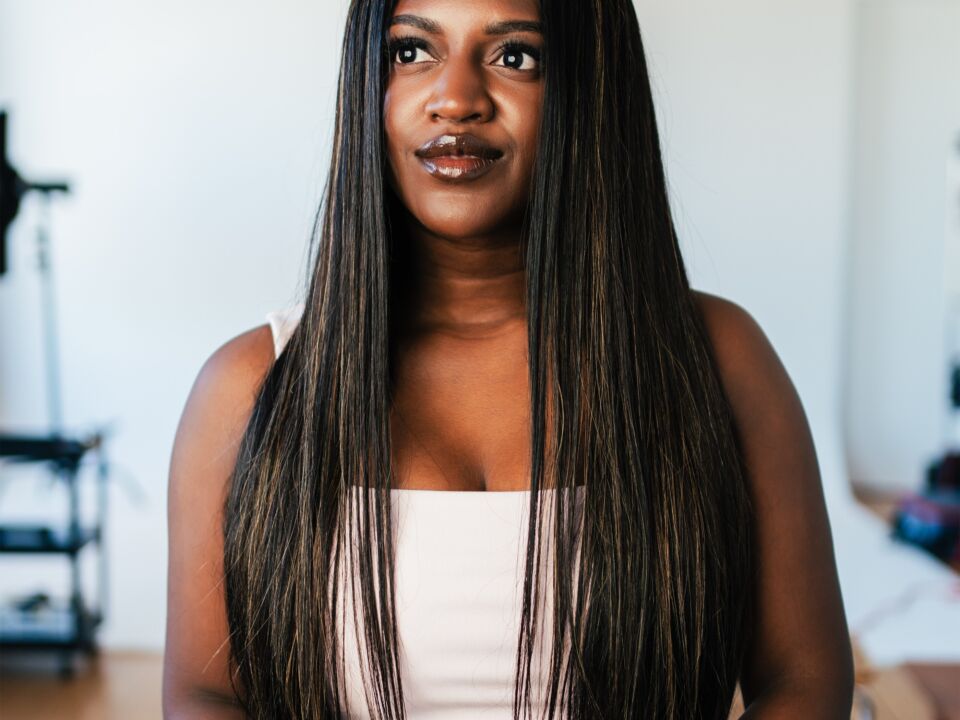
"Just a Delicious Story": A Conversation with Téa Mutonji
For our conversation, Téa and I decided to meet at her apartment in the later portion of the night, after attending Hanif Abdurraqib’s reading at Another Story Bookshop. Despite being friends for nearly a decade, many calls, and my having lived in Toronto for a year, this is the first time I am seeing Téa in person since moving back to the city. She apologized for her tight schedule, but I was just happy to finally have the opportunity to meet her cats.
Téa and I first met in a fiction class led by our professor Daniel Scott Tysdal at the University of Toronto Scarborough. When she introduced herself, the first thing she did was say she was old and that she wasn’t good at math. When we met we got along right away, and I found her equally admirable and outrageous. I’d like to believe she felt the same way about me.
In Téa’s debut novel, My Person, two lifelong best friends experience an abrupt friendship breakup when one woman seeks to untangle herself from the other. Beyond their codependency lies the trickier realities of race and class: Tania, the novel’s protagonist and initiator of the breakup, is Black, and Margot, her friend of over twenty years and “her person,” is white—and dancing around these realities have led to the friendship sinking in on itself.
Téa leaves an author's note that gives the reader room to identify as either a Margot or a Tania, much like one would as a Cristina or a Meredith from Grey’s Anatomy. Intrinsically, to be a Cristina and a Meredith or a Margot and a Tania with a friend, the relationship has to be complicated by the racial dynamics held between a white woman and a woman of colour, which Téa astutely observes and explores. In My Person, microaggressions are utilized for a desired metaphorical conclusion: as codes input to set off a bomb.
Victoria Mbabazi: I want to talk about what I call your “phoenix writing style.” Every time we call, you're always like, “I've deleted my whole book and I’m restarting.” I couldn't believe that your book came out this year because I was thinking, Didn't you delete this maybe six or seven times? Can you tell me about how you go about writing or storyboarding, and how you came out with your novel in the end?
[O]nce I have no desire to start over, I know my story has begun. That feeling has not been incorrect at any point in my writing career.
Téa Mutonji: Oh my goodness, thank you. Thank you for calling my writing style phoenix-like. Is it because they revive themselves?
Victoria Mbabazi: Yes.
Téa Mutonji: Love that. Well, once I have no desire to start over, I know my story has begun. That feeling has not been incorrect at any point in my writing career. I will keep starting over until I no longer feel the need to start over, and I promise I do get there.
With My Person, I did finish a complete draft when I was in New York. I wrote a really nice draft, and I decided to start over because I felt very strongly influenced by my cohort, being exposed to the “millennial American novel”—something that I wasn’t actually reading prior to being in New York and being at NYU. That was my first time restarting My Person: when I finished my time in New York.
I told myself, “I like what I've done here, it's a good starting point but it doesn't feel like me.” I had this very interesting experience of having a fake gap year when I left the New York campus. A few months prior to starting the MFA again on the Paris campus, I chose to not write at all and to just sit and think. I was almost searching for my voice again. When I started in Paris, I had a full book written. I was working with Raven Leilani, and I sat her down at our first meeting. I said, “I know the book is done. I know you said some nice things about it, but I would like to start over, is that cool?” And she was like, “Do you, girl! You know, it's your degree, it's your program.”
I kept telling myself, “Forget my cohort, forget the world, forget the American novel.” It's just me and a supervisor who happens to write in the same vein as I do. That allowed me to find my voice again. I didn't restart the whole book after the fact. I restarted chapters, but not the entire book.
VM: You just needed a change of scenery.
TM: I needed to find myself again. I think a big indicator to wanting to start over a book is when the voice doesn't feel right. Once the voice is there, I rarely want to start over. Once I got Tania’s voice, I was off to the races. There was no looking back.
VM: I remember you were saying once you got in the zone, “I’m not a person right now. I'm in Tania’s brain. I'm writing this book.”
TM: I was method acting. I was… method writing.
VM: What are three things you would tell me about Tania if she was your friend?
TM: Oh, I'd say… She is a writer. She's a whole lot of fun, but she can be quite snappy and a little... What's the word I'm looking for? Contradictory. She's a lot of fun and full of contradictions. She's like a beautiful ballad that wants to be a pop star. You learn to love that about her.
VM: Wait, that's so cute. I would love to meet her.
Back to the book: hair is a very big part of a Black person’s life. How we do our hair or how we don't do our hair says something about us, and our relationship to our Blackness. With that being said, what was going through your mind when you wrote the leave-out scene? I'd love to hear more about what role Bobbi plays in the story for you. And as an aside, that scene was outrageous.
TM: Why did I write that leave-out scene?
VM: Not why, but what was going on while writing?
TM: I was just following the real story. You're in a car. It's messy, it's small. Everything about it is kind of awkward. They're both slightly high, and they're awkward. Bobbi and Tania are the two Black people of the friend group and while it's not explicitly stated, for many years, they were sort of the only two Black people in their school. That creates a kinship that sometimes feels assigned and forced. They were both trying to reject that, though they are denying that there is chemistry between them.
With all of that chaos, plus you’re high, plus you're in a small car, plus you're in the parking lot… Bobbi’s also anxious, and then she erupts with joy and excitement and confusion. That's what I was thinking. I imagined myself being in that car, and I imagined myself as Bobbi, shocked at his own rupture.
VM: I found Bobbi and Tania’s relationship to be fascinating, because there are a lot of Black people who haven’t had the experience of being around other Black people, which can often create weird dynamics. But there are also people who just want to get along and be in community with one another, because they know that in predominantly white institutions or in suburban areas they're inherently in a violent place. Their “friendship” was so interesting to me because it didn't exist. Yet, Bobbi couldn’t help but take Tania’s side, and then as they’re commiserating over this they just had to be weird to each other at this moment.
TM: For me, Bobbi and Tania didn’t have any chance of exploring anything—whether it was a friendship that was platonic, romantic, whatever it was—because it was taken away from them. They both have resentment for their friend group for that.
VM: I found myself frustrated with Tania throughout the book—or at least the way the characters handle politics—her relationship with what was going on in her home country, and the news cycle in general, felt like a bomb ticking in the background. Though, of course, the bomb finally explodes.
I wanted to explore what it looks like when you are confused, and no one has given you motivation to care about politics.
Walk me through how you came up with the climax—or as a poet, it genuinely is more fitting to call the engagement scene the volta of this story.
TM: Thank you. It really is the volta, isn't it? The whole ticking metaphor that you're alluding to was very intentional. I knew that I wanted this book to feel like this is someone processing and learning how to process overwhelming feelings for the very first time. I thought it would be so interesting for both Margot and Tania to steal the show of an event that isn't theirs, and see who gets punished the most. We can argue for days on who had the worst performance in that scene, but I didn't plan for what happened in the scene to happen. The story led me there, and once I realized that's where I was going, I just couldn't stop.
VM: How did you go about creating a complex villain in Margot? Do you remember what traits or motivations you wanted to convey to readers, to flesh her out?
TM: Funnily enough, I gave Margot all of my confusion as a suburban girl. I knew that if I was still confused by race, it is only fair to also accept that my white counterpart probably was, too. I wanted to explore what it looks like when you are confused, and no one has given you motivation to care about politics. There's no reason to actually care beyond the small donation you make here and there. There's a part of me that wonders how different would Margot have been if Tania had said, at eighteen years old, “You know what, Margot, I would like for you to be more educated about my race, because I'm so educated about all your dumb shit.”
I wanted to spend time with that tension, and that comes in direct conflict with the reality that it was Margot's responsibility from the beginning to wake up. The big tension of the book—for me at least—is two people who have their own faults. Who is going to get the most grace based on their behaviour? I'm so stunned to find that a fair amount of people have given Margot more grace.
VM: But are we stunned?
TM: I personally am.
VM: To me, it's so typical. Here is a character who's experienced, in many ways, real harm, and the only thing that some readers can see is that she, Tania, wasn't very nice. That's a typical read from white women: they will only care about a Black woman's tone.
It has been my fantasy as a reader to experience a Black woman being so concerned by something as benign as a friendship breakup: so much so that her whole life stops making sense.
TM: I didn't expect it because the book is intentionally told through the interiority of a Black woman. I really didn't expect that you could bypass the need for care for the Black protagonist— part of what Tania’s experiencing is a lot of suffering, and it is painful. It’s just not necessarily “aggressive” violence. Maybe if I had explicitly gone into detail about the violence that Tania was experiencing, versus how it's affecting her internally, this would have garnered a different reaction. I don’t really care if it would have. Well, not that I don't care, but I'm very unconcerned with others’ truth of the story. I am more fascinated with the fact that they're bringing it to the conversation.
VM: Why would you say you are team Tania?
TM: It has been my fantasy as a reader to experience a Black woman being so concerned by something as benign as a friendship breakup: so much so that her whole life stops making sense. I think there's something so freeing about being heartbroken over something not working out, and that something is entirely unrelated to what is happening, in the larger sense, in the world. This character loved someone, and now she is losing that person. That story is just as valid and deserving of space as the other kinds of grief she is experiencing.
It was so exciting to me to have Tania just be a normal person, having normal twentysomething drama. Yet all of this is complicated by the fact that there's also a genocide happening in Congo, and Tania’s feelings [about this] are trivialized.
VM: All of Tania’s feelings, from cultural devastation and cultural loss to the personal grief of losing your best friend are trivialized.
TM: My quest with this book, and why I'm team Tania, was to experience a character that looks like me, yet was not necessarily behaving appropriately: instead, grieving quite loudly and making it everyone's problem. I thought that is a kind of freedom that I could never afford in my real life.
I wanted to root for someone, and see this character experience being devastated by the world—especially when the world was “happening” to her—and have her still land somewhere safe, with people to take care of her. That, to me, is just a delicious story. It was so exciting to me to have a Black protagonist not trying to be resilient. Not even trying a little bit. Tania said, “You know what? I'm not strong. I'm not a survivor. I'm not resilient. I'm just a twenty-nine-year old dumbass bitch. And I'm gonna go find my mom.”
VM: Good for her. And I'm glad she did.
