

How to Fall in Love in New Brunswick
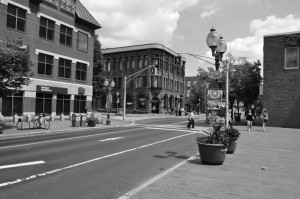 Downtown Moncton, New BrunswickCounting the Port Authority bus terminal, the cab, the Jazz hostel, and the unremarkable sports bar, I had probably been in Manhattan for an hour. Two hours by the time that she mentioned wanting to have mixed children because “white kids are so boring.” I wouldn’t have dared make eye contact with Lilia in Moncton or even Fredericton; she would have known someone I knew and I would have had to live with it, to be known as someone who wants something.We flirted and commiserated—joint admiration for Lil Wayne and James Joyce. The Carter III leak had just come out and Joyce remained dead. She became the first in a procession of earnest, well-meaning people to recommend Murakami. We talked about how isolating small towns are and how leaving them is never anything less than an escape, a flight, an imperative of survival and the gnawing promise of “a life”—at least that’s how I felt. She seemed dissatisfied with her childhood in the Hamptons, in any case.Russell told me that he had a knife and I could borrow it; that I should borrow it. Not to actually hurt Jay—not to cut him or stab him or leave him bleeding—all I needed to do was scare him. A rush and a flash of the blade would have been enough. A show of force and a brutal will to violence wouldn’t necessarily earn respect, but it could buy peace. This happened in the spring.Months earlier, Mr. Acker had pulled me into the hallway. He knelt down, smiled, and looked a little embarrassed. “You’re not going to be one of those kids that comes in and shoots up the school, are you?” I didn’t think so, so I said no. “I didn’t think so, I just thought that I should ask.” We both laughed it off and returned to the classroom.*
“There is a dependence in the region that breeds a culture of defeatism,”—Stephen HarperThe Petitcodiac River flows through Moncton, winding it’s way from west to east, dividing the city itself from Riverview and Dieppe. It’s all Moncton, though, and the Petitcodiac River is not a river at all; it’s a slick muddy embankment that cuts through the town. It’s a trench that divides stores and houses from other stores and other houses. Before the Moncton-Riverview causeway’s occlusion, the river was locally famous for it’s powerful tidal bore. Twice a day, seawater would flood upstream, washing through the slow, murky silt and causing the river to briefly run backwards. The causeway put an end to this. The silt began to slowly encroach along the banks and bends of the river. The river isn’t drying up, but it is thickening. It moves slowly.Moncton is someone’s lazy, unimaginative notion of a small town. It’s a sketch in the wilderness, given character through the sheer density of Tim Hortons shops and the bitter politics that the Hortons’ customers preach to each other. Railways used to run through and supposedly drove growth and commerce. Now the city mainly sustains itself through call centres, retail outlets, and garden supply stores. There are two Walmarts: one is in the mall and the other is not in the mall. There used to be two malls, but now there’s just one mall. There’s a Main Street; plants hang from street lamps and vape shops crowd against the bars. The bars tend to be pretty cramped, so everyone just spills out onto Main Street to brawl. It’s easier that way and it’s nice to get a bit of fresh air after a fight.Growing up, you were either a Whoop-Whoop, a Chez, a Prep, or a Redneck. Whoop-Whoops were white kids who identified with what is politely called “urban” culture. Preps came from the moneyed families, meaning that their home’s mortgages were paid off or there was little risk of their parents failing to do so. The Rednecks went mudding and inexplicably draped themselves in the confederate flag. A Chez could be a Whoop-Whoop or a Redneck. It was more of a marker of class than identity. If you were considered dirty, you were a Chez. If someone knew something about your family situation that could cause embarrassment, you were a Chez.I’m still angry at Moncton. I still resent the slow lacerations that cloud my sight, inflicted through people and geography and all that’s paralyzed within it. Titus Andromedon was completely right when he said, “Escaping is not the same as making it.” If there’s one thing that I learned through literature, it’s how to escape. Considering “literature an escape” is undoubtedly a cliché at this point. Reading was not an escape for me. It did define what I was escaping however, illustrating its contours and striking brutally upon its necessity.Last Christmas, I stayed at my father’s place. He was living with a loose group of seekers, misfits, and stoned mystics. The apartment was homey for the type; portraits radiating points of light and mapping chakras, mingled with volumes of self help books bought from the Salvation Army. There were signs in the windows advertising peace and attacking uranium mining.Sculptures of driftwood, sea glass, and shells stood sentinel, reminding me that there was the even deeper remoteness of waves, small homes built with recovered wood perched against the Northumberland Strait, and that dark forest outlined against the always-fading light. This was my childhood. I did have miles to go before I slept, though I knew whose woods they were and where the pot plants were growing.I stood on their porch, with a second storey view that afforded a clear line of sight to the Deluxe French Fries outlet. In the parking lot a man was hollering at a woman on the other side, shouting, “nutbar!” over and over again at her. This was a domestic scene and not one that I would want to get involved with. I had eaten at that Deluxe an obscene number of times. It was our lunchtime spot. Once, another student covered a fry in ketchup and smeared it into my hair.I remember this being the third most degrading fluid that I had been attacked with at school. At least this one was easy to wash out. Doing so in the Deluxe bathroom felt like a small victory. At least I could go back to class and be comfortable in the style of normalcy that I was trying to maintain. There’s darkness in the center too. Not so much darkness, but the absence of light—a visual flatness. I had been made aware of my own darkness for some time and the difference that it inscribed upon me.
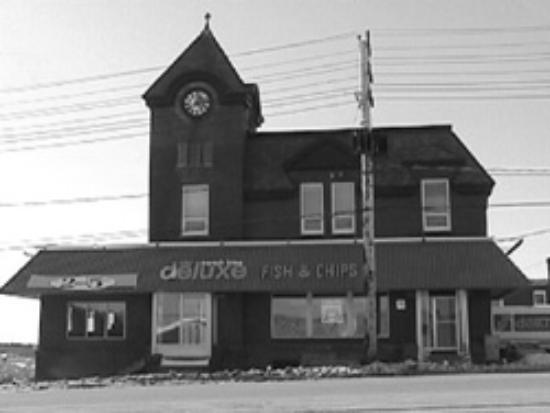 Moncton's Deluxe French Fries RestaurantEscaping isn’t the same as making it and that’s something that dawned slowly. Time is different in the Maritimes: it’s an amorphous duration, governed by sinuous generational ties. Urgency—of life and of action—is alien. Urgency is an affectation imported from Ontario.Established names and hatreds and dispossessions structure identity. Poverty in the Maritimes feels natural. We’re old poverty. Displaced anger takes on conspiratorial contours and cops get shot. Progress and loss are insignificant when you’re braced against the cold eternity of the Atlantic.I was told to write about race, theory, and literature—blackness and possible nativeness and likely Faulkner, Richler, and Joyce: my respective Christmas ghosts. I’m left here trying to make myself feel angry again and I'm worried that I’ll sound childish. I don’t know how else to sound. I’m more worried about needing to make myself feel in the first place. Perhaps that’s my inheritance—an indifference born through rejection and displacement. I’m black and I’m Acadian and I’m possibly native, but really no one in my family can say for sure. Faulkner couldn’t teach me a thing about race. Any Joe Christmas affinities are skin deep. I know what I am because you were very clear in telling me who I’m not.I’m not white. I learned that in the second grade. I was denied a chance to play with a fellow student’s GameBoy because I’m not white. It’s been 22 years and I still haven’t played Super Mario Land 2: 6 Golden Coins and I still want to. It’s a petty dispossession but that’s the way she goes on the East Coast.I’m not really Acadian, either. I learned that at my grandfather’s funeral when an uncle berated me for thinking that I was better than him. I was nine. I don’t speak Chiac, aside from a few stock phrases remembered to illustrate the dialect’s idiosyncrasy. My father tongue is a party trick—maybe my uncle was right.I’m not black, or at least not nearly black enough. Certainly I didn’t know how to play the role expected of me. I’ve been offered clothes from white Eminem fanatics: hand-me-downs meant to make sense of an identity I could claim. It’s an offensive gesture but not without kindness.*Montreal became a beacon after reading Mordecai Richler. I’m not sure why—perhaps it was close and felt like a place. A place is a place that they write about and speak about and know. Most of the Duddy Kravitz discussions that I’ve taken part in have focused on the character of the Jewish neighbourhood: St-Urbain and Wilensky’s and all that. The only thing that captivated me, however, was Westmount. The shining enclave strapped against the hill knows who’s welcome and who isn’t and feels that even asking the question is asking too much. It’s not that I wanted membership—I wanted to be denied membership to something worth wanting. Snobbishness is fine and snobbishness is necessary. Moncton snobbishness is low rent; it’s comical and cannot be taken seriously. It’s a little sad and little insidious. There’s no guiding benevolence from the city fathers when the stakes are so small.I’m losing my youth in the non-unionized factories and call centres of this blustery, decaying metropolis and I love it if I’m being honest. I watch my sensitivities ossify and my arteries harden and feel that this is only right.A few months after moving to Montreal, I read a short blurb on the CBC’s website that Leonard Cohen’s childhood home was for sale. After quickly searching through the realtor’s listings, I found the address and decided to take a look. I didn’t book an appointment or anything, as that would obviously have been ridiculous, and unfair to put some poor real estate agent through. Instead, I decided to simply walk by the house and gawk, treating it as my own private, absurd little pilgrimage. It was half of a red brick duplex. I remember the green shutters and the white fencing and the stultifying heat as I walked up Westmount to gawk religiously. Is this what I wanted? I don’t know why I went and I still don’t. Maybe I was hoping to latch an importance to the place itself—to make real something that still felt intangible and wholly imaginary. Maybe I was just bored.*Nothing happened with Lilia or the knife. I wouldn’t dare. Faulkner couldn’t teach me a thing about race but he knew memory and he knew family. He knew that sometimes wounds could be made for love. He knew that pride and history and a sense of place are already gone as soon as they’re grasped. That the land and those on it are dying and the dead simply wait for the living to catch up. That history is not narrative or even memory. History is just the knowledge of a pain that exists outside of yourself and has existed and will endure. And yes, the snow is falling softly and softly falling. It actually is as I snatch seconds away from my nine-to-five to cobble this thing together, worried about tone. I’ll be returning to Moncton tomorrow for Christmas and will split my time between my parents’ houses and the few friends who stayed behind. Navigating brokenness isn’t completely unpleasant when it feels like home.Damien Caissie lives and works in Montreal. When not cataloguing bizarre YouTube videos or defending Balloon Boy’s continued cultural relevance, he sleeps. He has studied English Literature at Concordia University and the University of New Brunswick. In addition to self-deprecation, his interests include post-colonial and modernist literature, ethics, politics, and cultural history.
