

Sequential Gestures: Reading Cameron Anstee
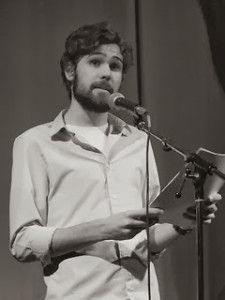 Cameron Anstee runs Apt. 9 Press in Ottawa, Ontario.
The Town Crier is proud to present the following essay from Puritan contributor Bardia Sinaee. Bardia’s poem “Etobicoke” was featured in Issue 20 of The Puritan. The following is a survey of Apt. 9 Press founder Cameron Anstee’s poetry to date. The Town Crier published a Q&A with Anstee in November.
Canadian publishers concerned with posterity would be well advised not to bother sending new titles to Library and Archives Canada. A more feasible and reliable alternative in light of recent cutbacks is to mail everything to Ottawa c/o the poet Cameron Anstee. Some people hoard books and others collect them, but Anstee accumulates books like mud flaps accumulate grit: the monographs, periodicals and literary ephemera lining his walls tell the story of where he’s been and what he’s encountered.books come out, gather around us, form walls along wallsa flesh thing approaches a flesh thing, distinctly, before collisionour mostly intact bones collect here, remember the shapes of our younger bodieshopeful of more books, and good fresh produce, and perhaps wine(from “Domestic”)After a handful of chapbooks from Carleton University’s In/Words Press, Anstee published Water Upsets Stone with Toronto’s Emergency Response Unit in 2009. Using Newton’s three laws of motion as a framing device, the three-part long poem traces a personal history through non-chronological events: the famous ice storm of 1998 obliterates the past (“I don’t remember the trees before ’98”); a creaky cold-water apartment (where Anstee founded Apt. 9 Press in 2009) is infiltrated by the weather; Anstee helps his father, an avid collector, haul books at an indeterminate point before developing his own “compulsion to archive.” All throughout, people try in vain to manage their material concerns, their homes, their bodies, their houseplants, and books which, even in stillness, are shifting imperceptibly:
snow evenly sheeredthe open
refusing gravity& tiny seasons where grass continuesbricks contracting toward their empty spaces(from “First Law”)Immediately evident is the stripped-down language. This was, after all, the year after the publication of Crabwise to the Hounds, a time many young Canadian poets spent forging unlikely compound words to use in dense, spondaic lyrics about effete woodsmen. Meanwhile, Anstee was working with hammers and nails, absorbing the long, meditative poems of Phil Hall and learning to use understatement and empty space from books like Monty Reid’s classic, The Luskville Reductions (2008). The few metaphorical flourishes that Anstee does permit himself are only stronger for their scarcity: taking in a snowy expanse, the panning gaze catches on a patch of grass—a tiny season, thinks the mind, while the heart, not quite leaping, skips a beat and continues on, sated.Another long poem in small parts, 2010’s aptly-named Frank St. is even more down-to-earth. The mood is diaristic and intimate, but not confessional:
the south side snowremains a whileafter the north sideis clearplants thrivein the east windowI am trying to grow a beardthe ivy grows betterAs in the work of fellow Ottawa poets Monty Reid and jesslyn gagno, the establishment of the home and its plants/garden mirrors the cultivation of the self and close relationships. Frank St. opens with a description of a couple’s new apartment (one “large enough to hold our books”) and ends with the image of an overgrown container plant which will need to be replanted “somewhere new / and large enough again.”Though love is often the occasion for Anstee’s poems—love for his partner, Jenn, whom he addresses directly in almost every chapbook, he is never effusive. The voice in Frank St. is especially humble and hesitant:
I still don’t know what I’m doingbut I know doing itsometimes I trace figuresinto your musclespoorly[…]tomorrow may wait under your handsand this poorly made poem[…]see better, poemHe is “trying to grow a beard,” but the ivy grows better and so, later, when Anstee writes, “I am trying to write a poem,” we are left to infer from the ensuing blank space that the poem has been upstaged by reality. He is even drowned out by others in his own home(/poem):
words and words and parts of wordsand parts of others’ wordsan open windowsanctions the moving airnone of the doors in Frank St. seal their roomthe common hall sounds clearlyWhat a surprise, then, to pick up She May Be Weary, one of the secret editions Anstee produces in very limited runs for individual readings (this one at the University of Ottawa’s Café Nostalgica in April 2011). Coming at the tail end of the Canadian ghazal renaissance when everyone and their mother was writing ghazals, anti-ghazals, bastard ghazals, prose ghazals, “flood” ghazals, and even “guzzles,” Weary is Anstee’s apocryphal demo album; the basement tape where he sounds off. It features what are to my knowledge the only exclamation points Anstee has ever committed to paper:
the application is in the mail, at last;a drink! enough alreadyanother poet borrowed your bookand returned it covered in waxhave you anything to declare?I found these wordsthe body will never deny youuntil one day the body denies you
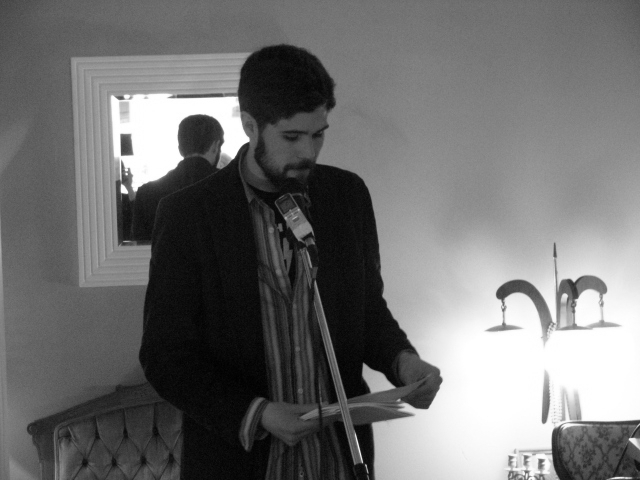 Anstee is pursuing a PhD in Canadian Literature at the University of Ottawa.It’s bizarre to see such a reserved poet take on a form traditionally driven by inebriation, ecstasy, and despair. “Shedding tears of blood is no game,” advises the 19th century Urdu poet, Ghalib, in one of his ghazals, “a strong heart, a steady nerve, are wanted.” But the ghazal is ultimately a love poem and Anstee, ever the love poet, shows confidence with the notoriously unruly form. Take for instance how “application” gives the words “declare,” “deny,” and “body” a second meaning in the bureaucratic context of, say, a granting body, threading together the otherwise disjointed couplets. And the tragedy of the damaged book! I can hardly conceive of a more direct blow to this poet’s heart. The idiosyncratic syntax and vernacular interjections (“enough already”) and the posited self addressed as a second person are all traceable to the late Anglo-Canadian poet John Thompson, author of the ghazal sequence Stilt Jack (1978), while several allusions to musicians link Weary thematically to Rob Winger’s ghazal collection, The Chimney Stone (2010). The ego-charged ghazal also compels Anstee to explore new emotional territory: Weary contains some morbid imagery as well as uncharacteristic expressions of indifference and contempt. Even Anstee’s familiar subjects—books and the weather—are addressed with new tropes like personification: “ah coolness, says the Fall / the grass dries out in solidarity // the red red blood breathes on the page.”The far-out Anstee of Weary represents a flirtation, a necessary deviation en route to the next phase in his writing. Starting with Regarding Renewal in 2012, Anstee began producing discrete, self-contained lyrics. The poems are smaller; no more than eight unbroken lines at the most, but Anstee’s range has expanded. Mixed in with modest observations about his immediate surroundings are sweeping statements about writing, bits of conversation, and micro-narratives, all facilitated by the quick tonal shifts we first encountered in the ghazals. Here is the poem “Construction” in its entirety:
on our day off we walk the Pink Lake Trailsmall load bearing stones on the muscles in need of expressionincomplete and somewhat unstable, I claim all errors as my ownI understand some things of decompositionfold the page until it tears with easeThere’s a subtle new confidence at work here. Anstee is toying with us a little. Some of the lines connect with the ones preceding them, some reach instead for motifs (e.g. muscles) found elsewhere in the manuscript, while others yet address the same subject but with differing inflections: the last two lines of “Construction” shift from the declarative to the imperative while drawing out separate notions of decomposition—to take apart, “fold the page until it tears,” or to rot, perhaps by the lake. Taken into consideration with the tension between “load bearing” and “unstable,” the rhyme of “stones” with “own,” and the iambic meter of the last line, it’s clear Anstee has mastered a variety of new means for building up and disrupting expectations.However, Anstee’s operating principle, from the early long poems to his numerous list poems to his newest chapbook, Consider Each Possibility, remains the same: accumulation. What rob mclennan, Anstee’s best critic to date, called “sequential gestures” back in 2009 are still at work in his collections of discrete poems. Influenced very much by minimalists like Nelson Ball and Mark Truscott, the poems in Consider Each Possibility are so distilled in places they practically dare you to find anything under the surface:
you wake upwake me upI boil the kettleyou boiled earlieryou dressI replace dishes(from “Mornings”)Rather than reading into such zoomed-in snapshots, we’re better off zooming out. The couple’s parallel but staggered motions in “Mornings,” for instance, can be read as an enactment of the “dissonant / stagger” between the numerous household clocks in the poem “Daylight Savings.” That poem, in turn, echoes the disorientation-in-time of another poem, “Scale,” which begins, “I forget my age on occasion,” with age being what the speaker is “now on the / wrong side [of]” in the poem “Parabola:”
the bodyis coming aparteach daya workof salvageSalvage connects “Parabola” to the poem “Plot,” about “a small garden / framed by salvaged brick,” which is also the subject of a later poem, “Garden.”I could go on, but this is a short chapbook and I’m already courting legal action from the publisher. Suffice it to say that Anstee could fit a poem of considerable depth on the face of a dime—like he says of the couple’s routine in “Mornings:” “it is minimal / I am enlarged.” This takes a clear eye and a strong heart.Water Upsets Stone. Toronto: The Emergency Response Unit, 2009.Frank St. Ottawa: above/ground press, 2010.She May Be Weary. Ottawa: St. Andrew Books, 2011Regarding Renewal. Ottawa: above/ground press, 2012.Consider Each Possibility. London: Baseline Press, 2015.Cameron Anstee lives in Ottawa, ON, where he runs the one-man operation Apt. 9 Press and is pursuing a PhD studying Canadian literature at the University of Ottawa. His latest chapbook of poetry, Consider Each Possibility, was published by Baseline Press in 2015.
