

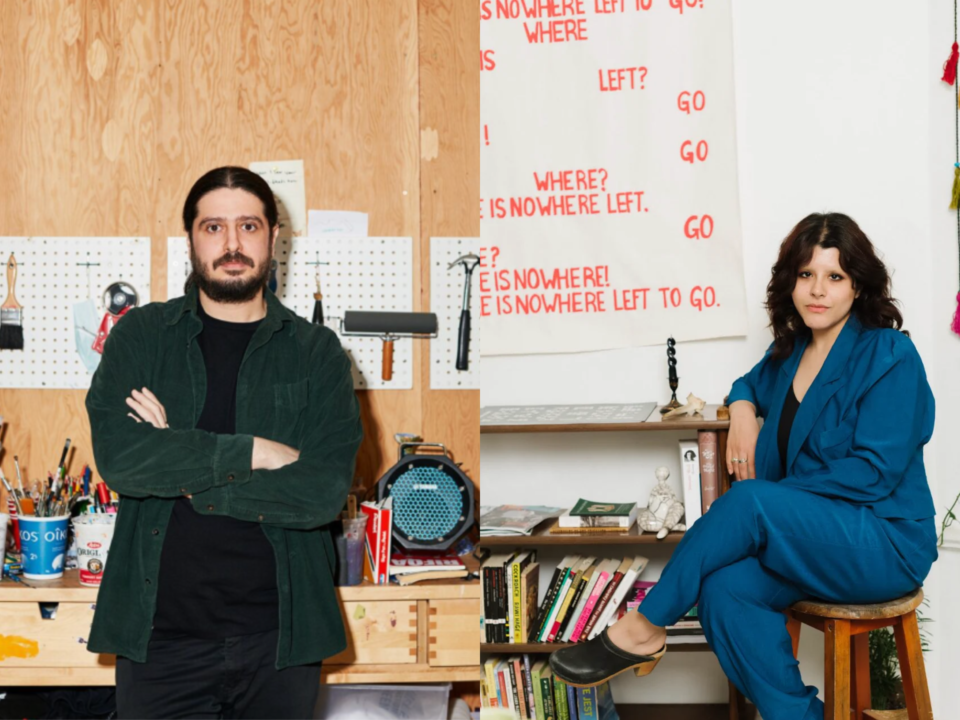
A Portrait is a Gift: A Conversation Between Ibrahim Abusitta and Nazanin Zarepour
I met with Ibrahim Abusitta in his studio in mid-July shortly after seeing his most recent work, Operations, at Whippersnapper Gallery. The installation felt like an impossibility: at all hours, day and night, a headcam POV video from the resistance in Palestine played from a storefront onto one of the busiest corners of Dundas street. Ibrahim had dutifully traced and re-traced the original video, entitled “Stones of David,” frame by frame, culminating in a short, looping animation (fig A). I was used to seeing self-recorded videos like this online – albeit in the corners of the internet. But encountering such a video in a busy public space, interpreted and relayed by an artist, felt like a rare moment of political honesty. Here, the violence of settler colonialism did not simply recede into the background noise of daily life. Nor could resistance to the occupation remain taboo.
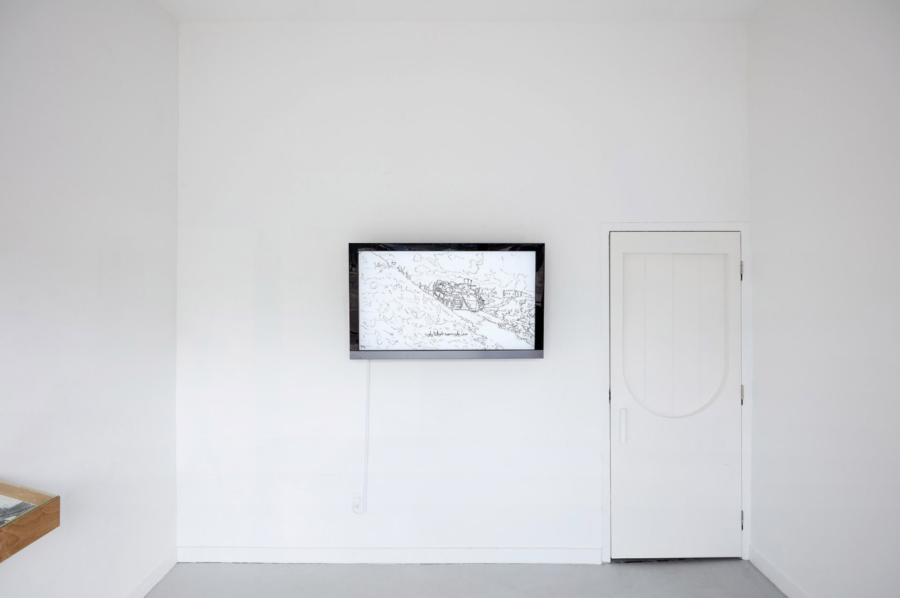
Fig. A
Nazanin Zarepour: The video from which you created Operations takes place in southern Khan Younes, on some of the lands just outside of Gaza. How do you locate yourself, or your own history, in this geography?
Ibrahim Abusitta: Both my parents are Palestinian, and they lived in Gaza before they moved to Saudi Arabia. My mother's side is from Gaza. They were there before the Nakba. My father's side had been expelled from their land just outside of Gaza. It was called Ma’in Abusitta—which translates to Abu Sitta Spring. The Abu Sittas were a Bedouin tribe. [Inhabitants of the land, as a Forensic Architecture investigation notes, were expelled in 1948, and the village was demolished to establish a number of kibbutzims.] The twisted connection is that on October 7th, the kibbutzims in the envelope which the fighters went to were precisely where our family’s land was located. And what’s even weirder is that one of the buildings that belonged to our family continues to exist on that land until today. In 2019, someone converted the building into a gallery, to “reflect” on what their presence on this land means.
Nazanin Zarepour: When I came to see Operations, you used the word “incorporate” a few times. You said “I want to incorporate this footage from the resistance into a hand-drawn animation.” The word incorporate makes me think of the corps, or the body—as though this act of translation from one medium to another is a kind of internalization. Incorporation seems to be a throughline in your work, where you take images from things that are quite ephemeral, and often digital, and incorporate them into a different, more tactile medium on a page. Beyond Operations, your illustrations of stills from the Electronic Intifada podcast (fig. B) do something similar. What do you think is the impetus of translating these images from one medium to another? Why draw these images?
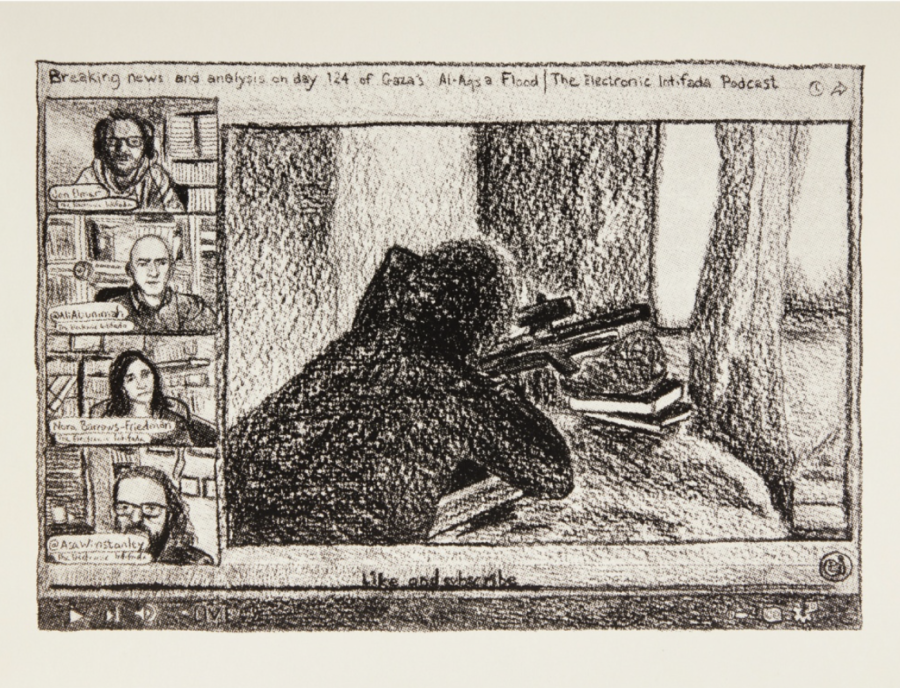
Fig B. Stills from the Electronic Intifada’s military analysis, illustrated and then sold as a limited-edition screen print to fundraise for the immediate family of artist Mohammed Sami.
Ibrahim Abusitta: I created Operations work while I was in residency. At the time, I was daily, obsessively looking at my phone, watching the Resistance News Network. I would long for another successful operation. Seeing these videos kept me from feeling really shattered. So I knew I just had to do something to honour the resistance fighters. I see drawing as a way of being endearing. It’s like drawing someone’s portrait. You could take a picture of someone… but when you draw someone, you’re really showing you care. Operations was similar to some of the work I’ve been doing in my other paintings, where I incorporate my family into paintings. I’m trying to archive the archive, or reinterpret the archive. Everyone has family photos, but to draw them or paint them gives a second life as opposed to a photograph that otherwise just sits there. It tells the viewer, I've given this thing importance by drawing it.
I’m trying to archive the archive, or reinterpret the archive. Everyone has family photos, but to draw them or paint them gives a second life as opposed to a photograph that otherwise just sits there. It tells the viewer, I've given this thing importance by drawing it.
Part of me wanting to draw it, versus, say, sharing the content itself, was knowing that the general Western audience can't handle the imagery. When I'm creating artwork for a Western audience, it's already loaded. I know the Western world has this view of Muslims and Arabs—that they’re backwards people who can’t have an opinion on how they can fight for themselves. I just don't know how to approach it sometimes when I'm thinking of a wide audience. And I thought maybe the best thing was to just recreate what I was seeing.
You can only support the resistance in so many ways. Especially us, by being on the internet, we support them by just sharing while everyone else was denouncing or condemning Hamas after the flood, even Palestinians. I felt very backstabbed at the time. I wanted to do something that put up front with my artwork that I support the resistance. In the case of Operations, I’m not sure if animation was the best approach, but it just felt like the first thing I wanted to do.
NZ: Why do you think you went with animation?
IA: I hate using the meditation term, but I was sitting with this work for a long period of time. I spent hours over days with this work. There was a slow burn happening in the action of making it. Because the video is from the man’s POV, there is a moment where you don’t see what he’s doing. He’s approaching the troop carrier and then you finally see him do the thing. It took me eight days to get to that moment in the drawing process. Even though I knew what would happen in the video, I was so gratified in drawing it. I was reliving it, but I was reliving it as a viewer too.
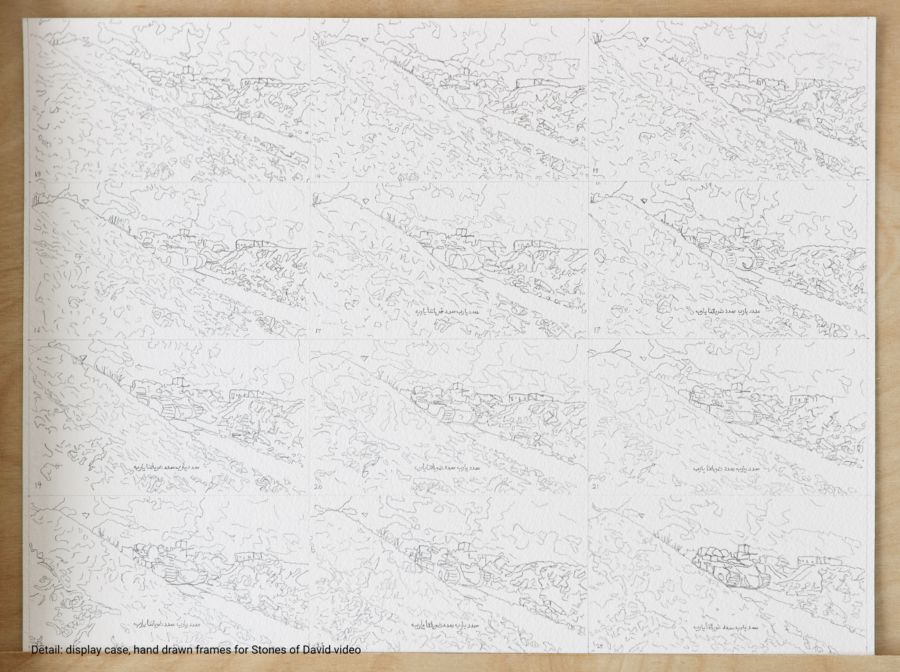
Hand-drawn frames from Stones of David. Courtesy of Ibrahim Abusitta's website.
NZ: You’ve spoken about how we’re in this moment where everything is called resistance, and you wanted to show a video that indexes actual resistance. This video is, of course, a video of armed resistance. But it’s also mediated—the man who is approaching the troop carrier is also documenting as he does it. Aesthetic decisions are being made, perhaps not necessarily in recording it, but in editing and posting it. That documentation, in other words, is such a necessary part of the process. What do you think of the role of culture in resistance? I wonder if culture, despite being necessary to resistance, is just something different from resistance.
As an illustrator, you’re documenting something that has already been documented. I imagine this process of documentation provokes two different kinds of relationships. One with the image itself, and one with the subjects of the image. How do you understand your own position as another documenter? Are there moments where you felt like you were there? Are there moments where you felt really far away? Did you feel any type of relation to, either the object itself—the physical video, but also the subjects within the shot?
IA: When I see these kinds of videos, a lot of the thoughts that go through my head are, have I ever been there? And then what sucks is a lot of times I can’t even recognize it—I don’t think anyone from there recognizes the land. Everything is rubble. The markers are gone. Because people used to describe things with markers. You go down to the street and see x house, turn here by x tree. Now all these things are gone. So part of me feels devastated when I look at these videos, knowing that I haven’t been there in a long time.
The connection for me really comes from the fact that I still have my mother tongue, the Arabic language. I feel the connection when I hear the video, when I hear the audio. In the video that I animated, there’s only one sentence that’s said: Sadid ya’rab. He’s praying to God to help correct his aim. He says, “correct it God, correct this aim.” And he says God twice, I think, ya’rab, ya’rab. It’s a prayer to God, but it’s almost like he’s telling himself, “oh, man, make this count—or get it right.” Because he has to climb and drop this thing in a very little opening—it’s a wide device, and he’s creeping and climbing it. I feel really distant from it all. But I think by making the work, I’m soothing myself by doing something. I’m almost attaching myself to these actions by honouring them or by recreating them, or by introducing them to a viewer.
NZ: I wonder whether “soothing” is the right word? What I hear is a sense of responsibility in how you describe watching these videos: that after seeing something, it becomes difficult to make work that behaves as though you haven’t seen it. I feel the same. I’m watching the news all the time. Nothing breaks me more than the fact that I just spend every day pretending like I didn’t see what I saw. It would be dishonest to produce work that doesn’t speak to what you’re seeing all the time. Or to abstract something to the point of non-recognition.
Nothing breaks me more than the fact that I just spend every day pretending like I didn’t see what I saw. It would be dishonest to produce work that doesn’t speak to what you’re seeing all the time. Or to abstract something to the point of non-recognition.
I know you mentioned that the people from Electronic Intifada had seen the drawings you did. Here in your studio, I’m seeing a sketch of Palestine Action organizers in the UK. These people—actioners, protesters, often don’t get really documented in any way unless they’re documenting themselves. And same with Electronic Intifada, right? They’re recording themselves, usually people don’t document them, or honour them visually. There’s an element here that almost sounds like a gift or a tribute. There’s something about it that’s really generous and intimate, like an offering.
IA: I don’t know exactly what that is. I’m only now connecting the dots that these works I’m making are always folks who are documenting themselves. It doesn’t seem like the typical approach to document a YouTube page. With the illustrations of the Electronic Intifada, part of me was hoping they would see it, because I know it can reach them.
A few years ago, I made a painting titled “Bouquet for Abu Baker.” It was for Abu Baker Abbed, a young journalist from Gaza who made a video showcasing a yellow rose bush that he had raised and tended to, and how despite all the destruction, the rose bush was a symbol of hope for the people. When I made this painting, in my head I thought, “You’re probably getting flooded with so many messages that you’re not going to see what I posted.” But when I posted, I tagged him and the next day he was commenting and we started following each other.
NZ: I wonder if that act of gift giving is an attempt at reaching out across the distance, maybe even unconsciously.
IA: I don’t know if you know of the RNN image, it’s someone with a kuffeiyah, holding up a rose. It’s like they’re gifting the rose, or that expression, giving them their flowers. Everyone’s cheering for them, but can they hear us?
When I think of October 7th, the flood, I despised when people only talked about Palestinian women and children. This idea that you can only support the “innocent” and you don’t see everyone as innocent—and in particular you don’t see our men as innocent. I think about if I existed in Gaza right now, I would either be dead already, or I’d hope that I would have the courage to join the resistance. And if not, I would definitely be on the streets supporting them and waving the flag, because I would want to give the men fighting for my freedom all the love and support. And they put their lives on the line and likely almost all of them probably kissed their mothers the night before because they knew there’s a good chance they’re not going to come back. We don’t feel the martyrdom because it’s so easy to just read it on a page. So many people are dying and have died for this greater cause that’s beyond them. It’ll have a ripple effect for years and years to come. I don’t know if from this end of the world, where I’m doing these small gestures, I will have a ripple effect that will ever touch them the way they are touching our hearts. But also like you said, what else am I going to do? As an artist? I’ve done floral and I’ve done these abstract things, but part of me feels that I don’t want to make work that doesn’t have meaning anymore.
NZ: I think a lot about this question of the role of the artist. There’s a problem with the framing of the question in the first place. The word “art” has so much baggage. “Art” isn’t thought of as something that exists in everyday life but a fragmented industry unto itself. Perhaps it’s better to use the word “culture.” Because of this separation, , we don’t necessarily see the type of artwork that goes into, say, movement work. We don’t see the person photographing Palestine Action, or these videos that we see on Instagram from organizers, or even the podcast Electronic Intifada, as “artwork” or even “culture” work. But it is culture work. We might immediately recognize it as journalism or movement work instead. But in fact, some of the most interesting work is happening in movement spaces—in movement exhibitions and publications. We have to begin imagining culture work as something that always has, and especially now, exists outside of the institution. With your work—your illustrations of Electronic Intifada or Palestine Action or even Operations—interrogates the idea that what emerges in movement spaces, what emerges outside of institutions, are not themselves cultural practices.
Before we met, you sent me the Al-Akhbar manifesto “Toward a Revolutionary Charter for Comprehensive Liberation,” a call to culture workers and academics to work in lockstep with the masses. The second point in the manifesto specifically spoke to rejecting “all forms of comprador-based funding, regardless of its source.” So much of the manifesto spoke to what happens when we put our intellectual or cultural work in institutions or receive funding from institutions that require us to waver on critical values. This is precisely what creates that gulf between art and movement work—where art practices become the realm of the censored and movements become the realm of what “cannot” be said. These institutions, in other words, create and maintain this gulf. Operations was striking precisely because it pushed against this gulf between struggle and “art”—or art as this circumscribed space for liberalism. And it pushed the boundaries of what can be done in a gallery space.
People sometimes talk about October 7th pessimistically—yet it’s sharpened the political line. It’s made complicity impossible or quite difficult. It’s become impossible to work with censoring institutions. It actually makes artists who cooperate with complicit institutions look quite clownish. October 7th has completely changed what it means to make art. I don’t mean that just in terms of “we should all be talking about this” or that artists are now organizing. But that it has become impossible to accept the kinds of violence that were acceptable for a long time. People now have to seriously reconsider everything that made an artist an “artist” over the last 20 years—that is, accepting censorship and working with complicit institutions to make a name for themselves.
October 7th has completely changed what it means to make art. I don’t mean that just in terms of “we should all be talking about this” or that artists are now organizing. But that it has become impossible to accept the kinds of violence that were acceptable for a long time.
We have to be ready to make serious sacrifices moving forward, in order for us to actually be able to talk about the resistance, to normalize talking about the resistance, and to make certain language, and action, possible in the Global North. We’ve entered a moment where artists need to be prepared to have other jobs and to be open to something more DIY and alternative, that yes, is unpaid sometimes. What clicked for me recently is that what has passed as the apex of progressive politics in the arts is whether you are able to get artists paid. Which is a valiant effort, to be sure. But it also creates a model where everyone and everything is dependent on funding that is, ultimately, ideological. We need to be more open to thinking about “culture work” outside of the kinds of things that have become “regular” in order to pay the bills. Nobody’s getting paid in movement work. Everybody just does it. We have to think about what it means to make art in the Imperial Core, and what kind of concessions we make in order to make a living from “art.”
IA: Luckily, I had someone tell me early on, don’t depend on trying to make money in the art, but don’t let not making money stop you from making art. And then whenever I do make money with art, it’s a bonus. Even though I have some older works that are not in line with my practice now. I was doing this work with references to the eye and the star and the head. It’s also visually and compositionally enticing. The godsend in keeping all this work is that it’s the stuff I’m using now to fundraise for the Sami family.
NZ: That is a very different relationship between art and money: rather than producing work to sustain a professional practice, the work becomes a way of moving money elsewhere. How did you connect with the Sami Family?
IA: The Toronto Palestinian Film Festival did an event called Gaza Lives to honour martyred Palestinian artists. I was speaking about the Palestinian artist Mohammed Sami Qariqa. I connected with his family to let them know we honoured their brother, but also to ask if they had a fundraiser. Mohammad was martyred in the first hospital bombing on October 17, the al-Ahli hospital. It was a weird coincidence, because my uncle Ghassan Abu Sitta was at the hospital when it happened. If you remember, the day after the bombing, they had a big press conference outside the hospital. They had all the bodies around them. Ghassan was in the middle of that image, doing the press conference.
I remember seeing Mohammed’s video go viral the next day. I even found his posting on Facebook. He wanted to be a journalist—that if he let the world know, maybe they would stop it. It was very hard to figure out how to get to his brother. Somehow I got in touch with Ehab. His brothers and their father died a few years ago. Their house is gone. The reason why they were at the hospitals was because their house was already destroyed and they were seeking refuge in the hospital.
We’ve done seven or eight rounds of fundraising, some using my older works, some from the screen print I did of Electronic Intifada. And we fundraise until he runs out of money and then we fundraise again. This is a family that I’ve never met and… I don’t know if we’ll ever meet, but they’ve become my second family. I know I used the word soothe before, but I think there is always, no matter what, a guilt that you feel in diaspora. I think some people ignore that feeling, but they also ignore a lot of things from their connection to the land.
NZ: A lot of diasporic art runs around memory—in the case of Palestine, sometimes it is simply just evoking Palestine as an icon or an image, without much mobilization beyond it. But again, the impetus of responsibility in your work seems to transcend the limits of memory—to mobilize your work to connect with people in Gaza, and to mobilize your audience to move money to Gaza. Is there something about doing this work that mobilizes you or mobilizes somebody else?
IA: For the first time in my life, I’m finally doing that thing that I want to do. I’ve only been doing it for just over a decade. But for a long time I was trying to make work for others. And searching for something that I didn’t know I wanted. When I was in school, I tried to make work about being Palestinian in a non-political way—really defanged. And I used to have my biases about taking the commercial route, knowing throughout that the money and art thing can be evil. But the flood, it released something in me. I got to reveal my cards in order to thin out the herd. And also, I think I’m opening up more to the alt spaces, the DIY spaces. We used to talk about selling out a long time ago, but people just stopped talking about that.
It would be nice to be recognized by an institution, but then I think of the AGO. I haven’t stepped foot in the AGO since October of 2023. And that was before the Wanda Nannibush thing happened. But it was because they put out that bullshit statement that every institution was putting out. Those who spoke on Palestine got booted and those who are loud and proud Zionists are still running things. The fact that everyone still does stuff with AGO, to me shows that not enough of us held it together. There could have been a real shakeup. The working artists could have all collectively stuck together. Yes, things have changed since the flood, but it’s not enough.
