

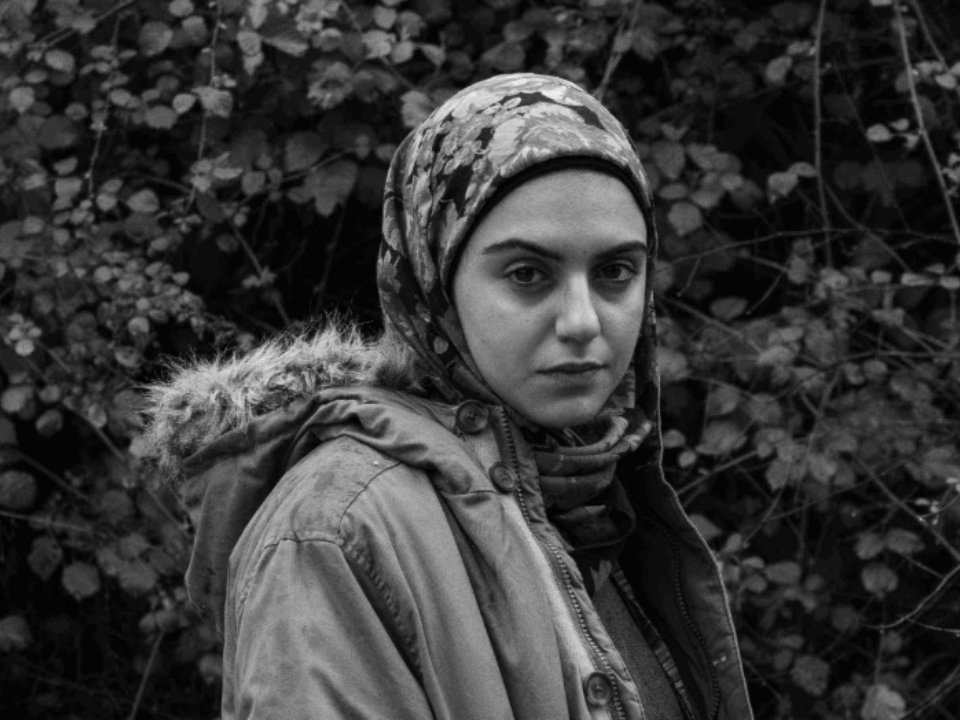
After Evidence: Fatima Joumaa on Photography, Martyrdom, and Return
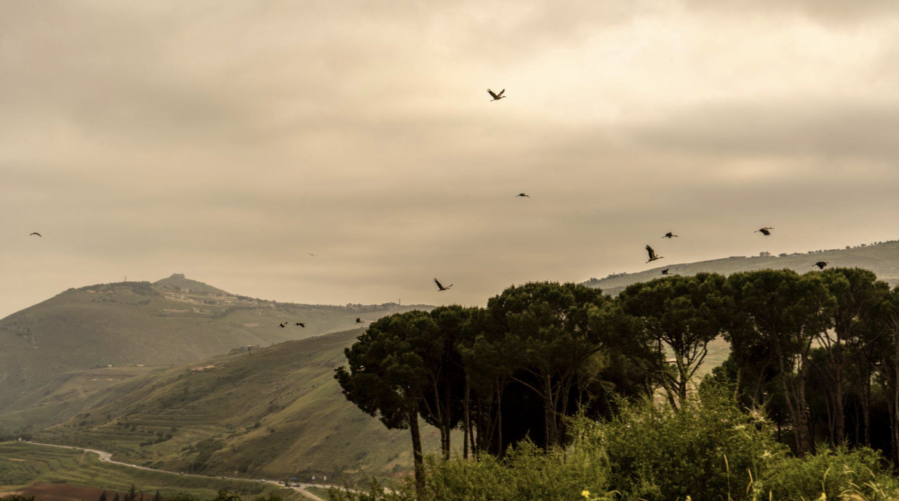
El-Mahmoudieh, South Lebanon, 2025. Photograph by Fatima Joumaa, courtesy of the photographer.
After the Israel–Lebanon ceasefire took effect on November 27, 2024, Fatima Joumaa returned to her home in Beirut’s southern suburbs. Her apartment was still standing, though neighbouring buildings had disappeared and the school beside it had been damaged. In the streets, people cleared shattered glass, recovered furniture, and gathered around images of those who had been killed. A young man was distributing portraits of Sayyed Hassan Nasrallah when a man in his fifties stopped his car, accepted one, kissed it several times, and began to cry. Joumaa remembers it as one of the most beautiful scenes her lens did not capture. The image remained with her without becoming a photograph.
The distinction between what must be witnessed and what should become an image runs through Joumaa’s practice. A photographer and filmmaker from South Lebanon, she works across still and moving images, personal writing, and forms of collective image-making. Since October 7, 2023, she has photographed funerals, displacement, and return across Jabal Amel and Beirut’s southern suburbs. Her images trace the relations reorganized by death and the ways the dead continue to shape the attachments and social worlds of those who remain.
Photography has long been asked to bear the burden of evidence. Joumaa’s work begins from the exhaustion of that promise. When visibility produces no corresponding obligation, the question shifts from what an image can prove to whom it remains answerable. A photograph may be requested by its subject, returned to a family, withheld from circulation, or preserved as raw material for an archive not yet made.
The conversation that follows moves from intimate photographic relations within communities that know her to the immense scale of a state funeral in Iran. Across these settings, intimacy entails its own permissions and responsibilities, its own forms of exposure, including the obligation to withhold. Throughout, Joumaa asks what it might mean for images to belong first to the worlds from which they emerge, and what possibilities remain for photography once its evidentiary promise has been exhausted.
Joumaa and I spoke on July 31, 2026. The conversation has been edited and condensed.
Zarah Khan: Your work emerges from a position of implication. How does belonging to the worlds you photograph change your sense of what should become an image? Does intimacy create forms of exposure?
Fatimaa Joumaa: Belonging does not protect against an exploitative gaze, and it does not free me from questions of power. I am still the one holding the camera and determining what enters the frame and what remains outside it. Belonging offers time, and with time, a deeper understanding of what should not become an image.
But it is harder when you know people. Once I understand the nuances of a relationship—who I am speaking with, the reality they endure—I become more aware of what the camera might change. During the war, I met a family from Chaqra composed largely of women. Most of the men in the family had been martyred. They lost their sole surviving brother during this last war. I initially went to interview them, but over time we developed a close relationship and I became part of the rhythm of their daily lives. In the intimacy of those relationships, you witness moments of vulnerability. People reveal things because they trust you and because, at some point, you are no longer there as a photographer. But does that intimacy make those moments available to the camera? Should they become part of my image-making process?
For me, this is the difference belonging makes. The opportunity is not to see more, but to see what is already there with greater clarity. Even when people understand the camera and consent to being photographed, I remain responsible for the frame I produce and the life that image may have afterward. But the opposite also happens. When people feel there is something they want to share, they turn to me and ask, “Where is your camera?”
Zarah Khan: What changes when the people you photograph begin to tell you when an image is needed?
Fatimaa Joumaa: The image is no longer mine alone to decide. The people I am photographing tell me when the camera is needed and what they want the image to preserve. But I do not think that the relationship between the photographer and the subject can be reduced to consent. Consent matters, of course, but I can have approval and the camera can still transform the scene into something it was not. You learn to sense when the camera begins to alter the scene it is witnessing. When I feel that shift, I put the camera aside. I have to remain there without making an image.
I remember Umm Hamza, the mother of a martyr. I met her during the war in 2024, and we grew close through the ordinary intimacy of visiting one another’s homes. When I visited her on the birthday of her martyred son, she was crying, and I hesitated to film her. Then she said, “No, Fatima, I want you to film this. I need to see it. I need proof of what happened.” Her asking changed the terms of the encounter. I no longer had to decide whether filming her grief would be an intrusion; she had already determined the place of the camera and what she wanted the image to hold. After that, it was just the mechanics of making the image.
Early in 2024, I was still trying to understand what I was doing. I am not an employee arriving with an assignment. This is not a job; I am in the South because I am from here. But I kept returning to the question: Who are these images for? At first, I thought I was gathering material to make a film. Over time, my answer changed. Now when people ask what the photographs are for, I say, “They are for you. Do you want them?” And they say, “Yes, we want the images of the funeral. We want images of the village.” That changes the process entirely.
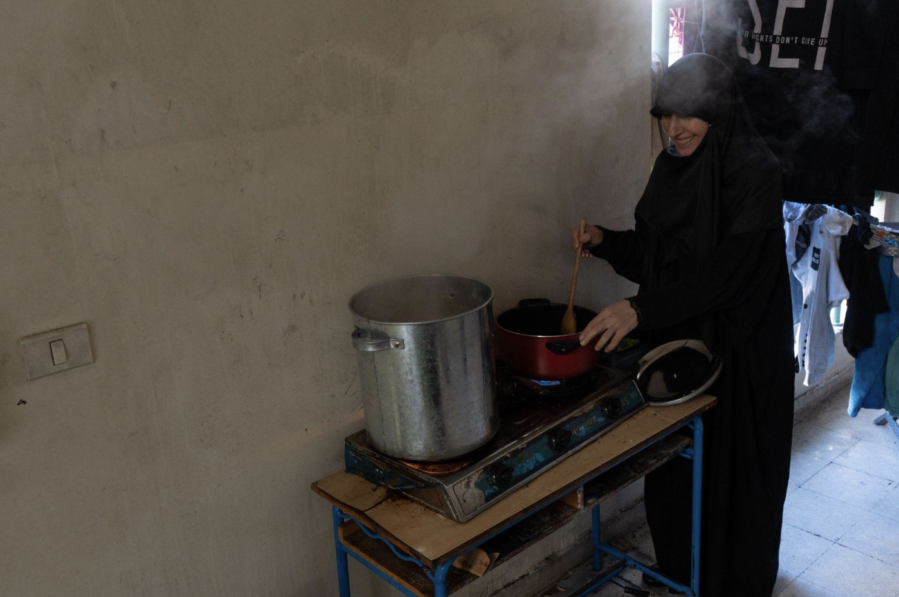
Umm Hamza prepares food at a school sheltering displaced families during her first encounter with Fatima Joumaa in 2024. Photograph by Fatima Joumaa, courtesy of the photographer.
ZK: You have written that some of the most important images are the ones you do not make. When you decide not to photograph, what other forms does witnessing take?
FJ: It is all an archive of choices—choices I make before entering a place, while I am there, and afterward, when I decide what an image should become and whether it should circulate.
For example, when a massacre has just occurred, I do not take photographs. People are still responding at the most elemental level. They are trying to survive, searching for those who are alive, learning who has been killed. At that moment, photography is not my responsibility. There are other forms of work that must come first—the work of paramedics and ambulance crews, and whatever duties the situation asks of those who are present. I might record a voice, remember a sentence, or later write what someone said. The camera is not the image’s only possible form.
In 2024, I went to a home in Souaneh where two boys had been killed alongside their mother. I arrived the day after the massacre. I could not photograph. I froze completely; I could not make sense of what I was seeing. While I was ruminating on what it would mean to begin shooting, I noticed a school notebook belonging to one of the boys. On one page, he had been practicing how to form words. I took the notebook with me. It was the only image I wanted from that day.
The camera gives us rectangles and frames. Reality has a horizon.
It was an image my camera did not make, but it was the only image that was true to the encounter. Sometimes other forms bring me closer to the truth I am searching for than a machine that is, in the end, limited. The camera gives us rectangles and frames. Reality has a horizon.
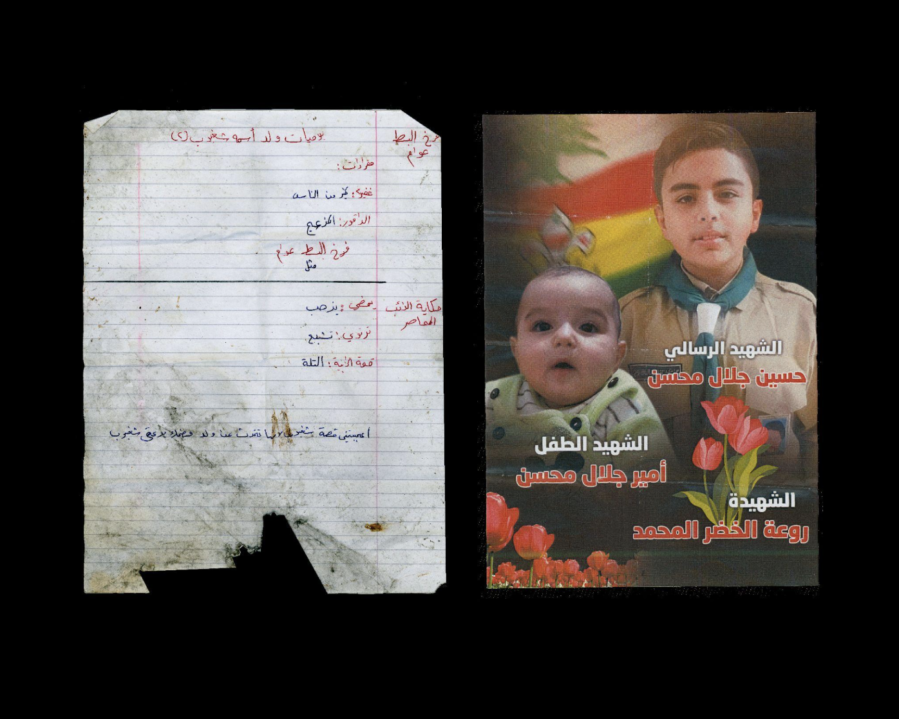
Page from the school notebook of Hussain Jalal Mohsen, who was killed alongside his brother, Amir Jalal Mohsen, and their mother, Ruah al-Muhammad, in Souaneh on February 14, 2024. Courtesy of Fatima Joumaa.
ZK: You describe funerals as moments of encounter and return. What becomes visible there between the dead and the living? What has photographing funerals allowed you to understand about political life?
FJ: At first, I went to funerals because attending is simply part of village life when someone dies, even if you do not personally know them. This is especially true in the South. During the first months of the war, the funerals were extremely dangerous. Many villages were nearly empty. The drone was always in the sky. There were no longer any rules, whatever that might mean during a war. People returned to bury their loved ones knowing the danger. At several funerals in Odaisseh, we could hear bombardment and missiles falling in or near the same village. I remember filming a woman speaking about her son beside the village’s Husseiniyeh.[1] That building has since been destroyed completely; the Israelis even circulated satellite images of its destruction. While she was speaking, we began to hear the missiles. Everyone present knew what could happen, and still they had come.
This return is also connected, for me, to martyrdom. The martyrs continue to bring us back to our villages, even after their deaths. Their generosity does not end when their spirits are no longer with us. Because they are buried in their own villages, their funerals require us to return there too. There were villages we had not been able to enter, or had not entered for some time, and now we were going back because a martyr had to be buried there. The martyr’s return to the village becomes, in that sense, a return for everyone who mourns them. The martyr is still creating a relation between us and the land, still making it possible for people to gather there and enter those villages again.
People come for the funeral, but they also see whether their homes are still standing, look for their neighbours, and learn what has happened in their absence. I remember people arriving in mourning and then embracing one another, kissing one another, asking about homes and families. The funeral becomes a temporary return to a social world from which they are displaced. Perhaps it lasts only for a few hours, but the martyr leads us back to the village once more. The accumulation of these returns carries within it the possibility that we will finally return.
The funeral also contains a kind of truth. I had been educated for years within an artistic language that made me suspicious of the very idea of truth. But at these funerals, I encounter something I cannot deny. A woman may grieve for her son with the full vulnerability of a mother who has lost someone irreplaceable. The same woman hears an Israeli drone overhead and addresses it directly: “You have machines, but we have men.” She is capable of both. I hear it and I see it. Death creates a moment in which certain truths become impossible to evade.
ZK: Women have occupied a central place in your work, from your mother’s writing to the women you photograph at funerals. What have their ways of remembering allowed you to understand about political memory?
FJ: I think I was touched by this very early. My grandmother lived with us, and she and my mother were the active narrators in the family. Whether every detail was historically accurate did not really matter. My grandmother could tell the same story many times, and each version would be different from the one before it. But variation was part of the telling. She also understood that she was speaking to someone who wanted to listen and might carry the story into another form. My mother and grandmother understood the act of transmission very well.
I began asking: Who told us the story? Who remained to see what happened and make it transmissible? Again, the answer was the women.
We are also taught from childhood that women are often the ones who preserve the account of what happened. Sayyidah Zaynab is the one who carried the story of Karbala forward.[2] I had heard that throughout my life, but I did not think through its significance until the war, when I found myself trying to narrate what was happening. I began asking: Who told us the story? Who remained to see what happened and make it transmissible? Again, the answer was the women.
That changed how I saw the women I was photographing. When I speak with the mother of a martyr, I begin by wanting to know about her. Sometimes she will say, “No, we begin with him.” This is not because she has no story of her own. She understands his life as a continuation of hers. And she does not tell me only that he was gentle, or beautiful, or brave. She tells me what he did at school, how he behaved as a teenager, what made him laugh. She restores the history of a whole person rather than limiting his life to the moment of death. Martyrdom is, in the end, a decision. It is not simply bestowed by the event of death. And we cannot treat that decision as purely individual. It belongs to a collective history—to the women who remained, who raised these children, taught them, and formed the world from which their choices emerged.
There is also the more intimate life that continues alongside this public meaning. We have spoken about the family from Chaqra. One woman in that family is both the daughter of a martyr and the wife of a martyr. She has a son and a daughter. Yet within the same life marked by these losses, she transforms her room into a kind of home like the one in which she was raised. Every two or three days, women gather there. They share stories, memories, gossip, and the details of daily life. This is also what belonging can give you. Over time, you are allowed into those details. The women produce the gathering, maintain the relationships, and shape the intimate life after death.
ZK: Pride in the martyr’s sacrifice does not erase loss. How do grief and pride exist alongside one another for those you photograph?
FJ: This belongs to a discourse of the spirit rather than one of logic or reason. I try to approach martyrdom through spirit and vision, to understand how the people who are grieving live with it and make sense of it.
There is immense sacrifice and grief that no one can deny. The women express both very openly. They will say, “We know who he was, and we are proud of him.” And still the question remains: what becomes of all this suffering? Part of the answer is that martyrdom gives the suffering meaning. For the women, this is not a symbolic consolation. We believe that the martyrs remain alive—that, as God tells us, we cannot perceive the form of their life.[3]
I had a remarkable conversation with the mother of three martyrs. She told me, “I cry for them constantly. I miss them, and I will never deny my grief or allow anyone else to deny it. But now, my task is different. Now, I am trying to understand how I can hear them, how I can sense them.” She described it as a journey in which she herself must become someone else in order to discover another way of relating to them. She understands martyrdom as another form of life.
Perhaps this is why the spiritual dimension is necessary. Who can truly speak about martyrs except the martyrs themselves? To understand that experience fully, one must inhabit it. But the women who remain are undergoing their own transformation. They now have different responsibilities toward themselves, their families, their villages. As the person they love is transformed, they must also transform in order to hear, feel, and communicate with them differently. They are, in a sense, reborn as mothers or wives or sisters. I would hesitate to call what follows from that a set of duties, but there are new roles and forms of relation that they learn to inhabit.
ZK: Your work honours the spiritual and political meaning of sacrifice. How do you keep that recognition from turning endurance into an obligation placed on the same families again and again?
FJ: We have to begin with what has happened since October 2023, especially in South Lebanon. Between 2006 and 2023, there was a period of relative calm. I would never call it peace, but there were certain rules of engagement.
When I speak with friends from the South, I often say that those years were the exception. If you understand South Lebanon as existing beside a colonial, genocidal state that seeks to destroy and annihilate, then what we are living now is not inexplicable. It is not normal, but it is the foreseeable consequence of our geography and of the colonial force beside which we live. The relative calm before 2023 was the exception, produced by a particular set of political conditions, including the presence of the resistance.
Sacrifice is not a requirement imposed upon these people simply in order to live. Collectively, they could decide that they have had enough—that they want negotiations, peace, or some form of coexistence. That is a choice available to them, and it is the choice many people, especially within the Lebanese government, would prefer them to make. We have seen what happens when people decide to surrender.
The meaning changes when sacrifice is understood as a choice rather than as something one is obliged to endure. We are losing our homes, our villages, the lives we knew, and the people we love. We also believe that our displacement is temporary and that we will return.
I think this also comes from the fact that, alhamdulillah, we understand ourselves through our relations to one another. I cannot think only of my immediate self-interest and say, “This will make my own life easier, and we will see what happens later.” My grandfather and my father did not preserve their homes so that I could secure a comfortable life by accepting that I would never see my village again.
Sacrifice cannot be separated from the larger question of what one is trying to preserve—not only life in its biological sense, but dignity, inheritance, place. Ultimately, it returns us to the question: What kind of life do I want to live? Everything else is a consequence of that answer.
The world has shown us that surrender does not produce a better or more livable existence. I have not seen those who surrender become freer than we are. I retain the dignity and honour of being able to say that I tried, whatever the consequences.
I am deeply saddened by what people are losing, by what I have lost. But choosing survival does not necessarily create a life worth living. Sacrifice cannot be separated from the larger question of what one is trying to preserve—not only life in its biological sense, but dignity, inheritance, place. Ultimately, it returns us to the question: What kind of life do I want to live? Everything else is a consequence of that answer.
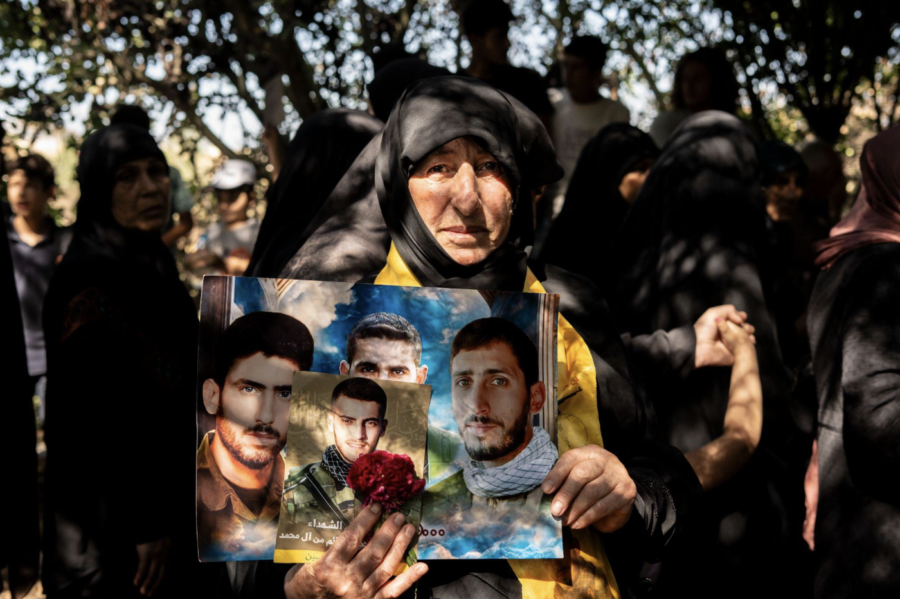
A woman holds portraits of her three martyred sons in Ayta El-Shaab, 2025. Photograph by Fatima Joumaa, courtesy of the photographer.
ZK: Photography has long carried the promise of bearing evidence, and Gaza has shown the limits of that promise. When visibility fails to compel a response, what can the image still do?
FJ: Visibility produces nothing. Even the word resistance is now applied to almost everything except what resistance actually requires. So, of course, you begin to ask what purpose the image still serves.
I do not pretend to have a complete answer. But I no longer think the primary function of image-making should be to change someone’s mind. For a person to recognize an image as an image of genocide, they must already be prepared to recognize the genocide. No photograph can compel someone to see what they have already decided not to see.
For me, one function of the image is to resist disappearance. I do not mean preserving the past nostalgically. I mean preserving what will be necessary to build a future from it. Because I attended funerals, I entered villages that no longer exist in the form in which I encountered them. I now have photographs, videos, and voices from places that have since been destroyed. I have images of colleagues who are now martyrs. I want to ask what these images can teach us about how to build the village again and how to carry the experience of the martyrs into the present.
Recently, I was working with images I made of Haj Ali Shuaib and Wissam, his photographer. Both were martyred while fulfilling their journalistic responsibilities. I do not return to those images only in order to grieve or to establish that these people existed. I return to them to understand who they were as human beings and what we might learn from their practice. The martyrs can become schools for us. Their experiences should not be sealed within the past. We need them in order to understand how to make the future. If an image has no effect upon how we inhabit the present, then I am not sure what meaning it has. The image is for us, so that we can understand how to rebuild, how to speak about the martyrs, and how to allow what they learned and lived to continue acting within the present.
I understand these images as raw material. Because of occupation, we have enormous archival absences. I have very few images through which to understand the villages of South Lebanon during the 1980s or the experience of occupation during that period. The photographs, films, and sound we are producing now are material from which knowledge can later be made.
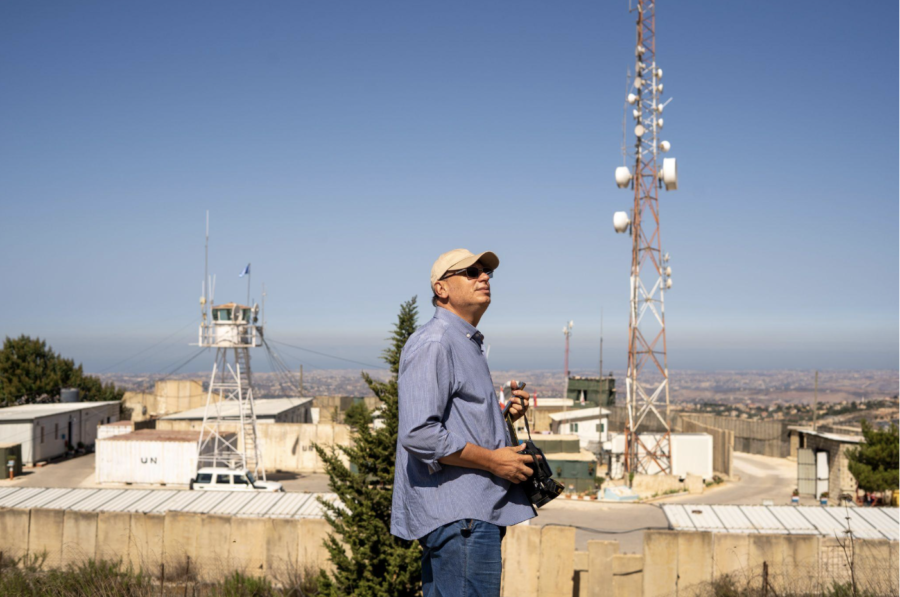
The martyr Haj Ali Shuaib at the Al-Abbad site, across the frontier from the Lebanese border town of Houla, March 2024. Photograph by Fatima Joumaa, courtesy of the photographer.
ZK: So much of South Lebanon’s visual history survives in French or Israeli archives. How does that absence change what it means for you to make images in the South now?
FJ: We are racing against a genocidal time. We need this record precisely because we did not inherit enough of it.
If I want to find an image of a village in South Lebanon during the sixties, seventies, or eighties, I may have to search a French archive. Or I may have to confront the fact that Palestinian film materials taken from Beirut in 1982 are now held in Israeli archives. We have not been allowed to possess the archive from which our own knowledge could be made. It is important that we retain the right to our own gaze and the right to make images from our own position, to determine what they address, and to decide what kinds of knowledge and life may emerge from them.
ZK: We have spoken about the pressure to make your world legible for audiences who may already approach it with suspicion. When your work circulates elsewhere, how do you think about those viewers without allowing their expectations to determine what the image must make sympathetic?
FJ: It was not something I had resolved before making the work. My practice taught me that this is not a question of finding the correct balance—of humanizing people, but not too much, or explaining enough without overexplaining. Every act of representation begins with a limit. The image is always partial in relation to the life it tries to hold.
Images and narratives circulate within unequal relations of power. My community is engaged in resistance, and in a form of resistance that is not approved of in Beirut or in the West. Under those conditions, transparency is not a neutral value. Not every truth carries the same obligation to be disclosed, and I do not consider it my responsibility to construct a discourse through which a suspicious audience might finally understand us.
My responsibility is to understand the conditions under which an image will circulate and how it is likely to be interpreted. I am accountable first to my people and to the truth of their experience, not to an audience that has already refused to recognize the legitimacy of our struggle and the legitimacy of the way we have chosen to resist.
I have often been told that a viewer will not understand what happened before or after a particular scene, or that an image should be removed because it lacks sufficient context. But when I watch films made in the West, I am rarely given every historical explanation in advance. I am expected to enter their language, to recognize that the film has its own world and that I may need to learn something in order to understand it. Yet when we make work, we are often expected to become historians, translators, and explanatory documents.
An image does not have to become a history lesson in order to justify its existence. It is our right to possess our own image and determine the terms through which it becomes visible.
I try to remain attached to my language. I mean the literal language spoken by my people, but also language in a wider sense of gestures, symbols, political references, and ways of seeing themselves. I do not approach these villages as subjects that must be translated completely for someone else. If you want to understand something, open a book. An image does not have to become a history lesson in order to justify its existence. It is our right to possess our own image and determine the terms through which it becomes visible.
At the same time, especially when I screen films, I consider the conversation afterward to be part of the film itself. Refusing to explain everything inside the image does not mean refusing an encounter. The film creates an opportunity for us to meet, to ask questions, to be in relation, and to speak to one another.
ZK: In South Lebanon, your funeral photographs emerge from intimate relations. In Iran, you photographed Sayyed Ali Khamenei’s state funeral on an immense scale, shaped by mass participation. How did that shift in scale and context change your position as a photographer? What did you find yourself looking for differently?
FJ: It was one of the largest funerals I have ever witnessed. I understood it as a funeral, but also as a kind of demonstration. People were grieving, but they were also making declarations about vengeance and continuity. Yet the scale of the funeral did not eliminate intimacy. During the two days before the public procession, the coffin was placed where people could gather around it. I had the feeling that he was sitting among them as he had before—that, for forty-eight hours, people were still living alongside him. Only after that extended proximity came the final farewell and the enormous public funeral. For me, that progression was very deliberate. The state funeral gave grief a public form through which people could see themselves and insist upon how they wanted to be seen.
Tehran does not allow you to imagine that you are separate from what is happening elsewhere in the country. The city continually returns you to it. At the airport and throughout the streets, there were images referring to the children killed in Minab.[4] We were given stickers depicting the map of Iran as a mouth, with the Strait of Hormuz declaring, “This water is ours.” The murals, posters, slogans, and objects circulating through the city all insisted that political events beyond Tehran remained present within it.
The people at the funeral carried this same consciousness. I remember a man holding a Palestinian flag who approached me because he saw the camera in my hand. He said, “I want you to make a perfect portrait of me.” He positioned himself with the flag and made sure the photograph was taken. I encountered this repeatedly. People understood that they were participating in the production of an image and wanted to determine how they would appear within it.
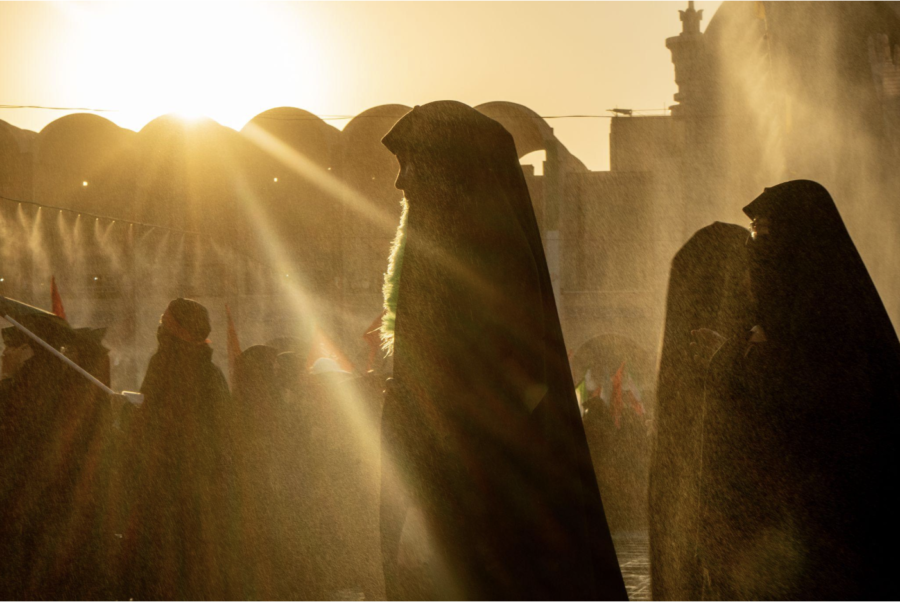
Mourners gather in Tehran during the funeral ceremonies for Sayyed Ali Khamenei, July 5, 2026. Photograph by Fatima Joumaa, courtesy of the photographer.
ZK: What does it mean to photograph people who are already actively producing their own political image?
FJ: It is very deliberate. I remember meeting a group of women in Mashhad when I stopped to ask if I could use their hotspot. Most of them were not wearing veils, while one woman had hers draped loosely. She asked if I could photograph them. Then she said, “Wait, I want to remove it.” She took off the veil and posed for the photograph. Afterward, she said, “Now they will understand that it is not only religious people who support the government.” She understood exactly what kind of image she wanted to create. She was thinking about how the photograph would be read, what assumptions it might interrupt, and which constituency it could make visible. She was directing the terms of her visibility and consciously constructing the image she wanted others to encounter.
ZK: In a liberated future, what image of South Lebanon would you want to make?
FJ: The train journey from Kfar Kila down to Haifa, Palestine.
Endnotes
[1]A Husseiniyeh is a Shi‘i congregation hall used for religious gatherings and commemorative mourning.
[2]Sayyidah Zaynab bint Ali, granddaughter of the Prophet Muhammad and sister of Imam Husayn, survived the Battle of Karbala in 680 CE. In Shi‘i memory, she occupies a central place as a witness and transmitter of the events of Karbala after Husayn and many of his companions were killed.
[3]Qur’an 2:154: وَلَا تَقُولُوا۟ لِمَن يُقْتَلُ فِى سَبِيلِ ٱللَّهِ أَمْوَٰتٌۢ ۚ بَلْ أَحْيَآءٌۭ وَلَـٰكِن لَّا تَشْعُرُونَ — “Do not say of those killed in the way of God that they are dead. Rather, they are alive, though you do not perceive it.” Joumaa is referring to this Qur’anic understanding of the martyrs as living beyond ordinary perception.
[4]On February 28, 2026, a US strike hit a school in Minab, southern Iran, killing more than 175 children and teachers.
