

A Review of Melissa Bull’s Rue
 Melissa Bull's poetry collection, Rue, is out from Anvil PressYou can still be lost even when you know exactly where you’re standing. That’s the takeaway of Melissa Bull’s Rue, a debut poetry collection grounded in a story about growing up, making mistakes, and coping with those mistakes your parents made, all the while wandering through Montreal’s boroughs. Rue is not just a personal narrative, it’s also a smart and referential tour of urban poetics. Without becoming overbearingly erudite, the book is well aware of its place in a literature set on city streets, in cafés, on highways, and in apartments that are never too far away from the noise.In a co-authored review of Rue in Maisonneuve, Laura Ritland wrote of Bull’s poetry:
 After what point does Bull’s focus on description become, well, description? I sometimes wondered if her dedication to the local, the immediate and the personal risked becoming esoteric or quotidian, an assemblage of images without enough directions for me to build them into full pictures.Ritland and Ruth Daniell’s review is mostly positive, but this one point deserves more attention. To expose my bias before going much further, I find that the local, the esoteric, and the quotidian deserve as much attention as anything. Georges Perec calls this the infraordinary, or “what happens when nothing happens.” There is a lot more action in Bull’s Rue than Perec’s study of the infraordinary, An Attempt at Exhausting a Place in Paris, but when Bull writes about highways, park benches, and passersby, she engages in a similar kind of mimesis of place. Bull is deliberately more invested in sonic qualities than Perec. For example, in “Flush,” Bull writes, “Squatting Cabot Square / cracking pastel pralines into paper cups / night globes over the old pissoir.” Saying it feels like chewing on road grit and gobbing it out.The finitely-detailed does not have to alienate readers without local knowledge, but the minutiae of names and intersections can create an intertextuality out of the everyday vocabulary of directions.
What The Streets Are Saying
The section “Skirting La Petite-Patrie” is full of street names, avenues, and squares, starting with Harvard Yard and Nevsky Prospekt and moving to Montreal locations: Clark, Dante, Everett, Plaza St-Hubert, Cabot Square, Parc Jeanne-Mance. “Skirting La Petite-Patrie” focuses on a relationship (or relationships), and these street names attach themselves to romantic events. It’s enough to say the name to evoke an emotional history. Street corners are memorials to the narrator’s personal regrets. The problem is, she has to go on passing through them.The title Rue is not just a pun. It’s a marriage of regret and urban geography. It’s about continuing to live in the space of your collected mistakes. Knowledge of the places Bull uses isn’t necessary, but the names are not meaningless. Street names and addresses are code words, often for class. Claremont Avenue, in “Claremont, Apt. 45,” is a street in lower Westmount, right on the border with NDG. There are old brick apartment buildings and greystone townhouses. Like the rest of NDG, none of them have the outdoor staircases that were used to save on space and money. It’s urban middle class. Just down the hill from the bottom of Claremont is Vaillant Street, in St-Henri, where there aren’t many trees and more of the houses are clad in aluminum siding. In “Vaillant,” Bull’s description of an apartment echoes the Lacasse family’s new house next to the railroad tracks in The Tin Flute: “The perpetual groan of engines from the highway behind the train tracks were the roar of the ocean.” Side by side with “Claremont, Apt. 45,” the reader can see that something bad has happened. The narrator moves from a (modest) Westmount address where there is a piano and pigfoot stew at Christmas into a place where she can recount the blood on the pavement from the murdered prostitute next door.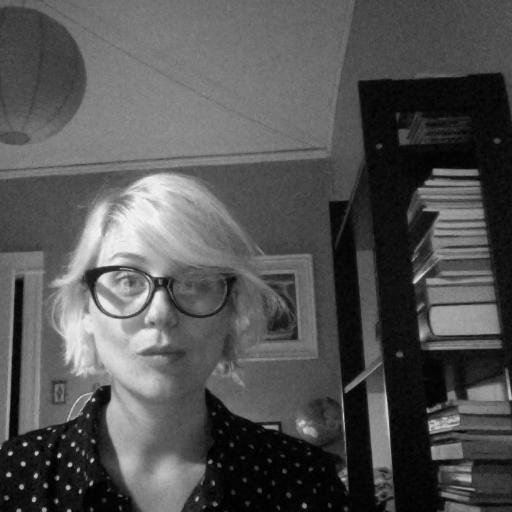 Melissa Bull edits Maisonneuve’s “Writing From Quebec” column
Nevsky Prospekt
Bull is not just concerned with the tropes of Montreal’s urbanism, though. She writes in “Scaffolding,” “I went to Nevsky Prospekt and I rambled along the embankment, and wherever I went I missed seeing the people I was used to meeting at the same place and at the same hour.” According to Gogol, “The man who lives on the Petersburg or Viborg Side who hasn’t seen his friend at Peski or at the Moscow Gate for years may be sure to meet him on Nevsky Prospekt.” This thoroughfare is the city’s meeting place, but the narrator has come here to mope about a missed connection, “I missed you by about an hour, I think.” Is it really that important that Bull has inverted Gogol’s panorama of Nevsky Prospekt? Yes, if only to point out that what seems personal may be a purposeful rewriting of public meaning. A walking tour without personality peddles officially sanctioned narratives. Melissa Bull’s walking tour, written with more private meaning than public significance, is a confession structured by geography.Surreal Streets
Mannequins are a Surrealist obsession. They were powerful visual symbols of the modern metropolis in the works of authors like Louis Aragon and Vítězslav Nezval. It’s not a coincidence or just a fact that these mannequins appear in the windows of Plaza St-Hubert:“Plaza Saint-Hubert Reconciliation Number Double-Digit”Headless mannequins pivot from their heels and bump into each other in clumsy slowmotion. Pigeonshit crusts the sidewalks. The odd passerbyer surprised to scope our makeout spot. We’re on a park bench between a discount houseware shop and a store full of 1950s child mannequins gussied up in satin first communion wear.One of the baby mannequins is black, the others are oh-so-precious white in white.Louis Aragon’s Paysan de Paris is a guide to the modern myths of Paris’s passages. Romantically called arcades, they were more prototypes to the downmarket mall and at least spiritually related to Plaza St-Hubert. In one scene, a cane shop window transforms into a subaquatic world inhabited by a siren and spinning umbrellas. Staring through the shop window after hours, one can get lost imagining the other side. The modern myth arises out of the individual, not the collective mind. Aragon concludes, “The modern world is entirely wedded to my idiosyncrasies.”The kind of street maps you can buy at a train station are sterile and boring. Google Maps are a little more fascinating, revealing business names, the shapes of buildings, those little cocktail and shopping bag icons as you zoom in. Maps drawn by people to give directions or, even better, as an exercise in representing their own perspective of a city, are colourful with individuality. The local is esoteric and individual. Laura Ritland wants “enough directions for [her] to build them [Bull’s images] into full pictures.” But Bull is giving directions all the time, with every street she names. She directs the reader through her city. She also directs the reader through a history of writing about cities.Melissa Bull is the editor of Maisonneuve’s “Writing from Quebec” column. Her poetry collection, Rue, and her translation of Nelly Arcan’s Burqa de chair are both out from Anvil Press. She lives in Montreal.
