

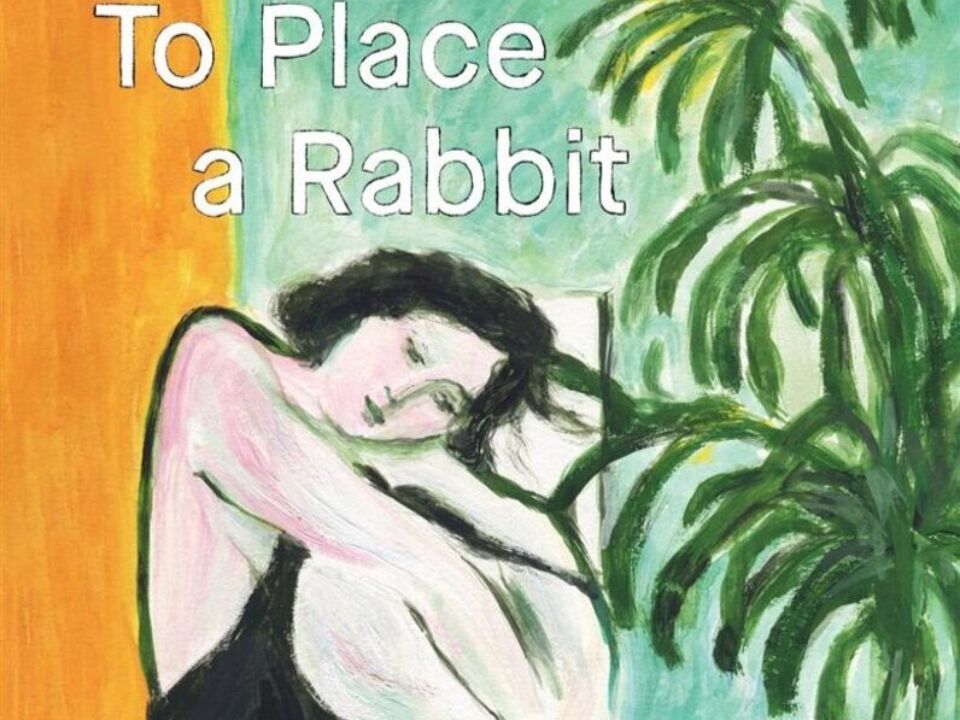
An Extra Life: On Madhur Anand’s To Place a Rabbit
Adapted from a talk delivered at the Frye Festival 2026
“All novelists,” remarks Anne Carson in Wrong Norma, “share the fantasy of a different kind of novel.” Yet most fail to “abolish” the novel, and instead simply “renounce” its familiar indicators of “plot, consequence, the pleasure a reader derives from answers withheld.” Madhur Anand’s To Place a Rabbit is a different kind of novel, but it isn’t interested in abolishing the novel form. Instead, it’s interested in questioning what the familiar indicators of fiction make possible. What can fiction do that nonfiction cannot?
The titular phrase “to place a rabbit”—borrowed from the French expression poser un lapin—translates as “to commit to doing something but not show up for it.” In other words, to stand someone up. I must admit that when I first came across the book, I found the title awkward. Had I read it correctly? My brain kept changing it to “how to place a rabbit,” not that this made more sense. But I quickly realized that the gap in logic, this puzzle, conjured by the untranslatable idiom, is precisely the point. This destabilizing effect ripples throughout the book’s storylines and apprises its structure.
To Place a Rabbit follows an unnamed protagonist, a writer/scientist who meets a novelist at a literary festival whose work has only ever been published in French translation, never in its original English. The protagonist, attending the festival on a tour for a nonfiction science book but seeing an opportunity to work with fiction, offers to retranslate the woman’s French novella back into its original language. Each chapter of To Place a Rabbit is broken into three sections: Un, an account of the present which is filled with literary festivals and encounters with other writers; Deux, which comprises passages from the fictional novella the protagonist is working on translating; and Trois, a recollection of the scientist protagonist’s passionate and sometimes turbulent relationship with her French lover, twenty years earlier. Alongside these three narrative paths the protagonist grapples with questions about the creative process, the borders between fiction and real life, between writing and translating, between the literary categories of autofiction, memoir, and scientific documentation.
The scientist protagonist yearns to write fiction, which for her is “about finding a novel method.” She explains to the novelist that her own novel is already researched, outlined, and all mapped out. All it lacks is a plot.
I told her it was about the lines dividing birth and death. And botany. And a relationship between two women. That sounded too vague, even for me, so I added: and climate change.
The scientist writer takes on the translation project in the secret hope that it will bring her closer to writing her own novel—to finding a way into fiction.
What I’d give for an extra life! Having an extra life would solve so many problems. It is certainly what the protagonist of To Place a Rabbit longs for.
But why does the scientist long to write fiction? This question is central to the novel’s puzzle. Early on in To Place a Rabbit we learn of Jhumpa Lahiri’s experience of writing fiction in Italian, a language that the virtuosic Lahiri picks up in midlife and proceeds to master so well that her Italian stories self-translated back into English are even more captivating than her earlier work. The narrator paraphrases Lahiri’s revelation that “one can undergo personal transformation when learning another language, that one can become someone else.” For Lahiri, “learning Italian did not simply change her life, it gave her a second life, an extra life.” This line really caught my interest as a reader and writer. What I’d give for an extra life! Having an extra life would solve so many problems. It is certainly what the protagonist of To Place a Rabbit longs for.
It might even absolve the novel’s central tension: the protagonist’s choice between remaining with her French lover, her queer life, and following the more conventional path toward marriage and a heterosexual family structure. An extra life might allow the protagonist to explore a whole new domestic model, like the two-apartment communal house that her lover dreams up. It occurs to me—as it occurs to Anand’s narrator—that this is one of the miraculous things that fiction can do. Clear a third path in a world that feels like it’s filled with binaries. I believe this is why our scientist protagonist wants to write fiction so badly. As she notes of her past relationship with her French lover: “If being with her was not the life I had lived, it could be the one I wrote about, in fiction.” An extra life means not giving anything up.
As Anand’s novel shows us, it's precisely in this imperfect transfer of language and memory, this “transcreation” or translation broadly conceived, that the possibility of an extra life emerges.
I think this is particularly true for fiction based on personal experience, so-called autofiction, which is often treated as a corrupted translation of life. Memoir is incriminated with this charge of corruption as well. For how else does one transcribe unadulterated memories, dialogue, or scenes from twenty years ago without making some things up? As Anand’s novel shows us, it's precisely in this imperfect transfer of language and memory, this “transcreation” or translation broadly conceived, that the possibility of an extra life emerges.
The scientist protagonist and the novelist first meet at the literary festival in the hospitality suite during a discussion about the blurring of life writing and fiction. The novelist describes her novella, which is titled La Traduction (“the translation”), as a story about an author who goes to France as a writer-in-residence and writes a novella that will be translated into French. This follows almost exactly the novelist’s own process for writing the novella. “Oh, it’s autofiction,” another writer in the group suggests, but the novelist doesn’t like this definition. She says it’s not quite autofiction as there are “too many critical discrepancies between the novella and her own real life.” “For one thing,” she says, “in the novella the translator is translating the work in real time, in France.” “But in real life,” she continues, “of course I did not complete it while I was there. I finished it back home.” Writing a story often takes a lot more time than living it.
I’ve had students who worry that their writing is not “creative enough” if based on their own experiences, thoughts, and feelings.
Many writers flinch at the term autofiction because it has often been used to minimize writers’—especially women writers’—creative efforts. Autofiction has been viewed by some as a self-indulgent act of transcription rather than an artistic act. Even though, as Myra Bloom shows us in her history of the genre in a special issue of English Studies in Canada,
far from the navel gazing of which they have often been accused, autofiction writers use tactics of self-fictionalization to better represent and interrogate the communities in which they are embedded … to imagine more equitable relationships … and to create expressive spaces for women, racialized, and queer subjects.
Nevertheless, I’ve had students who worry that their writing is not “creative enough” if based on their own experiences, thoughts, and feelings. They worry that they are simply copying their life onto the page and not inventing new material. For instance, I recently had a student who started writing about her adolescence in the Cypress Hills of Saskatchewan but then worried that this wasn’t sufficiently creative. She suggested instead that she write a story about two talking cats. She believed that this would be a purer form of fiction.
Perhaps this is a fear the protagonist in To Place a Rabbit has as well. At a writing retreat she attempts to write a story and admits: “I simply could not make anything up.” But this fear has shifted by the end of the novel, where the protagonist proclaims: “I knew that all copying was translation, just like all writing was fiction.” The boundaries between these two creative acts have grown much less distinct.
As To Place a Rabbit progresses, motives, thoughts, garments, gestures, and phrases begin to echo between the three narrative sections. Storylines blur, time and distances shrink. There’s a vertiginous effect—almost like the effects of Stendhal syndrome, where a person, in the presence of a great artwork, experiences dizziness as different moments in time collapse into one destabilized moment. There is a shift in the story as well. In reviewer Ian Colford’s words, the narrative’s “very nature is altered as these elements merge in a manner akin to a dream.” I’m reminded again of Lahiri: that through learning a new language you become someone else. Through writing fiction, you transform as well. Fiction expands the self beyond a single lived timeline. It offers a chance at a second or third life. An extra life.
